
Home › Blog › I love you in different languages
I love you in different languages: 30 phrases and how to use them
Saying I love you in your partner's first language is one of the most effective small gestures there is. It shows effort, it shows you were thinking about where they come from, and it usually gets a smile before the words are even finished. It is also easy to get wrong, because many languages have more than one way to say it, and the strongest version is not always the one you should reach for first.
This guide gives 30 phrases with a rough pronunciation, explains where a language has a light version and a heavy version, and suggests how to use them: when to say them, what to avoid and how to practise. The pronunciations are approximations written for English speakers, not linguistic transcriptions, so if you can, ask a native speaker to say the phrase once and record it. A recording from your partner or their family is worth more than any spelling guide.
Why it works so well
When you say I love you in your own language, the words are familiar. When you say it in someone else's, the words are a present. You are saying: I went out of my way to learn something that belongs to you. For couples where one partner grew up elsewhere, or where the two of you speak different mother tongues, this can mean a great deal. It can also work for couples who share a language and simply want a private code, a phrase from a holiday, or a way to say it that nobody around them understands.
It also works because it slows the sentence down. If you say I love you ten times a week in the same language, the words can start to slide past. Hearing them in a new form makes your partner listen again. If that sounds like your situation, our guide to ways to say I love you has other ways to freshen the habit.
Before you start: light and strong versions
English has one sentence for a huge range of feelings. Many other languages divide that range into several phrases, and picking the wrong one can be funny at best and awkward at worst. Here are the main cases.
- Spanish separates te quiero (a warm, common phrase used for partners, family and close friends) from te amo (a stronger, more romantic phrase, used less casually in many regions).
- Italian separates ti voglio bene (affection, often used for family and friends) from ti amo (romantic love).
- Japanese has suki da (I like you, often used for confessing feelings) and aishiteru (a very strong phrase that many couples say rarely).
- Korean and Mandarin have everyday and formal versions too, and how often couples say them differs between households.
A useful rule: if you are not sure which version to use, ask your partner or a native speaker which one couples actually say to each other in daily life. Do not pick the most dramatic version because it sounds the most romantic. That is a common mistake and it is the language-learning equivalent of proposing on the second date.
15 phrases from Europe
Pronunciations are approximate. Stressed syllables are in capitals.
| Language | Phrase | Approximate sound | Note |
|---|---|---|---|
| Spanish | Te quiero / Te amo | teh KYEH-roh / teh AH-moh | Te quiero is the everyday version. |
| French | Je t'aime | zhuh TEM | Used between partners; friends say it only lightly or not at all. |
| Italian | Ti amo / Ti voglio bene | tee AH-moh / tee VOH-lyoh BEH-neh | Ti amo is romantic; ti voglio bene is warm affection. |
| German | Ich liebe dich | ikh LEE-buh dikh | A serious phrase for partners; Ich hab dich lieb is lighter. |
| Portuguese | Eu te amo | eh-oo chee AH-moo (Brazil) | Common between partners in Brazil; pronunciation differs in Portugal. |
| Dutch | Ik hou van je | ik HOW fan yuh | Used between partners and in families. |
| Swedish | Jag älskar dig | yah EL-skar day | For partners; Jag tycker om dig is lighter. |
| Danish | Jeg elsker dig | yai EL-sker dai | Close to Swedish and Norwegian. |
| Norwegian | Jeg elsker deg | yai EL-sker day | Pronunciation varies by region. |
| Greek | S'agapó | sah-gah-POH | Written in Greek as Σ'αγαπώ. |
| Polish | Kocham cię | KOH-hahm chyeh | For partners and close family. |
| Russian | Я тебя люблю (Ya tebya lyublyu) | yah teh-BYAH lyub-LYOO | Used between partners and family. |
| Turkish | Seni seviyorum | seh-NEE seh-vee-YOH-room | The standard phrase between partners. |
| Irish | Tá grá agam duit | taw graw AH-gum ditch | Literally "I have love for you". |
| Finnish | Minä rakastan sinua | MIN-ah RAH-kahs-tahn SIN-oo-ah | Often shortened to Rakastan sinua. |
A note on French: Je t'aime is the phrase for a partner. For friends and family, many French speakers use je t'adore or simply show affection without the phrase. If you want to say it to your partner with a little more flavour, je t'aime à la folie means "I love you madly".
15 phrases from Asia, the Middle East and Africa
| Language | Phrase | Approximate sound | Note |
|---|---|---|---|
| Mandarin | 我爱你 (Wǒ ài nǐ) | woh eye nee | Tones matter; ask a speaker to record it. |
| Cantonese | 我愛你 (Ngo oi nei) | ngoh oy nay | Different from Mandarin in sound. |
| Japanese | 愛してる (Aishiteru) / 好き (Suki) | eye-SHEE-teh-roo / ski | Suki is the common one; aishiteru is very strong. |
| Korean | 사랑해 (Saranghae) | sah-rahng-HEH | Informal; saranghaeyo is the polite form. |
| Hindi | मैं तुमसे प्यार करता / करती हूँ | main TOOM-seh PYAAR kar-TAH / kar-TEE hoon | Karta for a male speaker, karti for a female speaker. |
| Arabic | أحبك (Uhibbuka / Uhibbuki) | oo-HIB-boo-kah / oo-HIB-boo-kee | Ending changes for male or female listener; dialects differ. |
| Hebrew | אני אוהב אותך (Ani ohev otakh) | ah-NEE oh-HEV oh-TAKH | Ohevet when the speaker is female. |
| Persian | دوستت دارم (Dooset daram) | doo-SET dah-RAHM | The everyday phrase between partners. |
| Vietnamese | Anh yêu em / Em yêu anh | ahn yoo-EM / em yoo-AHN | Changes with who is speaking to whom. |
| Thai | ฉันรักเธอ (Chan rak ter) | chun rahk tuh | Pronouns shift with gender and closeness. |
| Indonesian | Aku cinta kamu | AH-koo CHIN-tah KAH-moo | Aku sayang kamu is softer. |
| Tagalog | Mahal kita | mah-HAL kee-TAH | Mahal also means expensive; context makes it clear. |
| Swahili | Nakupenda | nah-koo-PEN-dah | One word, easy to remember. |
| Hawaiian | Aloha au iā ʻoe | ah-LOH-hah ow ee-AH oh-EH | Aloha means more than hello. |
| Latin | Te amo | teh AH-moh | Classical Latin; reads as playful. |
Two cautions. First, scripts like Arabic, Hebrew, Thai and Hindi are written differently from how they sound in English letters, so the spelling in the table is for reading aloud, not for printing on a card. If you plan to write a phrase on a gift or tattoo, have a native speaker check it. Second, dialects exist. Arabic in Morocco, Egypt and Lebanon differs in daily speech, and the standard phrase here will be understood but may not be what your partner's family says.
How to learn a phrase properly
- Hear it first. Ask a native speaker to say it slowly and again at normal speed. Record it on your phone.
- Learn the sounds, not the spelling. Written pronunciations like those above get you close. A recording gets you the rest.
- Learn what comes with it. A good partner phrase usually has a pair: a way to say "me too" and a way to say "good night". Learn those as well.
- Practise out loud, alone. It will feel silly. Do it three times anyway.
- Ask for correction. Say it to your partner and say, "Did I get that right?" Most people are charmed, not critical.
- Learn the reply. If your partner says it back in their language, you should understand it.
Tones and vowel lengths can change meaning in languages such as Mandarin, Cantonese, Thai and Vietnamese. A wrong tone is usually forgiven, but you are better off checking.
When and how to say it
The best moment for a phrase in a new language is a moment where it will not be mistaken for a joke or a show. A few ideas:
- Quietly, in person, when the two of you are alone.
- In a voice note, so they can listen again. This works well if you are on different continents.
- In a card, written in the original script with the pronunciation below it.
- At a family event, to their parents or grandparents. Ask your partner first whether this feels right for their family.
- As a private signal, a phrase you only use between you in public places.
If you are saying it for the first time ever, be careful not to use the language as a way to avoid saying it in a language you share. Foreign words can feel safer, but your partner will likely want to hear the real thing at some point. Our guide on when to say I love you for the first time covers timing in more detail.
Mistakes to avoid
- Using the strongest version too soon. Te amo, ti amo and aishiteru can carry more weight than the casual forms. If you are early in a relationship, check what is normal.
- Ignoring gender and formality. Some languages change the phrase depending on the speaker or the listener. Hindi, Arabic and Hebrew are examples.
- Copying a phrase from an online translator without checking it. Machine translations can be correct word for word and wrong in meaning, especially for phrases that depend on tone.
- Treating the language as a costume. A phrase from your partner's family language is a gesture of respect. Using it as a joke or a trick can feel like mockery.
- Mixing up similar-sounding phrases. "I love you" and "I miss you" can differ by one syllable. Test them first.
- Forgetting the culture around the phrase. In some families, verbal declarations are rare, and affection is shown through food, help and presence. The words may mean the most precisely because they are rare.
Ideas for couples who speak different languages
If you and your partner do not share a first language, the way you handle love phrases can shape your daily life.
- Swap. Each of you teaches the other one phrase a week. After a month you will each have a small stock.
- Choose a home phrase. Decide on one that belongs to the two of you, perhaps a mix of both languages, and use it for goodnights.
- Say it in both. Say it first in your partner's language and then in yours. This respects both.
- Keep a shared list. A note on your phones with the words that matter most: love, home, thank you, I am sorry, I miss you.
- Be patient with accents. You will both mispronounce things. Laughing about it together is part of the charm.
Our post on free apps for long-distance couples can help if a language difference is combined with distance, and the guide to long-distance relationship questions includes some good conversation starters about family, home and culture.
Turning phrases into a small ritual
One easy ritual is a phrase of the week. Each Sunday, one of you picks a new way to say I love you, from this list or from your own family, and uses it for seven days: in the morning message, in a note, in a goodbye. At the end of the month you have four phrases and a little more shared language. Another is a goodnight phrase that stays the same, to anchor the day, plus a rotating phrase for surprises.
If you want to practise but your partner is not a language person, record yourself saying a phrase and send it. No reply is required. It is a gift, not a test.
A closing thought
The words are only part of it. When you say I love you in another language, what your partner hears is attention: you learned something for them, you cared enough to get it right, and you were willing to sound a little silly. That tends to count for more than perfect pronunciation. Pick one phrase from this list, ask someone to say it for you, practise it, and say it tonight.
Where Buffaly fits
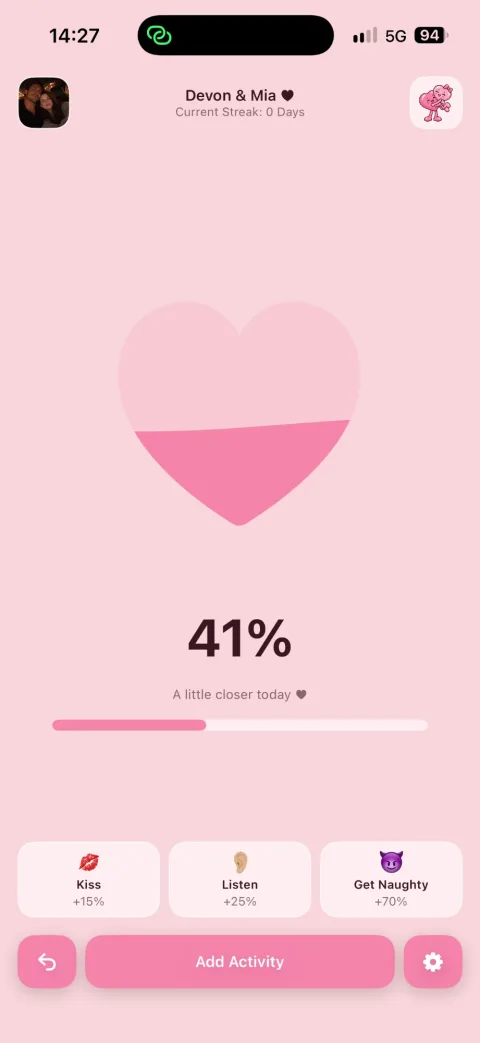
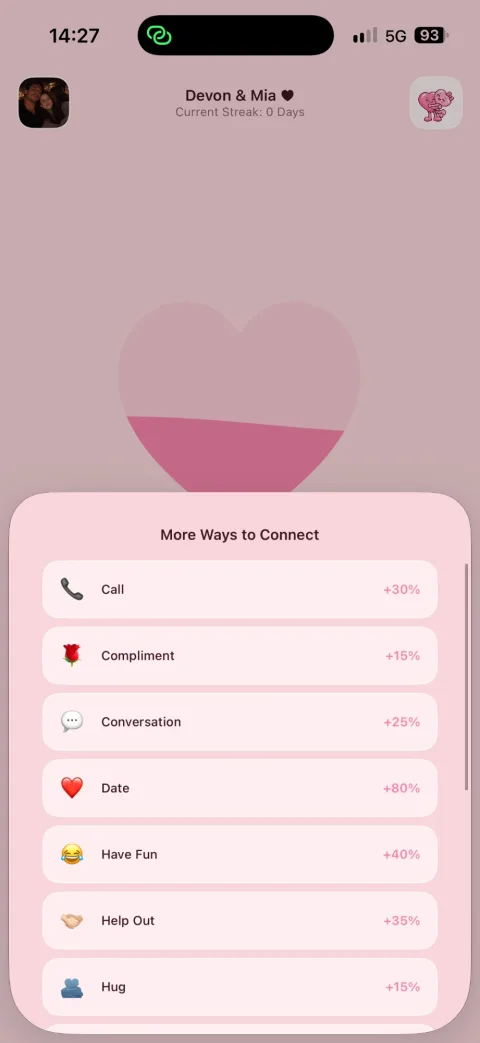
Learning a phrase is a small effort that your partner can feel, and small efforts are what Buffaly is for. Buffaly is an iPhone app for couples who are already together. You connect with a 4-character code and share one heart. Compliment, Hug and Kiss each add 15 percentage points, a Conversation adds 25 and a Date adds 80. The heart slowly empties, so it shows when you last made time for each other and nudges you to top it up. Widgets on the Home Screen and Lock Screen keep the number visible between moments.
What Buffaly is not: it is not a quiz or content app, not a messaging app, and it does not share your location. It is an entertainment tool, not a medical, psychological or counselling service, and it will not make a relationship good by itself. The download is free. Using Buffaly needs a subscription, and one subscription covers both partners; the price is shown in the App Store in your own currency before you subscribe. It needs an iPhone with iOS 17 or later; there is no Android version yet.
Frequently asked questions
How do you say I love you in different languages?
Spanish: te quiero or te amo. French: je t'aime. Italian: ti amo. German: ich liebe dich. Japanese: aishiteru or suki da. Korean: saranghae. Mandarin: wo ai ni. The table in this guide lists 30 phrases with a rough pronunciation.
What is the difference between te quiero and te amo?
Te quiero is warm and common, used for partners, family and close friends. Te amo is stronger and more romantic, and many speakers use it less casually.
Which language is the most romantic for saying I love you?
There is no single answer. The best phrase is the one in your partner's own language or in a language that means something to the two of you.
Can I trust an online translator for I love you?
Check it with a native speaker first. A translation can be correct word for word and still sound odd, formal or too strong.
Should I say I love you in my partner's language even if I make mistakes?
Yes. Most partners are touched by the effort. Ask them to correct you and say it again.
Is it okay to get a foreign-language phrase tattooed?
Only after a native speaker has checked the spelling, the script and the meaning. Tattoos are permanent and small errors in tone or characters are hard to fix.
Can Buffaly help me practise love phrases?
Buffaly does not teach languages. You can log a Compliment or a Conversation after using a new phrase and watch the shared heart fill.