
Home › Blog › How to say I love you over text
How to say I love you over text: 40 messages and when to send them
A text is the easiest way to say I love you and the easiest way to say it badly. It is easy because your thumb is already on the phone and the message arrives in a second. It goes badly because a text has no voice, no face and no pause, so the same three words can read as warm, as automatic or as a plain sign-off, depending on the moment and the wording around them.
This guide is about the text itself. It covers whether texting I love you is a good idea, how to word it, what makes a message land, 40 examples sorted by situation, how to handle the awkward cases (the first time, no reply, a wrong send) and how to keep it from turning into a habit nobody notices. It is not a script to copy word for word. Use the examples as raw material and swap in details only the two of you would recognise.
Is it okay to say I love you over text?
For a couple who already say it out loud, yes, without a second thought. A text I love you in the middle of a workday is a small reminder that the other person is on your mind. Most people enjoy getting one, and many keep these messages for a long time.
The question is harder for the very first time. Saying it for the first time through a screen can feel like you took the easy way out, and some people will read it that way. Our guide on when to say I love you for the first time goes into timing; the short version is that the first one is usually better in person, or at least by voice. If you are in a long-distance relationship and a call is the best you can do, a call still beats a text for this one.
After the first time, the picture changes. Once you have said it face to face, a text is not a replacement for that moment. It is a different tool: a small, frequent, low-effort way to keep the words alive between the bigger moments. Treat it that way and the worry goes away.
What a text can do that a conversation cannot
It is worth knowing why texting works, because it helps you write better ones. A text arrives while the other person is in the middle of their own day. They read it in a meeting, on a train, in a queue. It cannot be interrupted, and they can read it twice. That makes it good for three things.
- Timing. You can say something at the exact moment you think it, rather than saving it for the evening when you have both forgotten.
- Precision. You can choose your words without being watched while you search for them. For people who freeze in the moment, this is a real advantage.
- A record. The message stays. On a hard day your partner can scroll up and find it. A spoken sentence is gone by the time the kettle boils.
What a text cannot do is carry tone. You cannot soften it with a smile or fix it with a squeeze of the hand. That is why wording matters more in writing than it does in speech, and why the next section is the longest in this guide.
How to word it so it does not read as automatic
The most common problem with a text I love you is not that it is wrong. It is that it is generic. If every goodbye ends with the same three words, they turn into a punctuation mark. Here is how to keep them meaningful.
Add a reason
The simplest upgrade is a because. "I love you" becomes "I love you, and I keep thinking about how you handled that phone call this morning." The reason proves you were paying attention. It does not need to be big. It needs to be true and specific.
Anchor it in the moment
Refer to what is happening right now. "Just saw a dog that looks like the one from your story and thought: I love you." A message tied to a real moment can only have been written at that moment, which is why it feels personal.
Use your own words
Every couple has private language: a nickname, a joke, a phrase from a trip. A message that includes it cannot be copied from the internet. If you are short on ideas, our list of cute names to call your boyfriend or pet names can help you find one, as long as it sounds like you.
Say it without asking for anything
A good I love you text does not require an answer. "I love you, no need to reply, go and have your meeting" takes the pressure off and tends to get a warmer reply than a message that ends in a question.
Vary the shape
Sometimes a single line. Sometimes a paragraph. Sometimes a photo with three words. Sometimes a voice note instead of typed text. If every message has the same length and format, the format is what your partner sees, not the words.
10 short messages for an ordinary day
These work when you have a minute and want to say something simple. Each is a starting point; change the details.
- I love you. That is the whole message.
- Thinking of you and smiling at nothing, like an idiot. Love you.
- No reason, no occasion. Just: I love you.
- Whatever your day looks like, I am on your side. Love you.
- You are my favourite person to text. Even when it is only to say this.
- Halfway through my day and you are still the best part of it. Love you.
- I love you more than I love weekends, and that is saying something.
- Reminder: someone out here is very glad you exist.
- I love you. Eat something proper for lunch.
- Seen anything funny today? I want to hear it. Also, I love you.
Notice that two of these add a small practical line. That is on purpose. Mixing affection with something ordinary ("eat lunch") sounds like a real person rather than a greeting card.
10 messages for when you want to say more
These are longer and suit a quiet moment, a milestone or just a feeling you want to put into words.
- I was thinking about the first few weeks we knew each other and how nervous I was. I am not nervous any more, I am just in love with you.
- You do a lot of small things that you probably think I do not notice. I notice every one. Thank you, and I love you.
- I do not say it as often as I think it. Here it is in writing so you can keep it: I love you, and I am glad we are doing this together.
- Something about how you listened to me last night changed the way I feel about this week. I love you for that.
- If I had to pick one thing, it is how safe I feel with you. I love you.
- You make ordinary things better. Grocery shopping, a bus ride, a long silence. I love you.
- I am proud of you for the way you handled today, and I wanted you to hear it from me. I love you.
- There is no one else I would rather be bored with. I love you.
- I read back through our old messages today. We have come a long way, and I love where we are now.
- Sometimes I look at you across the room and think: that is mine to love. I do. Every day.
If you want a larger pool of specifics to draw on, our guide with reasons why I love you is organised by character, feelings and little things, and any single reason there can be turned into one of these messages.
10 messages for hard days
An I love you text is most useful when the other person is having a bad time. The aim here is to comfort without trying to fix, and without a long lecture. Keep it short.
- I heard it was a rough one. You do not have to talk about it. I love you and I am here.
- You do not have to be okay right now. I love you either way.
- Proud of you for getting through today. I love you. Tonight is for resting.
- I cannot fix this, but I can sit with you in it. I love you.
- Whatever happens with this, I love you, and that does not change.
- Take all the time you need today. I am not going anywhere. Love you.
- I know you are anxious about tomorrow. For what it is worth, I believe in you, and I love you.
- Want me to call, bring food, or leave you alone? Any answer is fine. I love you.
- You are allowed to be tired. I love you, and I am on your side.
- Sending a very large imaginary hug. I love you.
A tip for these moments: end with an option, not a question that needs work to answer. "Want me to call, bring food, or leave you alone?" is easy to answer with one word. "How are you feeling about everything?" asks someone who is struggling to write an essay.
10 messages for long distance
When you are apart, texts carry more weight, because they are a bigger part of your shared life. The risk is that they become logistics only. Good messages here mix affection with detail, so your partner can see your day.
- Woke up and the first thing I thought of was you. Love you.
- The bed is too big without you. I love you and I am counting the days.
- Saw something today that you would have laughed at. I will tell you tonight. I love you.
- Whatever time zone I am in, my heart keeps your time. Love you.
- Counting down to seeing you. Eleven sleeps. I love you.
- Walking past our usual coffee order and missing you. Love you.
- I am not good at being far from you, but I am good at loving you. That part is easy.
- Good night from here. Sleep well there. I love you across all of it.
- Thinking about the first thing I will do when I see you. It involves a very long hug. Love you.
- Distance is just a number. You are the thing that is real to me. I love you.
For more on this, see our guides to long-distance relationship questions and free apps for long-distance couples. A text is a good start, but it works best with a call and a plan for the next visit.
Awkward situations and how to handle them
The first time you say it by text
If you have not yet said it in person and you are thinking about writing it, ask yourself why. If the answer is "because I am too nervous to say it out loud", that is human, but consider whether you would rather save it for a moment together. If the answer is "because we are in different countries and I cannot wait", you can write it, and it helps to make it personal: not just the three words, but a sentence about why. Then make sure a call follows soon after, so you can hear each other say it.
They do not reply
Do not panic and do not send a second message to check. People are in meetings, driving, asleep or without a signal. A reply that comes late is usually not a reply that comes cold. If an I love you text goes unanswered for a whole day and this is unusual for your partner, ask about it kindly in a call. Do not turn it into a test.
They reply with only an emoji or a short "you too"
This is more often a style than a signal. Some people reply with an emoji because they are in a hurry or because writing words feels exposed. Look at the pattern over weeks, not one message. If you want more, say so gently and without blame: "I love getting a longer reply from you sometimes, it makes my day."
You sent it to the wrong person
If you wrote it to your partner but sent it to a friend, the friend will most likely smile and move on. Send a quick "wrong chat, but the message stands" to your partner too, and carry on. If you wrote it to someone who is not your partner, that is a different problem, and a text will not fix it.
You are in an argument
A text I love you in the middle of a fight can help or can feel like a dodge. The difference is whether it comes with ownership. "I love you and I am sorry about how I spoke" can help. "I love you, can we stop now" usually does not. Our post on how to say I love you after an argument covers this in detail.
What to avoid
- Using it as a closer to end a conversation you want to escape. If "love you, bye" is always how you hang up, its meaning wears thin.
- Using it to make up for something. A text cannot replace an apology or a change in behaviour.
- Saying it only when you want something. If I love you arrives mostly before a request, your partner will learn to read it as a lead-in.
- Screenshots of other people's quotes with no words of your own. A shared quote can be sweet, but it works best with a line from you attached.
- Demanding it back. "Say it back" turns a gift into a debt.
- Overdoing it. Ten a day will make them blend together. A few well-chosen ones beat a stream.
- Using it as a replacement for being present. If you live together and spend the evening on separate screens, a text from the other room is not the cure.
Beyond text: other ways to deliver the same words
A plain text is one option. If you want the same words to land differently, try one of these.
- A voice note. Your voice carries tone that typing cannot, and your partner can replay it. This is the best option for long distance.
- A handwritten note photographed and sent. The handwriting does the work that fonts cannot.
- A scheduled message. Many phones let you schedule a text, so a message arrives at a moment when you are not nearby, such as just before an important meeting.
- A note in a place they will find it. Inside a coat pocket, a book or a lunch bag. See our post on love notes for ideas.
- A line in a shared list or notebook. A small surprise in an unexpected place.
The point is variety. For a wider range of approaches that do not depend on a screen at all, see our guide to ways to say I love you.
Matching your style to theirs
Some people love long, expressive messages. Others find them a little much and prefer one dry sentence. If you are not sure, watch how your partner writes to you. Do they use lots of words or few? Do they send voice notes? Do they use emoji or avoid them? Answer in a similar register, a notch warmer. It is also fine to ask directly: "Do you like it when I send you random I love yous in the day, or would you rather save them for the evenings?" Most people are happy to be asked, and the answer saves months of guessing.
It also helps to think about what your partner hears as love. A person who values words of affirmation will treasure a thoughtful text. A person who values practical help may prefer "I booked the car in for you, love you." Both are valid versions of the same sentence.
Building a text habit that stays fresh
A few simple rules keep these messages meaningful over years.
- Write one a day that is not a goodbye. Not a reply, not a logistical aside. One message whose only job is affection.
- Keep a note of specifics. When you notice something you love, jot it in your phone. You will always have material.
- Keep the good ones. Screenshot or star the messages that matter. On a bad day, scrolling back is a small, free comfort.
- Mix in other channels. One call, one voice note and one written note a week is a better mix than only text.
- Do not turn it into a score. The goal is not to send more messages than last month. The goal is for them to feel something when they read it.
A closing thought
A text is a small thing, and small things count when they are honest and specific. Say it by text when you mean it, add a because, change the shape from time to time, and follow it up with something you do in person. The words are the easy part. The harder and better part is that the person on the other end can tell you meant them.
Where Buffaly fits
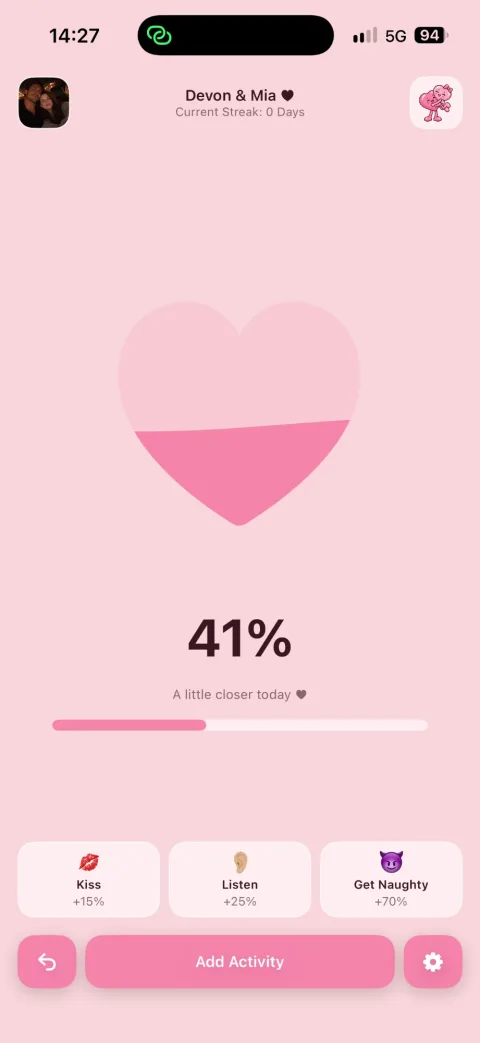
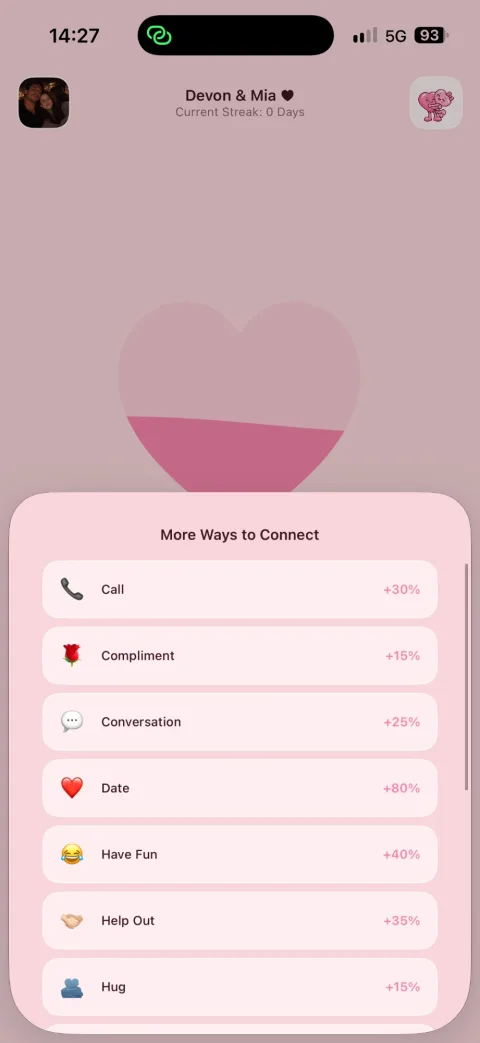
A text is one way to say I love you; Buffaly is built for the moments around it. Buffaly is an iPhone app for couples who are already together. You connect with a 4-character code and share one heart. Compliment, Hug and Kiss each add 15 percentage points, a Conversation adds 25 and a Date adds 80. The heart slowly empties, so it shows when you last made time for each other and nudges you to top it up. Widgets on the Home Screen and Lock Screen keep the number visible between moments.
What Buffaly is not: it is not a quiz or content app, not a messaging app, and it does not share your location. It is an entertainment tool, not a medical, psychological or counselling service, and it will not make a relationship good by itself. The download is free. Using Buffaly needs a subscription, and one subscription covers both partners; the price is shown in the App Store in your own currency before you subscribe. It needs an iPhone with iOS 17 or later; there is no Android version yet.
Frequently asked questions
Is it okay to say I love you over text?
Yes, once you have already said it in person or by voice. For the very first time, most people prefer to say it face to face or at least on a call.
How do I say I love you over text without sounding generic?
Add a specific reason, tie it to something happening right now, use a private joke or nickname, and vary the length and format from message to message.
What should I do if my partner does not reply to my I love you text?
Wait. People are busy, driving or without signal. If it is unusual for your partner, bring it up kindly later in a call instead of sending more messages.
Is a voice note better than a text?
Often, yes. A voice note carries tone and warmth that typing cannot, and your partner can replay it. This is especially good for long distance.
How often should I text I love you?
There is no number. A few well-chosen messages a week that are specific and unprompted tend to mean more than many identical ones.
Can I say I love you by text for the first time?
You can, but most people find it lands better in person or by voice. If distance makes that impossible, add a personal sentence and follow up with a call.
Can Buffaly help me say I love you?
Buffaly does not write messages for you. You can log a Compliment, a Call or a Conversation with your partner and see the shared heart fill.