
Home › Blog › How to say I love you after an argument
How to say I love you after an argument: when, what and what not to say
The hardest time to say I love you is the hour after a fight. You are tired, a bit raw, probably still a little right in your own head, and the words feel either false or too big. Yet it is also the moment when those words matter most, because they tell your partner that the relationship is still standing even though the conversation was ugly.
The trouble is that I love you after an argument can do two opposite things. It can repair: it says the fight was about the issue, not about whether you are on the same team. Or it can dodge: it says let us stop talking about this, which your partner may hear as being brushed aside. This guide explains how to tell the difference, how long to wait, what to say first, and gives word-for-word examples for different kinds of fight. It is not a guide to winning arguments or to deciding who was right. It is about the minutes after, when the way you say three words changes the rest of the evening.
Repair versus dodge
Before you say it, ask yourself what you want the words to do. There are roughly two answers.
- Repair: "I want you to know I am still here and still on your side, even though I am upset."
- Dodge: "I want this to stop, and I hope saying I love you will end it."
Both wishes are human, but only the first one works. The second tends to land as pressure: you said the nice thing, so now you expect the other person to relax. If your partner is still hurt, they cannot relax on command, and the words can make them feel worse because they now have to either accept the peace offering or look unkind for refusing it.
A simple test is whether the sentence contains any ownership. "I love you, and I am sorry I raised my voice" repairs. "I love you, can we drop it?" dodges. "I love you, but you started it" does the opposite of both.
Do you need a pause first?
Sometimes yes. When people are very upset their bodies react: the heart beats faster, thinking gets narrow, and it becomes hard to listen. Words said in that state tend to be sharper than intended, and words heard in that state tend to be harsher than meant. Many couples find that a short break, agreed on out loud, helps more than pushing on.
A break works best when it is stated clearly, not as a slammed door. For example: "I am too worked up to talk well. Can we take twenty minutes and come back to it? I am not leaving, I just need to calm down." The last sentence is the important part. It tells your partner the break is not a punishment and not abandonment. Then actually come back at the time you said. A pause that turns into a silent day is not a break; it is withdrawal.
How long to wait depends on the fight. After a small spat, a few minutes may be enough. After a deeply hurtful one, an evening or a night may be needed. What matters is that both of you know what is happening. If you are unsure, ask: "Do you want to talk now or later? Either is fine."
What to say first
The words I love you are rarely the best opening. Starting with something that acknowledges the other person's side makes it easier for them to hear the three words that follow. Here are a few openers, in rough order of how much they ask of you.
- A small acknowledgement. "I can see I hurt you."
- A bit of ownership. "I should not have said it like that."
- A statement of your intention. "I do not want to be at war with you."
- Then the three words. "I love you."
Putting the words at the end, after something real, lets them mean what they are meant to mean. Put them at the start with nothing behind them and they can sound like a shortcut.
It also helps to be specific about what you are apologising for. "Sorry you feel that way" is not an apology; it is a comment on the other person's feelings. "I am sorry I brought up your family in the middle of a fight, that was unfair" is. If you want a longer look at this, our guide on how to apologize breaks down what a good apology contains.
Example scripts for different kinds of fight
After a small, silly argument
These are the ones about dishes, plans or who forgot what. A light touch is fine.
- "That was a stupid fight about a stupid thing. I love you, let us order food and start over."
- "I am sorry I snapped. I love you more than I care about the dishwasher."
After a fight where you were wrong
Say so first. Do not bury it.
- "I was wrong, and I am sorry. I love you, and I do not want to make this harder."
- "I have been thinking about what you said, and you were right. I am sorry for how I handled it. I love you."
After a fight where you both said things you regret
- "We both said things we did not mean. I am sorry for mine. I love you, and I would like to try again."
- "I do not want to keep score. I am sorry for my part, and I love you."
After a fight where you still disagree
Not every argument ends in agreement. Sometimes the honest thing to say is that you are still not on the same page but you are on the same side.
- "We still see this differently, and that is okay. I love you, and I want to find a way that works for both of us."
- "I do not agree with you yet, but I do not want to lose you over it. I love you."
After a fight where your partner is still angry
Do not push for a reply. Say it once, gently, and give space.
- "I know you are still upset and that is fair. I love you. I will be in the next room when you are ready."
- "You do not have to answer. I just want you to know I love you and I am not going anywhere."
After a fight in public or in front of other people
- "I am sorry that happened in front of everyone. It was not fair to you. I love you, and I want to make it right."
How to say it without words
If words feel too heavy right after a fight, you can start with actions. A small gesture often helps the other person lower their guard before a conversation.
- Make them a drink. Tea, coffee or water, brought without comment.
- Offer a hug and ask first. "Can I hug you?" works better than assuming.
- Do the thing they asked about. If the argument was about the washing up, do it quietly.
- Sit next to them. Physical closeness without pressure.
- Write a short note. A few honest lines, left on the table or sent as a text.
The aim is not to buy forgiveness. It is to show that you care about the person even while you are still sorting out the problem. If you want ideas for this kind of non-verbal repair, our guide to how to be more affectionate and the post on love notes may help.
A short text version
When you are not in the same room, a text can open the door. Keep it short, make it a sentence they can answer with one word, and avoid arguing the case in writing. Some examples:
- "I am sorry about earlier. I love you. Talk when you are ready?"
- "Thinking about our fight. I was out of line. I love you."
- "I do not want to leave this unfinished. Call me when you can. I love you."
Avoid sending a long message full of explanations. A long text can read like a second round. Save the details for a conversation, where tone can do its work. Our guide to how to say I love you over text has more on wording short messages.
What to avoid
- Saying it as a trade. "I said I love you, now you say it back." The words are not a bargain.
- Using "but". "I love you, but you always..." erases everything before the "but".
- Using it to end the discussion. If the issue is not finished, say so: "I love you, and I would like to finish this talk tomorrow."
- Saying it in a sarcastic tone. Sarcasm turns the words into a weapon.
- Saying it while walking away. It can sound like an insult instead of an invitation.
- Repeating it when your partner has asked for space. One clear message, then wait.
- Bringing up old fights. The argument you are in is enough.
- Expecting instant forgiveness. Some people need an hour, some a day. Give time.
When your partner does not say it back
It hurts when you say I love you after a fight and the answer is silence or a flat "okay". Try not to read too much into it. People who are still hurt often cannot say it back without feeling false. The silence may mean "I heard you, I am not there yet", not "I do not love you".
Respond calmly. You might say, "That is fine, you do not have to say it. I just wanted you to hear it." Then give them time. If after a day or two things are still frozen, ask: "Is there something I have not understood yet?" Often there is, and the fight was a symptom of it.
If you notice that fights keep ending in cold silences, or that one of you regularly feels dismissed, the issue is bigger than any one conversation. Our posts on how to fix a relationship and feeling neglected in a relationship cover those patterns in more depth.
When you are the one who is hurt
Not every post-argument moment is about you saying the words. Sometimes you are the one who needs to hear them, and you are not ready to give them. Here are some things you can say without faking warmth.
- "I love you, and I am still hurt. Give me a little time."
- "I am not ready to talk, but I am not leaving."
- "Thank you for apologising. I need to think about it."
- "I want to forgive you. I am just not there yet."
Honesty is better than a fake reconciliation. A quick "it is fine" that is not fine tends to return later with interest. If an argument touches trust, for example after a lie or a broken promise, repair may take longer than a night. Our guide on how to rebuild trust in a relationship goes into that.
Making the repair last
The words are the start, not the end. A few habits make it more likely that the next fight ends faster.
- Agree on a break signal. A word or phrase either of you can use when things are getting too hot.
- Come back to it. When you are both calm, spend ten minutes on what the fight was really about. Not who was right, but what each of you needed.
- Name one change. Each person picks one small thing to do differently next time.
- Show it, do not only say it. If you promised to listen more, listen more this week.
- Do something good together. A walk, a meal or a film. Fights are easier to leave behind if the next shared memory is a good one.
- Do not keep a record. Once it is repaired, let it go.
Some couples find it helpful to keep a few regular check-in questions. Our list of relationship check-in questions offers prompts that can catch small tensions before they become fights.
A closing thought
I love you after an argument is not magic, and it is not an eraser. It is a bridge. If you build it with an honest sentence in front of it and give the other person room to cross at their own speed, it usually holds. If you use it to hurry the evening along, it usually does not. Say it when you mean it, say what you are sorry for, and let the rest of the repair happen in the days that follow.
Where Buffaly fits
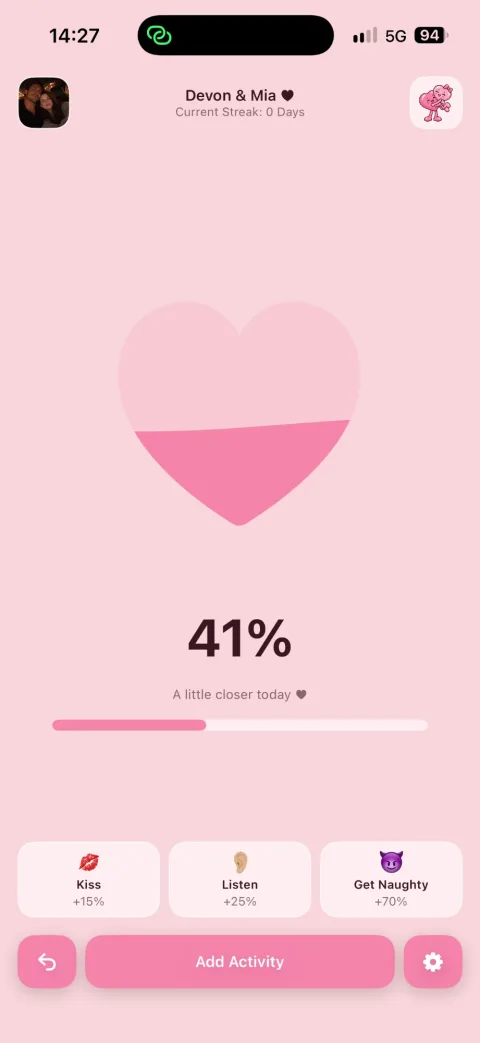
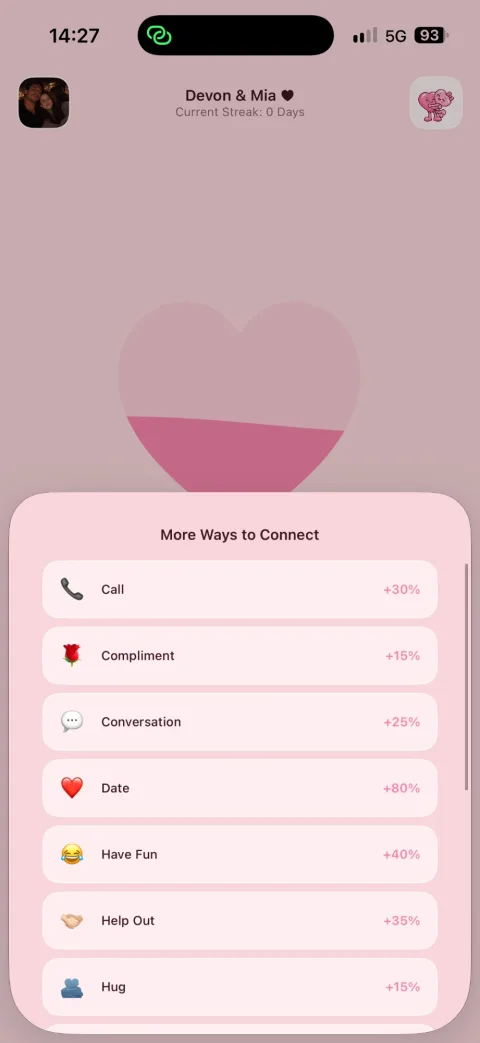
After a fight, small gestures often do more than a big talk, and Buffaly helps you notice the small gestures. Buffaly is an iPhone app for couples who are already together. You connect with a 4-character code and share one heart. Compliment, Hug and Kiss each add 15 percentage points, a Conversation adds 25 and a Date adds 80. The heart slowly empties, so it shows when you last made time for each other and nudges you to top it up. Widgets on the Home Screen and Lock Screen keep the number visible between moments.
What Buffaly is not: it is not a quiz or content app, not a messaging app, and it does not share your location. It is an entertainment tool, not a medical, psychological or counselling service, and it will not make a relationship good by itself. The download is free. Using Buffaly needs a subscription, and one subscription covers both partners; the price is shown in the App Store in your own currency before you subscribe. It needs an iPhone with iOS 17 or later; there is no Android version yet.
Frequently asked questions
Should I say I love you right after an argument?
Yes, if you pair it with real ownership, such as an apology for your part, and you do not use it to end the conversation. If you are both still very upset, take a short agreed break first.
What should I say to my partner after a fight?
Start with a small acknowledgement, take responsibility for your part, state that you do not want to be at war, and then say I love you.
How long should I wait before talking after an argument?
It depends on the fight. A few minutes can be enough for a small spat, an evening or night for a hurtful one. State the break clearly and come back at the time you said.
What if my partner does not say I love you back after a fight?
Do not take it as rejection. They may still be hurt and cannot say it yet. Say it once, give space, and check in later.
Is it bad to say I love you to stop an argument?
If you use it to end a conversation your partner still wants to have, it can feel like a dodge. Say you love them and also say when you can continue the talk.
Can I apologise by text after an argument?
Yes, keep it short and sincere to open the door, then talk in person or on a call for the details.
Can Buffaly help after an argument?
Buffaly does not mediate fights. After you make up you can log a Hug, a Conversation or a Compliment and see your shared heart fill again.