
Home › Blog › Words of affirmation
Words of affirmation: what it means and 50 examples for your partner
Some people feel most loved when they hear it. A kind sentence at the right moment can stay with them for days, and a harsh one can hurt for weeks. If that sounds like your partner, or like you, words of affirmation may be a key love language. This guide explains what it means, how to spot it, and gives you 50 examples to say or write, plus tips for sounding sincere.
What words of affirmation means
Words of affirmation is one of the five love languages that people often talk about: words of affirmation, quality time, receiving gifts, acts of service and physical touch. It is a popular framework for conversation, not a scientific test, and most people respond to several of them. Words of affirmation means feeling loved through spoken or written encouragement, appreciation and praise.
It includes compliments, thank-yous, notes, messages and the tone in which you speak. For a person who values it, what you say matters, and what you do not say matters too. A partner who is silent about their feelings may leave them feeling unsure, even if the love is there.
Signs it may be your partner's language
- They light up at compliments and thank-yous.
- They keep notes, cards and messages.
- They remember what you said, word for word.
- They feel hurt by criticism or sarcasm more than others do.
- They often say kind things to others.
- They ask "do you love me?" or "are you proud of me?".
- They feel low when they do not hear appreciation.
- They talk about what people said to them years ago.
None of these proves anything. The best way to find out is to ask and to watch how they react to different kinds of kindness.
Everyday words of affirmation
- Thank you for making dinner. It tastes great.
- I appreciate how hard you worked today.
- I love seeing you laugh.
- You handled that so well.
- I am glad you are in my life.
- You look great today.
- I like how you think.
- Your idea was really good.
- You are really good at this.
- I am proud of you.
The simplest ones are often the most useful. Say them often, and say them to the person's face.
Words of affirmation for hard times
- I am here, whatever happens.
- It makes sense that you feel this way.
- You do not have to figure it out alone.
- I believe in you.
- You are doing better than you think.
- I love you through all of this.
- It is okay to rest.
- You are not a burden.
- We will get through it together.
- I am not going anywhere.
In hard moments, people do not need a speech. They need to know they are safe and that you are on their side.
Words of affirmation about their character
- You are one of the kindest people I know.
- I admire your patience.
- You make people feel welcome.
- I trust you.
- You have a great sense of humour.
- I love how you care for others.
- You are dependable and I am grateful.
- You are brave in ways you do not notice.
- I love your curiosity.
- You make the world around you better.
Praise for character lasts longer than praise for looks. It also helps people see good things in themselves. For longer lists, see our compliments for your partner.
Words of affirmation for appearance and attraction
- You are beautiful, inside and out.
- I like looking at you.
- You take my breath away.
- That colour suits you.
- I love your smile.
- You look comfortable and happy, and I love that.
- I find you very attractive.
- I am so lucky to be with you.
- You always look good to me.
- I still get butterflies when you walk in.
Make it genuine and avoid comparisons with others. Notice what makes your partner feel good about their appearance.
Written words of affirmation
- Write a note and leave it where they will find it.
- Send a message in the middle of the day.
- Create a list of ten things you love about them.
- Write a letter for a special day.
- Leave a sticky note on the mirror.
- Add a line to a card.
- Send a voice note when you are apart.
- Write something in a shared note on your phone.
Written words can be read again and again. Many people keep them for years. For more ideas, see ways to say I love you and reasons why I love you.
How to sound sincere
- Be specific: "I loved how you handled the meeting" lands better than "good job".
- Mention the effect on you: "It made me feel proud."
- Avoid adding a "but" or a request.
- Say it when you mean it, not on a schedule.
- Look at them and slow down.
- Match your tone to your words.
- Do not use praise to avoid a hard conversation.
If you are not used to saying kind things aloud, start with one a day. It will feel awkward at first and then natural.
Words that hurt: what to avoid
- Sarcasm, especially about something they are sensitive about.
- Name-calling, even in anger.
- Comparing them to others.
- Dismissing their feelings.
- Using the silent treatment.
- Bringing up past mistakes as a weapon.
- Saying "I was only joking" after a hurtful remark.
For a person who values words, harsh ones cost more. If you slip, apologise quickly and specifically. See how to be a better partner for how to repair after a fight.
Balancing words with action
Words alone are not enough. If you say kind things but do not follow them with kind behaviour, the words lose weight. Make sure your actions match your messages. Show up on time, keep your promises and help when you can. Words of affirmation work best when they describe what you also show. And if your partner needs more than words, explore the other languages in how to make your partner feel loved.
If your partner needs words and you do not
It is common for one partner to value words and the other to value something else. If you are the person who shows love through action, saying kind things aloud may feel unnatural or even a little fake. That is understandable, and it is a skill you can learn. Start small. Choose one moment each day, such as when you say goodbye or when you sit down to eat, and say one specific thing you appreciate. Write it in your phone if you need a reminder. Notice how your partner reacts, and let that encourage you. Over a few weeks, the habit becomes easier, and you will probably find that the words also change how you feel.
It helps to explain, too: "I show love by doing, and I am learning to say more. Please bear with me." That gives your partner context and prevents misreading your quietness as coldness. If you feel stuck, reading a few of the examples above out loud can make them feel less strange.
If you need words and your partner does not give them
If words matter to you and your partner rarely offers them, it can feel lonely. Resist the temptation to hint or to test them. Instead, say what you need in a calm moment: "It means a lot to me when you tell me what you appreciate. Could you try to say something kind each day?" Be specific about what helps. Some people need a thank-you for chores, others need to hear that they are attractive, others need to hear "I am proud of you". When your partner does offer a kind word, thank them for it. Positive feedback encourages more of it.
It also helps to look at what your partner does offer. They may show affection through actions you do not read as love. Ask them what they feel they give, and share what you feel you receive. Then agree on a few small changes that meet in the middle. If you notice that feeling unappreciated has become a regular theme, see feeling neglected in a relationship.
Words of affirmation in long-distance relationships
When you cannot see each other, words carry more weight, because they are often the main way you connect. Make them count. Send a message in the morning and one before bed. Write letters. Record voice notes so that your partner can hear your tone, which often says more than the words. Share specific compliments rather than general ones: "I loved how you described your day" is better than "you are great". Keep a shared note with things you love about each other and add to it over time. Use video calls to say things face to face. If you are looking for more ways to stay close, read long distance date ideas and apps for long-distance couples.
Building a habit of appreciation together
A small shared ritual makes appreciation automatic. Choose a daily or weekly moment, such as dinner or Sunday evening, and each say one thing you are grateful for about the other. Keep it short, so it does not feel like a performance. Over a month, you will have thirty or more specific things said, and you will both notice that you look for good things during the day. If you do this regularly, difficult conversations also become easier, because you have a stock of goodwill. Add a monthly check-in, using our relationship check-in questions, to share what is working and what you would like more of.
A one-week practice
To try this out, choose a different kind of kind word each day for a week. On Monday, thank them for something practical. On Tuesday, praise something about their character. On Wednesday, send a message in the middle of the day for no reason. On Thursday, tell them what you admire about how they handled something. On Friday, write a short note and leave it where they will find it. On Saturday, say something about how you feel when you are with them. On Sunday, ask which of these they liked best. Their answer will tell you where to put your effort, and the habit of paying attention will outlast the week. Keep the notes in a folder, and read them back together on an anniversary. You may be surprised how much they add up to over a year.
Where Buffaly fits
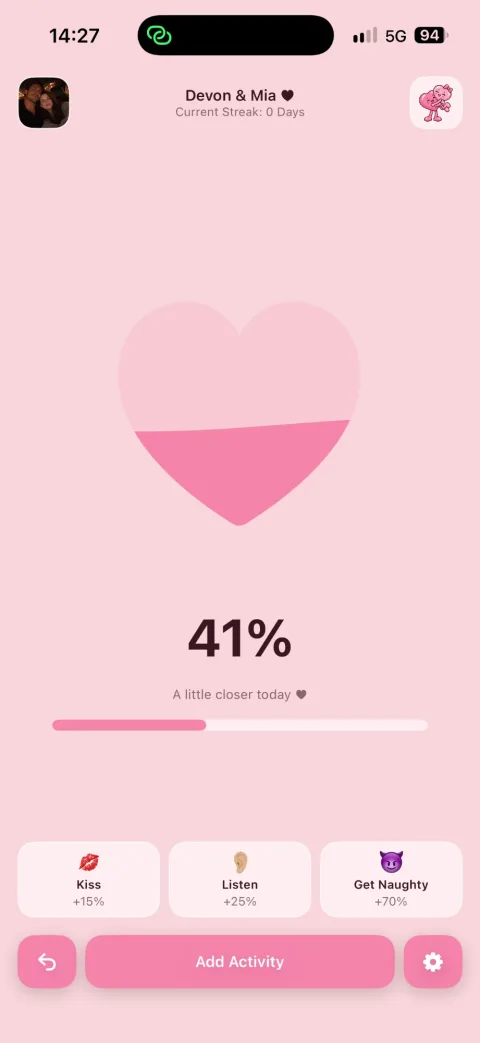
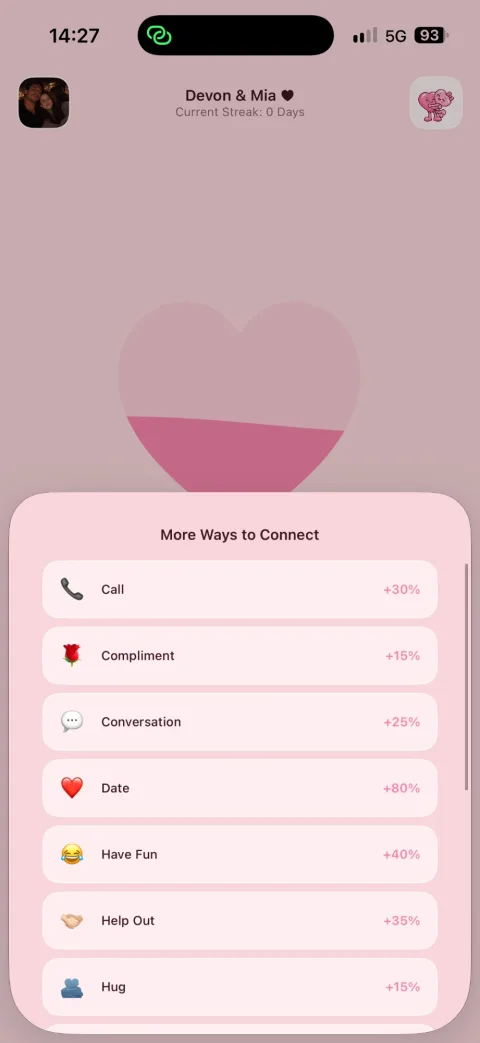
A kind word is a small moment, and Buffaly's Compliment action is a quick way to keep the habit going. Buffaly is an iPhone app for couples who are already together. You connect with a 4-character code and share one heart. Hug, Kiss and Compliment each add 15 percentage points, a Conversation adds 25, a Date adds 80. The heart slowly empties, so it helps you keep topping up closeness instead of waiting for a big moment. It is meant to make small moments easier to remember. It will not make a relationship good by itself.
What Buffaly is not: it is not a quiz or content app, not a messaging app, and it does not share your location. It is an entertainment tool, not a medical, psychological or counselling service. The download is free and your first action is free. Then there is a 7-day free trial, then EUR 4.99 per month or EUR 29.99 per year for both partners. It needs an iPhone with iOS 17 or later; there is no Android version yet.

Frequently asked questions
What does words of affirmation mean?
It means feeling loved when you hear kind, encouraging and appreciative words from your partner.
What are examples of words of affirmation?
Thank-yous, compliments, encouragement, notes and phrases such as "I am proud of you" or "I am glad you are in my life".
How do I give words of affirmation if I am shy?
Start with one sincere sentence a day, or write it in a note or message.
Can words of affirmation backfire?
Yes, if they feel fake, are used to avoid a hard topic or do not match your actions. Be specific and honest.
Can an app help?
Buffaly can remind you to make small moments happen. It is an entertainment tool, not a counselling service, and it works best alongside real talks and time together.