
Home › Blog › Questions to ask your partner
Questions to ask your partner: 40 conversation starters that go beyond "how was your day"
After a few months or a few years together, most conversations turn into logistics: who picks up what, what is for dinner, who answers the landlord. The good questions do not disappear. They just stop getting asked. Here are 40 questions to ask your partner, in five groups from easy to deeper, and a few simple rules that make them work.
How to use these questions
- One question at a time. Do not turn it into an interview. Ask, listen, then follow up on what you heard.
- Answer it yourself too. If only one person talks, it feels like a test.
- Phones away. Ten minutes with full attention beats an hour with half.
- Skip freely. A question that feels wrong tonight can work next month.
- Do not fix, just listen. If an answer surprises you, ask "tell me more" before you react.
Pick the right moment
Timing matters more than the wording. Questions land best when nobody is hungry, rushed or already annoyed: on a walk, while cooking together, on a drive, or in the last ten minutes before sleep. The side-by-side setting is underrated. Many people find it easier to say something honest when they are not being stared at across a table. Avoid the moment right after a fight, and avoid the door-in-hand moment when one of you just got home.
Introduce it without making it weird
If asking out of nowhere feels awkward, say so. A line like this works well: "I realised we mostly talk about logistics lately. Can I ask you one real question tonight? You can ask me one too." That is honest, it is small, and it makes clear that you are not about to start an interrogation.
Follow-up questions are the real skill
The first answer is often the polite one. The second is where it gets interesting. Keep a few follow-ups ready and use them instead of jumping to the next question on the list:
- "What was that like for you?"
- "What makes that important to you?"
- "Can you give me an example?"
- "Is that still true today, or has it changed?"
- "What would help there, from me?"
Example: you ask "What do you need from me when you have had a rough day?" and the answer is "Nothing, I'm fine." Instead of accepting that or pushing, you can say: "Fine is allowed. Would it be okay if I just sat with you for ten minutes, no talking required?" You respect the answer and still leave a door open.
Easy warm-ups
Light questions that get you talking without any pressure.
- What was the best part of your day, and what was the worst part?
- What is a small thing that made you smile this week?
- If we had a free Saturday with no plans, what would you want to do?
- What is a song, show or food you could never get tired of?
- What is something you are looking forward to, big or small?
- What did you want to be when you were ten?
- Which of our inside jokes is your favourite?
- What is one thing you would like us to try this month?
Memories and the past
Questions that remind you why you chose each other.
- What is your first memory of us?
- What did you notice about me first?
- What is the best trip or day we have had together, and why?
- When did you first realise this was serious?
- What is a moment from our relationship you think about more often than I would guess?
- What is something we got through together that you are proud of?
- Which family tradition would you like us to keep, or start?
- What is a memory from before we met that shaped who you are?
Daily life and the small things
The everyday stuff is where most relationships are won or lost.
- What is one small thing I do that makes your day easier?
- Is there something you wish I would notice more often?
- How are you really doing with work, money or stress right now?
- What does a perfect ordinary weekday look like for you?
- When do you feel most like we are a team?
- What is one chore or task you would happily hand over, and one you do not mind?
- How much time together do you need in a week to feel connected?
- What do you need from me when you have had a rough day: advice, a hug, or space?
Feeling close and loved
These take a little courage. Go slowly and be kind with the answers.
- When do you feel most loved by me?
- What is something I do that makes you feel appreciated?
- Is there a way you would like me to show affection more often?
- What helps you feel close to me when we are busy or tired?
- Is there anything you have been wanting to say but have not found the moment for?
- What is something you are afraid to ask me for?
- When did you last feel really seen by me?
- What is one thing you would like us to do differently so we feel closer?
The future and what you want
Good for a slow evening, ideally with no deadline for decisions.
- Where do you picture us in five years?
- What is something you want to learn or try before next year ends?
- What would a great life together look like to you, in ordinary terms?
- What do you want more of in your life right now, and what less?
- Is there a dream you have put aside that we could make room for?
- What is one thing we should start doing now so we do not regret it later?
- What kind of couple do you hope people see when they look at us?
- What would you like us to still be doing together when we are old?
Questions for specific situations
The 40 above work for most couples. Some phases of a relationship ask for a slightly different angle. This is opinion from our side, not a rulebook.
Early in a relationship
Keep it curious, not evaluating. "What does a good week look like for you?" and "What are you proud of that most people do not know about?" tell you far more than "Where is this going?" on date three. Save the future questions until both of you are ready for them.
Before moving in together or getting married
Here the practical questions matter, and they are easier to ask calmly now than in the middle of a disagreement later. Useful areas: how you each handle money and shared costs, how much alone time you need, how you want to split chores, where you want to live, whether and when you want children, how involved families should be, and how each of you wants to handle conflict. You do not need matching answers on everything. You need to know the answers. If you want a neutral third party for big decisions, a licensed couples counsellor can guide a premarital conversation.
Long-distance relationships
Distance makes small talk feel pointless and deep talk feel heavy. A good middle: one question per call, saved for the first five minutes before the usual updates. Memory questions work especially well, because you build a shared story even when you are in different time zones.
After a rough patch
Go gentle. Skip "why did you" and use "what do you need" instead. If you are trying to find your way back to each other, our guide on how to reconnect with your partner is a better starting point than a list of questions. And if the same hurt keeps coming back, a licensed therapist is the right help, not a list from the internet.
Common mistakes when asking questions
- Asking, then waiting for the "right" answer. If you already know what you hope to hear, it is a test, not a question.
- Using questions as ammunition. "When do you feel loved by me?" is not the moment to prove that you do more than your partner.
- Going too deep too fast. Starting with the fear and future questions on a tired Tuesday often ends in silence. Warm up first.
- Rushing to defend yourself. If the answer is "I wish you noticed me more", the first sentence back should not start with "but I".
- Turning it into a monologue. Your answer matters, but a long speech ends the exchange.
- Forcing it. A partner who says "not tonight" is giving you information. Respect it and offer another time.
- Looking at your phone. Even a quick glance tells the other person where your attention is.
- Doing it once. One big talk rarely changes a daily pattern. A small habit does.
Making it a habit instead of a one-off
Most couples try a list like this once and then forget it. What helps is to make it small and regular: one question over dinner, in the car or on a walk, a few times a week. Put a reminder in your calendar if you need to. It does not need to be deep every time. The point is to keep asking.
Three easy ways to build the routine
- The jar. Write questions on small slips of paper, drop them in a jar, and pull one out at dinner. Either person can veto a slip.
- The anchor. Tie one question to something you already do, like the Sunday walk or the first coffee on the weekend.
- The date. Pick three questions and bring them to your next evening out or evening in. Our ideas for date nights at home pair well with this.
If you want a regular, structured format instead of random questions, a short weekly talk can work too. See our relationship check-in questions for a simple version.
If you live apart, these work on a video call too. Pick one question each, and take turns.
Where Buffaly fits
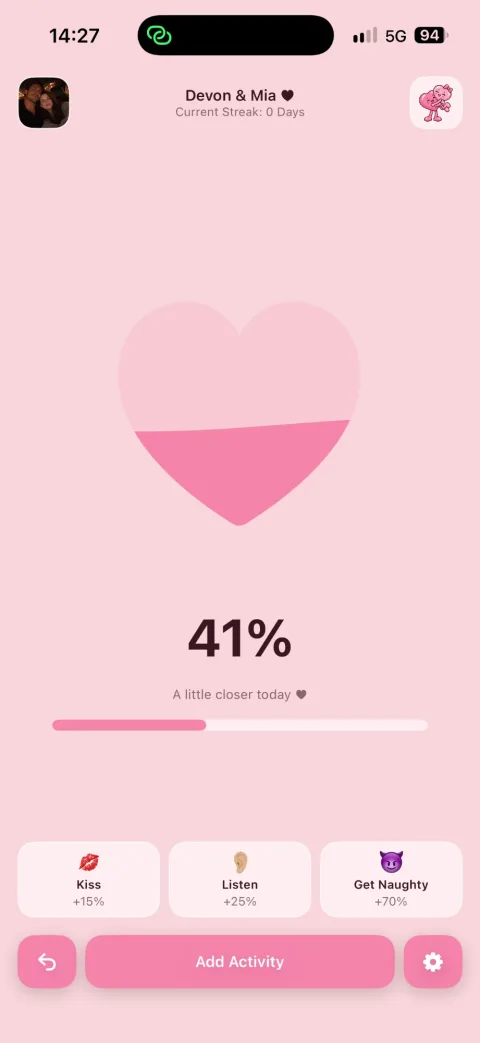
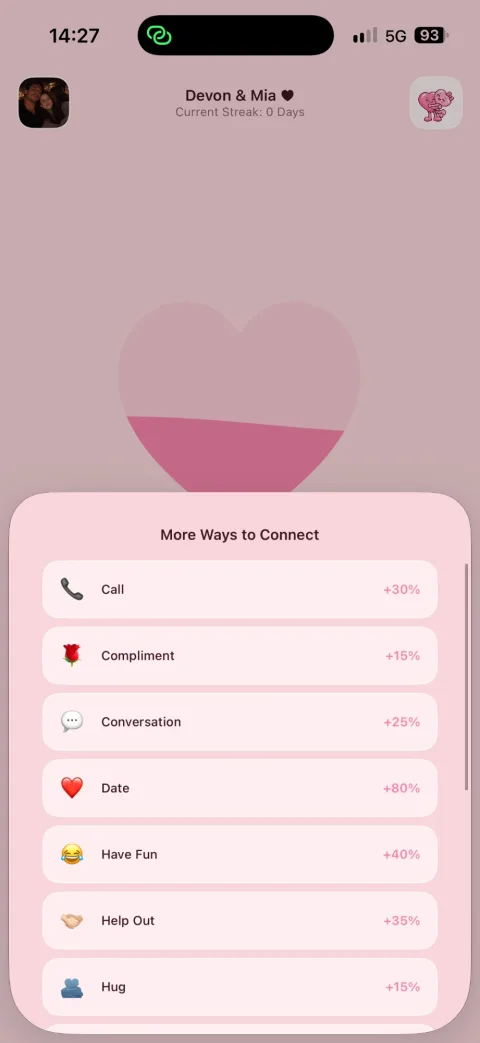
Buffaly does not give you questions, and we do not want to pretend it does. What it does is make the conversation count and easy to remember. Buffaly is an iPhone app for couples who are already together. You connect with a 4-character code and share one heart. When you have a real talk, either of you logs it as a Conversation, which lifts the shared heart on both phones (+25 percentage points, lasting 24 hours). Listen, Call and Date are separate actions in the same list. The heart slowly empties, so a small talk every few days keeps it full.
What Buffaly is not: it is not a quiz or content app, not a messaging app, and it does not share your location. It is an entertainment tool, not a medical, psychological or counselling service. The download is free and your first action is free. Then there is a 7-day free trial, then EUR 4.99 per month or EUR 29.99 per year for both partners. It needs an iPhone with iOS 17 or later; there is no Android version yet.

Frequently asked questions
How often should couples ask each other deeper questions?
There is no right number. A few times a week for ten minutes works better for most couples than one long talk every few months. Keep it light enough that you actually do it.
What if my partner does not like answering questions?
Start with the warm-ups, answer first yourself, and keep it short. Some people open up more while walking or cooking than when sitting across a table. Never turn it into a test.
Are these questions good for long-distance couples?
Yes. Pick one question each for your next video call and take turns answering. The memory and closeness questions work especially well when you cannot be in the same room.
What should I do if a question leads to an argument?
Pause. You can say "I want to understand this, and I need a break first", and come back later. If the same topic keeps causing pain, a licensed couples therapist can help, and an app is not a replacement for that.
What are good deep questions to ask your partner?
Good deep questions are open, personal and not a trap. Try "When do you feel most loved by me?", "What is something you are afraid to ask me for?" or "What do you want more of in your life right now?" Ask one, listen fully, and follow up before moving on. Deep works best when it is slow.
What are fun questions to ask your partner?
Think light and a bit silly: "What would you do with a free Saturday?", "Which of our inside jokes is your favourite?" or "What did you want to be when you were ten?" Fun questions are also the best warm-up for deeper ones.
What questions should we ask before getting married?
Cover the practical big topics: money, children, where to live, family involvement, how you handle conflict, and how much time you each need alone. You do not need identical answers, but you should know each other's. A licensed couples counsellor can help guide premarital conversations if you want support.
How many questions should we ask in one sitting?
One to three is plenty. A short conversation you both enjoy beats a long one that feels like homework. Stop while it is still good, and pick it up again another day.
Does Buffaly provide questions to ask my partner?
No. Buffaly is not a quiz or content app. It lets you log real moments, such as a Conversation, so the shared heart shows that you made time for each other.