
Home › Blog › How to reconnect with your partner
How to reconnect with your partner: 12 ways to rekindle closeness
Most couples do not drift apart in one big moment. It happens slowly: busy weeks, tired evenings, phones at the table, conversations that are only about logistics. The good news is that closeness usually comes back the same way, in small steps. Here are 12 ways to reconnect with your partner and rekindle the spark, without a big gesture.
Why couples drift (and why it is normal)
Drifting is common, and it does not mean the relationship is over. In our experience, it is usually a pile-up of small things: less time, less attention, fewer shared jokes. That is also why the fix can be small. Think of closeness as something you keep topping up, not something you either have or do not.
Signs you have drifted
None of these is a verdict on your relationship, but together they are a good reason to act:
- Your conversations are mostly about schedules, chores and money.
- You are in the same room but on separate screens.
- You share good news with friends before you share it with each other.
- Small things annoy you more than they used to, or you stopped bothering to mention them.
- You cannot remember the last time you laughed together.
Why small steps beat big gestures
A surprise weekend away is lovely, but it rarely fixes everyday distance on its own, because on Monday you are back in the same routine. Short, repeatable moments change the routine itself. They are also easier for a tired or guarded partner to say yes to. This is our opinion from writing about relationships, not a scientific claim, and it is worth testing with your own partner.
Small daily habits
- Greet each other properly. Look up from your phone, say hello, give a hug or a kiss when one of you comes home.
- Send one message a day that is not about logistics: a photo, a memory, a "thinking of you".
- Say one thing you appreciated before you go to sleep.
- Do a long hug or a slow kiss every day. It sounds silly and it works as a reminder to slow down. If touch has become rare, our guide on how to be more affectionate has gentler starting points.
Spend time together on purpose
- Protect one evening a week for the two of you, even if it is just at home. Our date night ideas at home can help.
- Try something new together. New things give you something to talk about that is not the usual stuff. Need inspiration? See things to do with your partner.
- Take a walk with no phones and no destination.
- Do something you used to do early in the relationship: the same cafe, the same game, the same playlist.
Talk honestly and kindly
- Ask real questions. Our 40 questions to ask your partner are a good start.
- Do a short weekly check-in about how things are going. See our relationship check-in questions.
- Say what you miss in a calm way: "I miss us having time together" lands better than "you never".
- Ask what they need instead of guessing. The answer is often smaller than you expect.
What to say in the first conversation
The hardest part is often the first sentence. You are not trying to settle everything. You are trying to open a door without anyone feeling blamed. Here is a simple shape that tends to work.
Pick the moment
Not at 11 pm, not mid-argument, not while one of you is rushing out of the door. A walk or a slow weekend morning works well, because side by side feels less like a confrontation than face to face.
Use three short steps
- Start with warmth: "I love being with you, and that is why I wanted to talk."
- Name one thing you miss, not what they do wrong: "I miss the evenings when we just hung out and laughed."
- Make one small, specific offer: "Could we try keeping Thursday evening for just us, phones away?"
Listen before you fix
Then stop talking. Your partner may have noticed the distance too, or may feel surprised or defensive. Try "Tell me how it looks from your side" and let them finish. If they bring up something that stings, resist the urge to defend yourself. "That makes sense, thank you for telling me" costs nothing and keeps the door open.
If it goes badly
If the talk turns into an argument, pause rather than push through: "I do not want us to fight about this. Can we take a break and try again tomorrow?" Then actually try again tomorrow. For more prompts, see our questions to ask your partner.
A 4-week reconnect plan
This is a simple structure, not a method with proven results. Adjust it to your life. The idea is to start tiny and add a little each week, so it never feels like homework.
Week 1: Notice each other again
- Greet each other properly every day.
- Send one non-logistics message per day.
- Say one thing you appreciated before sleep.
Week 2: Add time
- Keep everything from week 1.
- Plan one phone-free evening, at home or out. Our date night ideas at home make this easy.
- Take one walk together with no destination.
Week 3: Add a real talk
- Keep the first two weeks going.
- Have the conversation described above, if you have not already.
- Try a 15-minute check-in with a few questions from our relationship check-in questions.
Week 4: Look back and decide
- Ask each other: what felt good, what felt forced, what should we keep?
- Turn two or three things into permanent habits, such as the weekly evening and the daily message.
- Pick one new thing to try next month.
If you miss a day or a week, just pick up again. Perfect streaks are not the point.
After a hard stretch, a baby or time apart
Some distance has a clear cause, and the advice changes a little.
After a new baby
Sleep loss and constant care leave little energy for each other, which is normal. Lower the bar: five minutes of sitting together with the baby asleep, a shared joke, a hand on the shoulder, a thank-you for the night shift. Say out loud that you are on the same team. Talk about who does what in a calm moment, not at 3 am. If either of you feels persistently low, anxious or hopeless, please talk to a doctor or midwife; that is a health matter, not a relationship failure.
After a fight or a rough patch
Repair first, connect second. A sincere "I am sorry for how I said that" does more than a gift. Then do something easy and pleasant together, like a meal or a walk, to show the relationship is bigger than the argument.
After time apart
After a trip, a long work stretch or distance between you, do not expect to click back in on day one. Plan a low-key first evening, share what each of you went through, and ask what you missed. If you are apart for long periods, see also our notes on how to make your partner feel loved.
When the cause is deeper
After broken trust, serious conflict, or if you ever feel unsafe, tips from a blog are not enough. A licensed couples therapist or, in an unsafe situation, a professional support service is the right next step.
Common mistakes when trying to reconnect
- Waiting for a perfect moment or a big trip. Start this week with something small.
- Keeping score or bringing up old arguments. If something old needs to be resolved, give it its own calm talk.
- Demanding closeness. Offer it, and make it easy to say yes. Pressure usually creates distance.
- Turning it into a project review. Constant "how are we doing?" questions feel like an exam. Keep most of the time light and fun.
- Only fixing it when it hurts. Small habits kept up when things are fine are what prevent the next drift.
- Expecting the same pace from both of you. One partner may warm up faster. Stay patient, and keep offering.
- Ignoring your own feelings of neglect. If you mostly feel overlooked, read feeling neglected in a relationship.
If you have tried for a while and still feel stuck, or if there is hurt that you cannot talk about, a licensed couples therapist can help. There is no shame in that, and many couples go before things are truly bad.
Where Buffaly fits
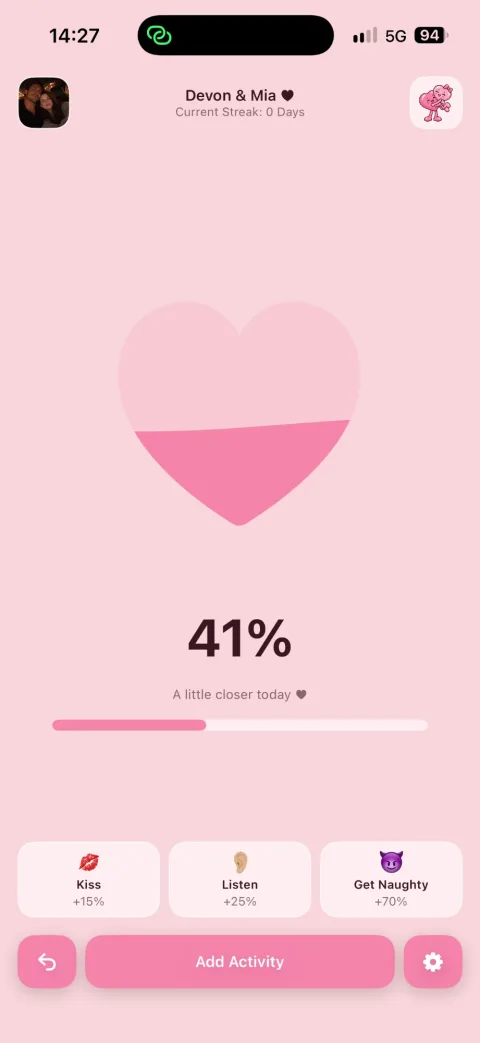
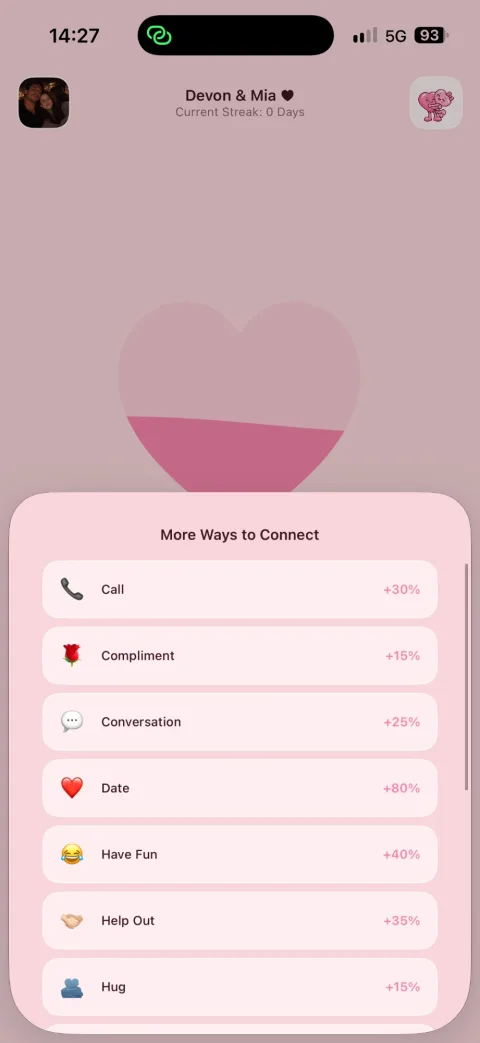
Buffaly is an iPhone app for couples who are already together, built around exactly these small moments. You connect with a 4-character code and share one heart. Hug, Kiss and Compliment each add 15 percentage points, a Conversation adds 25, a Date adds 80. The heart slowly empties, so it helps you keep topping up closeness instead of waiting for a big moment.
What Buffaly is not: it is not a quiz or content app, not a messaging app, and it does not share your location. It is an entertainment tool, not a medical, psychological or counselling service. The download is free and your first action is free. Then there is a 7-day free trial, then EUR 4.99 per month or EUR 29.99 per year for both partners. It needs an iPhone with iOS 17 or later; there is no Android version yet.

Frequently asked questions
How do you reconnect with your partner after drifting apart?
Start small: greet each other properly, talk about something other than logistics, protect one evening a week and say what you appreciate. Regular small steps usually work better than one big gesture.
How long does it take to rekindle a relationship?
There is no fixed timeline. It depends on the couple and on what caused the distance. Small, regular habits tend to show up in everyday moods first, such as more eye contact and more jokes, before bigger things change. A four-week plan is a reasonable first test.
How do I bring this up without starting a fight?
Choose a calm moment and start with warmth, then name what you miss rather than what they do wrong: "I miss us having evenings together" instead of "you never". Offer one specific thing you would like to try and then listen.
What if my partner does not want to reconnect?
You cannot force closeness. Ask without pressure what is going on for them, keep offering small, easy moments, and look after your own wellbeing. If they stay closed off, a licensed couples therapist or an individual therapist can help you work out the next step.
How do we reconnect after a fight or a rough patch?
Repair first: a sincere apology or acknowledgement of how the other felt. Then do something easy and pleasant together, like a meal or a walk, so the relationship feels bigger than the argument. If the same fight keeps returning, consider a couples therapist.
How do we reconnect after having a baby?
Lower the bar and keep it small: a few minutes of sitting together, a thank-you, a shared joke. Talk about who does what when you are both calm, not in the middle of the night. If either of you feels persistently low or anxious, please speak to a doctor or midwife.
When should we see a couples therapist?
If you keep having the same argument, if there is hurt or distrust you cannot talk about, or if you feel stuck after trying. A licensed couples therapist can help.
Can an app help us reconnect?
An app can remind you to make small moments happen. It cannot replace talking, time together or professional help. Buffaly is an entertainment tool, not a counselling service.