
Home › Blog › Relationship check-in questions
Relationship check-in questions: 25 questions for a short weekly talk
A relationship check-in is a short, regular talk where you ask each other how things are going, before small problems grow. It is not a fight and not a performance review. It is fifteen minutes, once a week, with a few good questions. Here is how to run one, a word-for-word 15-minute script, a monthly and a long-distance version, and 25 relationship check-in questions to choose from. Everything below is practical opinion from us, not research and not therapy.
How to run a 15-minute check-in
- Pick a calm time. Not in bed, not when one of you is hungry or leaving. A walk or a Sunday coffee works well.
- Start with appreciation. Each of you names one thing you valued this week.
- Ask two or three questions from the list below. Do not try to do all of them.
- Listen first. Repeat what you heard before you answer.
- End with one small action. One thing each of you will try next week.
A sample 15-minute script
If you have never done this, a time frame helps more than good questions. Set a timer on your phone and use something like this:
- Minutes 0-2: appreciation. Each of you finishes the sentence "This week I was glad that you...". Be specific. "You picked up the dry cleaning without me asking" beats "You are great".
- Minutes 2-5: how are you, really? One question from "Feeling and connection", for example the 1-10 connection score. Whoever answers first, the other only listens and then says back what they heard: "So it was a 6 because we barely talked on Wednesday?"
- Minutes 5-10: one practical topic. One question from "Daily life and teamwork" or "Needs and stress". Only one. If it turns into a bigger topic, write it down for a separate talk.
- Minutes 10-13: something light. One question from "Fun and closeness". This keeps the check-in from feeling like a meeting.
- Minutes 13-15: one small action each. "Next week I will try to put my phone away during dinner." Small and concrete, not "be better".
When the timer rings, you can stop. Ending on time is part of what makes the next check-in easier to agree to.
A monthly version for a deeper talk
Some couples like one weekly check-in kept very light and one longer talk per month, around 30 to 45 minutes. A monthly version can look back and ahead: what was the best part of the last month, what was the hardest, did the small actions from the weekly check-ins actually happen, and what is coming up (travel, family visits, money, a busy period at work)? The questions in "Needs and stress" and "Looking ahead" suit this slot. Take the longer talk somewhere you both feel relaxed, and keep the hard topic to one per session.
If you are busy parents
With small children, "a calm quiet hour" may not exist. Lower the bar instead of skipping it: ten minutes after the kids are asleep, or a walk with the stroller, or a talk in the car while one of you drives. Pick two questions only, for example "What is taking more of your energy than it should?" and "What would make next week easier for you?". Agree in advance that the check-in is not the place to settle who did more this week. Its job is to find one thing that makes the coming week a little lighter for both of you.
If you are in a long-distance relationship
Distance changes the questions, not the idea. Book the check-in like a date, as a video call or a plain voice call, at a time that works in both time zones, and keep your phone on the table, not in your hand. Questions that fit well: "Did you feel in touch enough with me this week?", "Is there a day this week when you would have liked to hear from me more?", "What is one thing about the next visit you are looking forward to?" and "Is anything about our schedule making you feel like an afterthought?". Ask about the rhythm of contact itself, since that is often where long-distance couples quietly drift apart. Our post on apps for long-distance couples covers tools that can help.
Why a regular check-in can help
Most couples only talk about the relationship when something has already gone wrong. By then, both people are tense, and a small thing has often grown into a pattern. A regular check-in turns that around: because it happens when things are fine, it is easier to say small things early ("I felt a bit left out on Saturday") before they turn into big ones ("You never include me"). It also gives good things a place. Hearing "I noticed that, thank you" once a week is its own reward. We cannot promise results, and every couple is different, but short and regular is, in our opinion, the part that matters most.
Feeling and connection
- How connected did you feel to me this week, from 1 to 10?
- What moment this week made you feel closest to me?
- Was there a moment you felt alone or ignored?
- What is one thing I did this week that you appreciated?
- Is there something small I could do that would make you feel more loved?
- Did we have enough time together, just the two of us?
Daily life and teamwork
- Does the load at home feel fair to you right now?
- What is taking more of your energy than it should?
- Is there something I am doing that adds to your stress?
- What is one thing we could simplify this week?
- Do you feel supported in what you are working on?
- Is there anything coming up that we should plan together?
Needs and stress
- What do you need more of right now: time, help, space or attention?
- What do you need less of?
- Is there something on your mind you have not told me yet?
- How are you sleeping, eating and looking after yourself?
- Is there something I said or did that is still bothering you?
- What would make next week easier for you?
Fun and closeness
- When did we last laugh properly together?
- What would you like us to do together this weekend?
- Is there something new you would like us to try?
- Do you feel like we are keeping the romance alive in a way that works for you?
Looking ahead
- What is one thing we are doing well that we should keep?
- What is one thing you would like us to change?
- What is one thing each of us can try this coming week?
How to answer so the talk stays kind
The same question can open a talk or start a fight, depending on the answer. A few small habits help:
- Start from your own experience. "I felt alone on Thursday when we both stayed on our phones" is easier to hear than "You are always on your phone".
- Name the need, not just the problem. "I would like ten minutes with just you after work" gives your partner something they can actually do.
- Say it back before you answer. "What I hear is that the evenings feel rushed to you. Is that right?" Even when you disagree, this slows things down.
- Say thanks for hard answers. "Thank you for telling me" costs nothing and makes it more likely your partner will be honest next week.
If you want more ideas for what to say, our list of questions to ask your partner goes beyond check-ins, and how to reconnect with your partner helps when you have drifted apart a bit.
Common check-in mistakes
- Doing it only when there is a problem. Then the check-in becomes the thing you dread. Keep it regular, even when everything is fine.
- Using it to win an old argument. Bring up what happened this week, not the last three years.
- Asking too many questions. Two or three is enough. A list of 25 is a menu, not a checklist.
- Fixing instead of listening. If your partner says they feel stressed, the first answer is not a solution. Ask "Do you want help with this, or do you want me to just listen?"
- Starting at a bad time. Right after work, in the middle of a task, or late at night when you are both tired rarely goes well. Agree a time in advance.
- Ending without an action. If nothing changes after the talk, the check-in starts to feel pointless. One small, concrete thing each is enough.
- Turning it into a performance review. Give feedback in both directions, and balance each hard point with something you appreciate.
- Skipping it for weeks and then doing a marathon. If you missed a few weeks, return to the short version. It will feel less heavy than a big catch-up.
After the check-in
The talk itself is the easy part. What makes it worth doing is what happens on the other days. Write the two small actions somewhere you both see them, for example a shared note or the fridge, and open the next check-in by asking how they went: "Last week you wanted to try phone-free dinners. How did that go?" A lighter follow-up in between helps too: a short message on Wednesday such as "Thinking of our check-in: I liked the walk we took tonight" keeps the good feeling going. For ideas that fit a small weekly action, see how to make your partner feel loved.
If a check-in gets tense
Stop and breathe. You can say "I want to hear this, and I need five minutes first." Do not bring up old arguments, and do not use the check-in to win a point. If you keep running into the same wall, a licensed couples therapist can help. A check-in is a habit, not a replacement for professional help.
A check-in is also not the right tool in every situation. If you feel afraid of your partner, are being controlled, belittled or threatened, or you do not feel safe being honest, do not use a check-in for this. Talk to a licensed professional or a trusted support service in your country instead. Questions like "What do you need?" only work when both people can answer without fear.
Where Buffaly fits
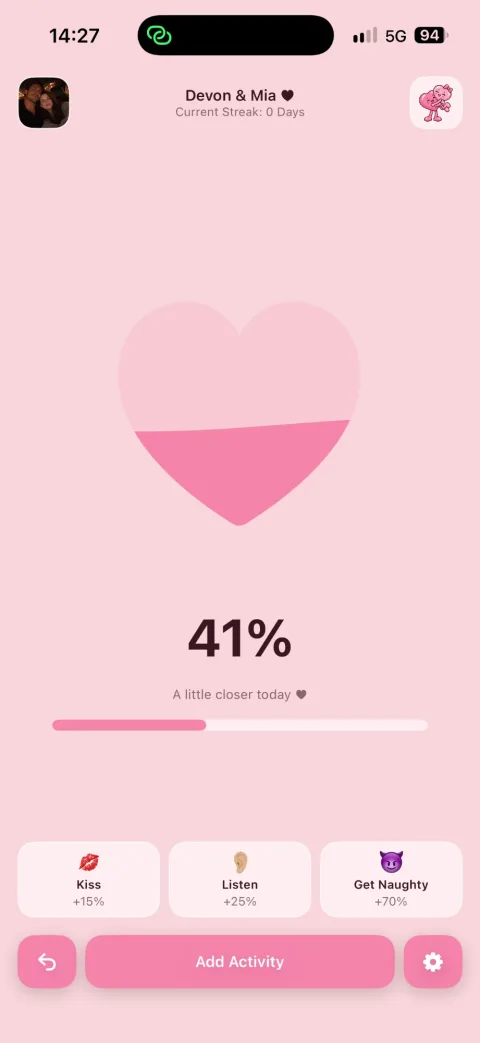
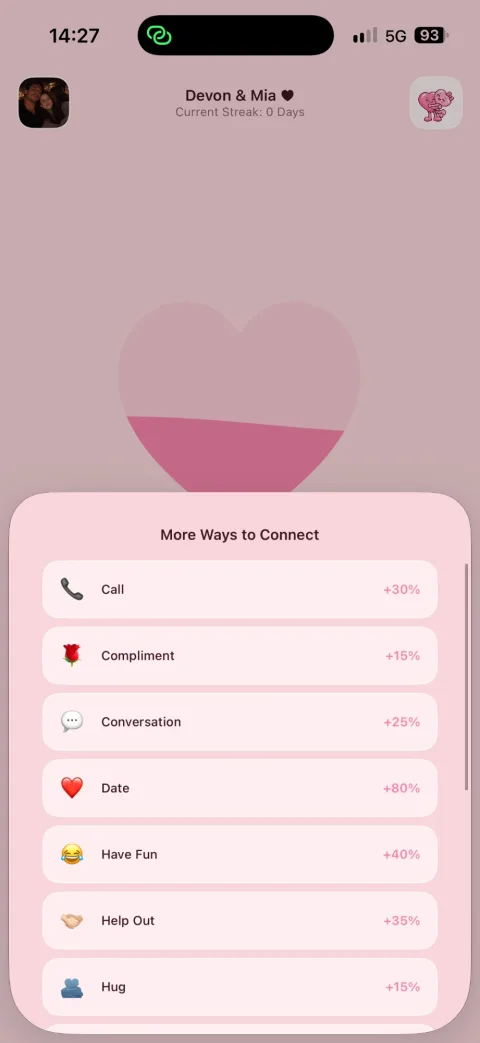
Buffaly does not run check-ins for you. It is an iPhone app for couples who are already together, with one shared heart that you both fill by logging real moments. A check-in fits in as a Conversation (+25 percentage points, lasting 24 hours) or a Listen (+25, 24 hours). Because the heart slowly empties, it also gives you a gentle reminder that it is time for the next one.
What Buffaly is not: it is not a quiz or content app, not a messaging app, and it does not share your location. It is an entertainment tool, not a medical, psychological or counselling service. The download is free and your first action is free. Then there is a 7-day free trial, then EUR 4.99 per month or EUR 29.99 per year for both partners. It needs an iPhone with iOS 17 or later; there is no Android version yet.

Frequently asked questions
How often should a couple do a relationship check-in?
Once a week for around fifteen minutes works for most couples. If that feels like too much, try every two weeks. A short regular check-in beats a long rare one.
How long should a relationship check-in take?
About fifteen minutes for a weekly one. A monthly version can run 30 to 45 minutes. Use a timer and stop when it rings, so the next check-in is easy to agree to.
What should we talk about in a relationship check-in?
Start with appreciation, then pick two or three questions about connection, daily life and needs. End with one small thing each of you will try next week.
How do I start a relationship check-in without it sounding serious?
Keep it light: "Want to do our weekly check-in over coffee? Fifteen minutes, and I will start with something I appreciated." Starting with a compliment, and picking a walk or a coffee instead of a sit-down talk, makes it feel less like a meeting.
What if my partner does not want to do check-ins?
Keep it short and light, ask for fifteen minutes just once, and start with appreciation. Make it a walk or a coffee rather than a formal talk. Ask what would make it feel comfortable instead of pushing the format. If they still do not want to, that is worth talking about gently, and a licensed couples therapist can help if it stays stuck.
Are relationship check-ins good for a new relationship, or only for long-term couples?
Both. In a new relationship, a check-in can be as simple as asking how things are going and what each of you enjoyed. In a long relationship, it helps keep routine from quietly taking over. Adjust the questions to where you are, not the habit.
Is a relationship check-in the same as couples therapy?
No. A check-in is a short, regular habit you do on your own. Therapy is guided by a trained professional. If you are stuck, a licensed couples therapist can help.
Does Buffaly include check-in questions?
No. Buffaly is not a quiz or content app. You can log a Conversation or Listen after your check-in so the shared heart reflects that you made time.