
Home › Blog › How to apologize
How to apologize to your partner: 6 steps that sound sincere
Everyone gets it wrong sometimes. You say something sharp, you forget something that mattered, you let your partner down, or you do something that actually hurts. What happens next matters more than the mistake. A good apology can repair trust. A bad one can make things worse than the original problem.
This guide shows you how to apologize to your partner in six steps, with examples you can adapt, a list of phrases to avoid, scripts for common situations and advice on how to follow up. It is general relationship advice from us, not therapy. If a conflict involves repeated harm, fear, control or abuse, an apology is not the main thing you need. Talk to a licensed professional or a support service.
Why a good apology matters
An apology does three jobs. It tells your partner that you understand what happened. It tells them that you take responsibility. And it tells them that you want to do better. When any of the three is missing, the apology feels empty.
Many apologies fail because they focus on the person apologizing. "I am sorry you feel that way" shifts the problem onto the other person's feelings. "I am sorry, but you also..." turns the apology into an argument. A good apology is about the other person's experience, not your defence.
It also helps to know what an apology cannot do. It cannot erase what happened, and it cannot demand forgiveness. Forgiveness takes the time it takes. Your job is to be honest and to act differently, not to be forgiven on schedule.
The six steps
1. Wait until you are calm, but not too long
Apologizing in the middle of a heated argument often fails, because both of you are still defending. Take a break if you need one, and say so: "I need twenty minutes, and then I want to talk about this properly." Come back at the time you said. Waiting days makes it look like you do not care.
2. Name what you did, specifically
A vague apology feels cheap. "I am sorry for everything" does not show you know what went wrong. Say the actual thing: "I am sorry I forgot your appointment" or "I am sorry I raised my voice and called you lazy." Specific words show you listened and thought.
3. Acknowledge the effect on them
This is where many apologies stop short. Say what you think the effect was: "I can see that made you feel unimportant" or "That must have been embarrassing in front of your friends." If you are not sure, ask: "How did that land for you?" Then listen without correcting.
4. Take responsibility without excuses
Own it. "I did that, and it was not okay." Leave out "but" and "if". You can explain the background later if it helps, but only after the apology has landed and only if your partner wants to hear it. An explanation is not the same as an excuse, but it often sounds like one in the first minute.
5. Say what you will do differently
A promise to do better is only useful if it is specific and realistic. "I will put the dates in the shared calendar" is better than "I will try harder". Do not promise things you cannot keep. A smaller promise you keep is worth more than a big one you break.
6. Ask what they need, and give them time
Close with an open question: "Is there anything else you need from me?" or "What would help right now?" Then be prepared for silence, tears, anger or a request for space. Do not press for forgiveness. "Thank you for listening" is a good place to stop.
What a sincere apology sounds like
Here are a few examples you can adapt. Use your own words, because a script read out loud sounds like a script.
- "I am sorry I did not call when I said I would. I know you were waiting, and I made you feel like you were not a priority. I will text you if my plans change."
- "I am sorry I said that about your job. It was unkind and it was not true. I should have kept my frustration to myself."
- "I am sorry I forgot our anniversary. I can see it hurt you. I have put it in my calendar with two reminders."
- "I am sorry I looked at my phone while you were telling me about your day. You deserved my attention."
- "I am sorry I raised my voice. That is not how I want to talk to you."
Phrases that ruin an apology
- "I am sorry you feel that way." It apologizes for their feelings, not your behaviour.
- "I am sorry, but..." Everything before "but" disappears.
- "If I hurt you, I am sorry." The "if" questions whether you did.
- "I said sorry already." It rushes the other person.
- "You are too sensitive." It blames the person who was hurt.
- "Everyone does it." It shrinks what happened.
- "I was just joking." It blames the other person for not finding it funny.
- "Can we move on?" It puts your discomfort first.
Apologies for common situations
After an argument
Say what part of the argument was yours. "I am sorry I interrupted you and did not let you finish. I want to hear what you were going to say." You do not have to apologize for your opinion, only for how you treated your partner.
After forgetting something important
Skip the excuses and go straight to repair. "I am sorry I forgot. I know it mattered to you. Can I make it up to you this weekend?" Then do it.
After saying something hurtful
Repeat what you said, not a softened version. "I called you selfish, and that was cruel." Do not repeat it in a way that hurts again. Then explain how you will handle frustration next time.
After being late or unreliable
Be clear about what you will change. "I have set an alarm and I will leave earlier." If the pattern continues, an apology is not enough. Change the behaviour.
After a bigger breach of trust
If the issue is serious, such as a lie, secrecy or betrayal, a short apology is only a start. It may take many conversations. Be open, answer questions honestly and do not demand quick forgiveness. Our guide to how to rebuild trust in a relationship goes into more depth. A licensed couples therapist can also help if you are stuck.
Apologizing in writing
Sometimes you cannot talk right away: your partner is away, the moment is too raw, or you simply find it easier to think on paper. A written apology can work if you treat it like a spoken one.
- Use the same six steps. Name what you did, the effect, your responsibility and your change.
- Keep it short. A few clear paragraphs are better than a long essay.
- Do not hide behind it. Offer to talk in person as soon as they are ready.
- Read it aloud before you send it. If it sounds defensive or dramatic, rewrite it.
- Do not expect an instant answer. Let them read it in their own time.
What to do after the apology
Words are the first half. The second half is what you do over the following days and weeks.
- Do the thing you said you would do. Quietly, without asking for credit.
- Listen when they want to talk about it again. Some people need to return to the subject more than once.
- Do not bring it up as a bargaining chip. "I apologized, so you should..." undoes it.
- Show care in small ways. Take over a chore, bring tea, give a hug if they want one, plan something simple together.
- Notice patterns. If you keep apologizing for the same thing, the apology is not the problem.
For more ideas on being a considerate partner, see how to be a good boyfriend, how to be a good girlfriend and how to fix a relationship.
When your partner is not ready to accept it
Sometimes you do everything right and your partner still needs time. That is not a sign that the apology failed. People process at different speeds.
- Do not repeat the apology over and over. One clear apology, repeated through action, is enough.
- Respect their space. Ask when it would be good to talk again.
- Stay consistent. Keep doing what you said you would do.
- Look after yourself. Guilt can be heavy. Talk to a friend or write down your thoughts.
- Know the limit. If your partner repeatedly refuses to talk about a problem, a third person such as a counsellor may help.
When your partner owes you an apology
This works in both directions. If you are the one who was hurt, you may find it hard to ask. Try to be specific: "When you cancelled at the last minute, I felt like my time did not matter. I would like you to tell me earlier next time." Keep it about the behaviour, not the person. Give them the chance to respond. If they apologize, accept it as well as you can, and be honest about what you still need.
How to stop repeating the same mistake
An apology is stronger when it comes with a change. Ask yourself:
- What was I feeling or doing just before it happened? Tired, stressed, defensive?
- What small change would help? An earlier bedtime, a pause before replying, a reminder in your phone.
- Can I tell my partner my plan? It shows commitment and invites support.
- When will I check in on it? A short check after a week or a month helps.
For ideas on talking regularly, try our relationship check-in questions.
Where Buffaly fits
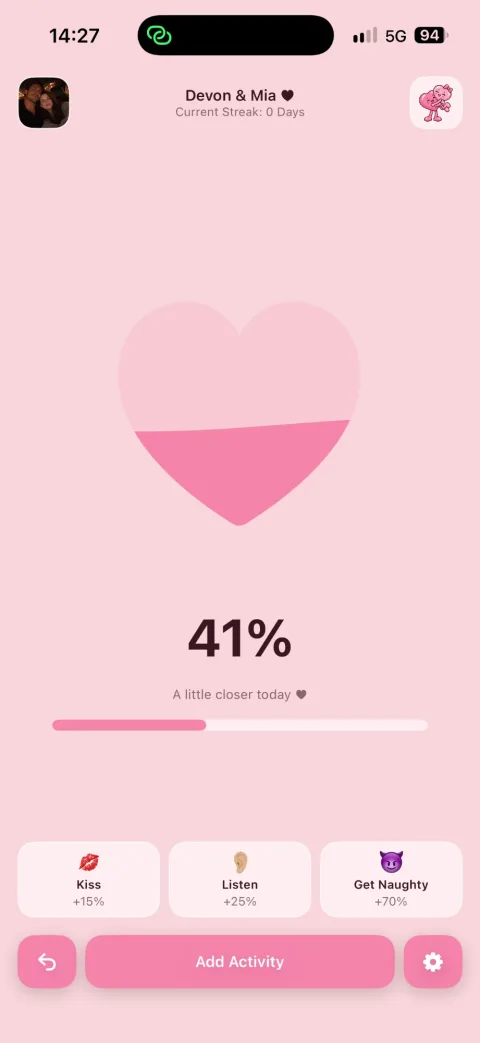
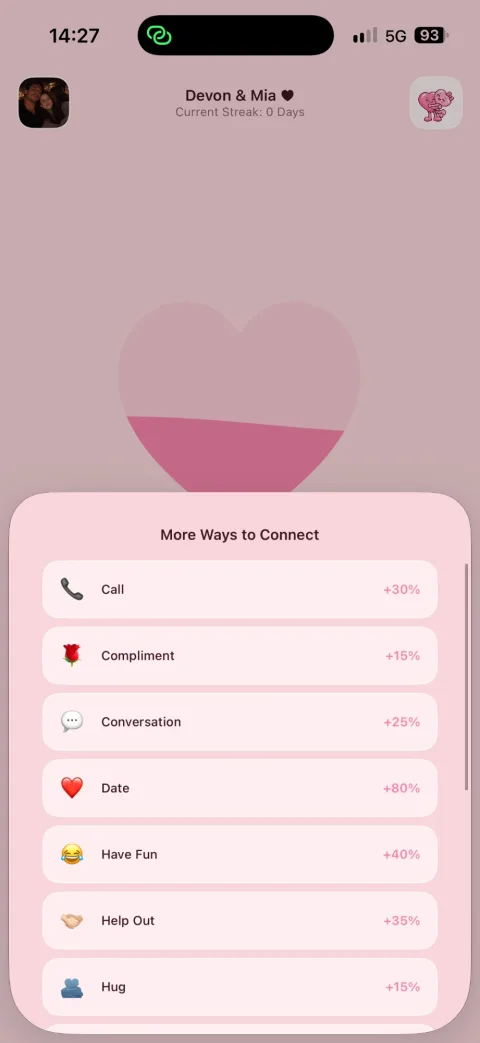
Buffaly is an iPhone app for couples who are already together. You connect with a 4-character code and share one heart. Buffaly cannot apologize for you, and logging an action is not an apology. After you have said sorry and meant it, small actions help show it over the following days: Listen adds 25 percentage points to the shared heart for 24 hours, Help Out adds 35 for 30 hours and Hug adds 15 for 18 hours. The heart slowly empties, so it shows when you last made time for each other.
What Buffaly is not: it is not a quiz or content app, not a messaging app, and it does not share your location. It is an entertainment tool, not a medical, psychological or counselling service. The download is free. Using Buffaly needs a subscription, and one subscription covers both partners; the price is shown in the App Store in your own currency before you subscribe. It needs an iPhone with iOS 17 or later; there is no Android version yet.
Frequently asked questions
How do you apologize to your partner?
Wait until you are calm, say exactly what you did, acknowledge how it affected them, take responsibility without excuses, say what you will do differently and ask what they need. Then give them time.
What should you say when you apologize?
Use your own words and be specific: "I am sorry I did X. I can see it made you feel Y. It was not okay, and I will do Z next time." Avoid adding "but" or "if".
What should you not say in an apology?
Avoid "I am sorry you feel that way", "I am sorry, but...", "If I hurt you", "You are too sensitive" and "Can we move on?". They shift the focus away from your behaviour.
What if my partner will not accept my apology?
Give them time and space. Say it once, clearly, and then show it through action. Do not repeat the apology over and over or demand forgiveness. If the issue stays stuck, a counsellor may help.
How do you make up after an argument?
Take a break if needed, then return to the conversation. Apologize for your part, listen to theirs and agree on one small change. Finish with something kind, such as a hug or a cup of tea, if they want it.
Is it okay to apologize with a text or a gift?
A short text can open the door, but a real apology works best in a calm conversation. A gift can show care but should not replace words or change in behaviour.
Can Buffaly apologize for me?
No. Buffaly cannot apologize for you, and logging an action is not an apology. After you have said sorry and meant it, small actions such as Listen, Help Out or Hug can show it in the following days.