
Home › Blog › How to rebuild trust in a relationship
How to rebuild trust in a relationship: 12 steps for both partners
Trust usually breaks in a moment and mends slowly. It may have been a lie, a secret, broken promises or something bigger. This guide gives 12 practical steps for both sides: the partner who broke the trust and the partner who was hurt. It is general information, not therapy, and it cannot promise a result. Whether trust comes back depends on both of you and on what happened.
What trust is, and why it takes time
Trust is the feeling that your partner will be honest with you, keep their word and treat your feelings with care. When it breaks, the hurt partner often feels unsafe, checks things they never used to check, or goes numb. The partner who caused it often feels guilty and wants it to be over quickly.
Those two speeds rarely match. That mismatch is normal, and it is the first thing to expect. Repair is not a single big talk. It is a long run of small, boring, reliable moments. This is our opinion from writing about relationships, not a scientific claim.
Before you start: safety first
If you feel afraid of your partner, are being controlled, threatened or hurt, this guide is not for you. Please contact a professional support service in your country. Rebuilding trust only works when both people are safe.
If you broke the trust
- Stop the behaviour and tell the truth. New lies or half-truths restart the clock. If there is more your partner will find out anyway, it is usually better that they hear it from you.
- Take responsibility without excuses. "I did this, it hurt you, and it was my choice" lands differently from "but you were also..." Explanations can come later, if your partner asks for them.
- Answer questions, even the repeated ones. Your partner may ask the same thing many times. That is how people process it, not an attack. Stay calm and answer honestly each time.
- Be predictable. Do what you said, when you said, and tell them if plans change. Reliability in small things is what slowly rebuilds belief in big things.
Do not demand forgiveness or a deadline. "Aren't we past this yet?" tells your partner that their pain is a problem for you.
If you were hurt
- Take the time you need. You do not owe anyone a quick recovery. It is fine to say "I am not ready to talk about this tonight".
- Say what would help, specifically. "I need you to text me when you are going to be late" is easier to act on than "I need you to be better". Ask for things that are reasonable and that the other person can do.
- Notice effort as well as words. Look for changed behaviour over weeks, not just apologies.
- Decide your own limits. You are allowed to ask for space, to say what you cannot accept, or to decide that you do not want to continue. Rebuilding trust is a choice, not a duty.
Constant checking, such as going through a phone or tracking location, may feel like the only way to feel safe for a short while. If you both agree to some transparency, make it temporary, clearly agreed and focused on getting back to normal. Surveillance without an end date tends to keep the hurt alive. That is our view, not a research finding.
Together: talk, repair, and give it time
- Set a regular time to talk. Agree on a short, scheduled conversation, rather than letting it erupt at 11 pm. A calm slot protects the rest of the week. Our relationship check-in questions can give the talk a shape.
- Listen to understand, not to win. Repeat back what you heard before you reply: "What I hear is that you felt invisible. Is that right?"
- Add good moments back in. Repair needs warmth as well as hard talks. Small, low-pressure time together, like a walk or a meal, shows the relationship is more than the problem. If it has gone quiet, see how to reconnect with your partner.
- Look at what led up to it. Sometimes the breach grew out of distance or unspoken needs. That never excuses it, but understanding it can help you prevent a repeat. If one of you has felt unseen for a while, our guide on feeling neglected in a relationship may help to name it.
Signs it may be working, and signs it is not
There is no checklist that proves trust is back, and no fixed timeline. These are things many couples look for. They are not a guarantee.
Signs of movement
- Questions get calmer over time, and the hurt partner has more good days than bad ones.
- The partner who broke trust stays honest, also when the truth is uncomfortable.
- You can talk about it without it taking over the whole evening.
- You laugh together again, and it feels real.
Signs you may be stuck
- The same breach keeps happening or new lies appear.
- One of you is doing all the repair work.
- Conversations end in contempt, silence or fear.
- You feel worse and more alone as the weeks go on.
When to get professional help
Consider a licensed couples therapist if the breach involved infidelity or repeated lies, if you keep having the same painful conversation, or if you cannot talk about it without it blowing up. A therapist can give structure that is hard to build alone. You can also see an individual therapist for your own feelings. If either of you feels hopeless or unsafe, please speak to a doctor or a professional support service. There is no shame in asking for help, and many couples do it before things get worse.
For wider ideas on mending a relationship that feels strained in several ways, read how to fix a relationship.
Where Buffaly fits
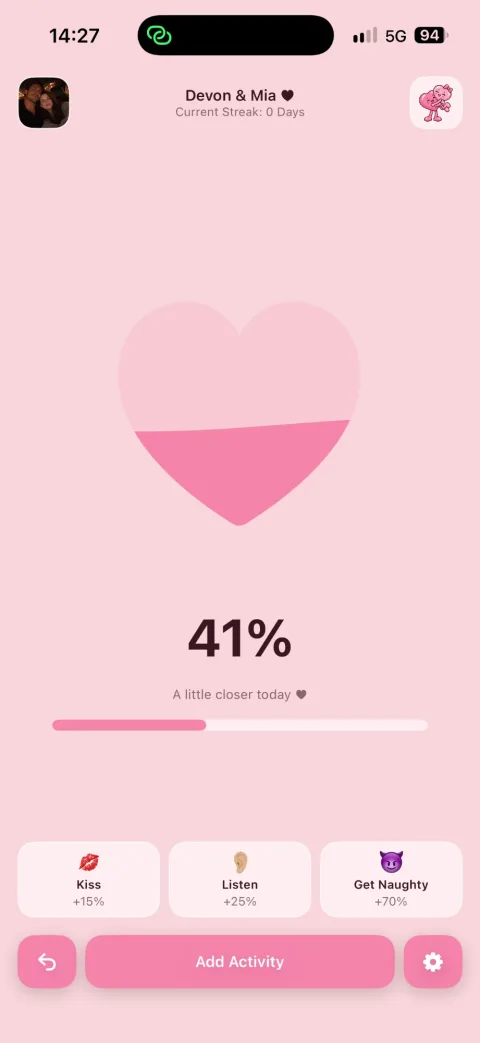
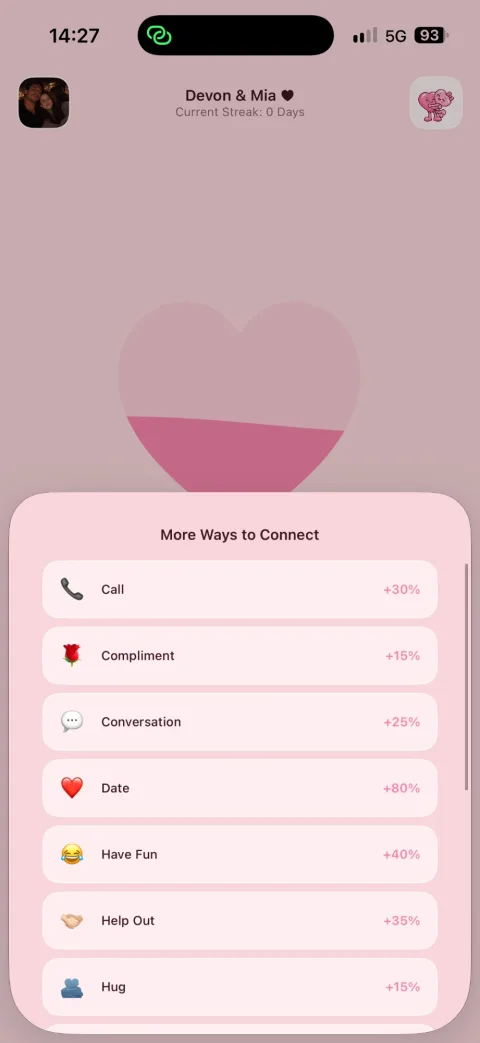
Buffaly is an iPhone app for couples who are already together. You connect with a 4-character code and share one heart. Hug, Kiss and Compliment each add 15 percentage points, a Conversation adds 25, a Date adds 80. The heart slowly empties, so it helps you keep topping up closeness instead of waiting for a big moment. It is built for everyday warmth, not for repairing a breach, and it is not a monitoring tool: it does not share your location. If you are both choosing to rebuild, small shared moments can be one gentle way to add good days back in. They do not replace honest conversations or professional help.
What Buffaly is not: it is not a quiz or content app, not a messaging app, and it does not share your location. It is an entertainment tool, not a medical, psychological or counselling service. The download is free and your first action is free. Then there is a 7-day free trial, then EUR 4.99 per month or EUR 29.99 per year for both partners. It needs an iPhone with iOS 17 or later; there is no Android version yet.

Frequently asked questions
How long does it take to rebuild trust in a relationship?
There is no fixed timeline. It depends on what happened, how honest both of you are now and how safe the hurt partner feels. Many couples find it takes months or longer, with good days and bad days. Rushing usually backfires.
Can a relationship recover after trust is broken?
Some do and some do not. It tends to help when the partner who broke trust takes responsibility, stays honest and is patient, and when the hurt partner chooses to try. Nobody can promise an outcome, and it is also valid to decide to leave.
What should I say to my partner to start rebuilding trust?
Keep it short and honest: say what you did or what you feel, say you understand it hurt, and ask what they need from you. Avoid excuses and avoid asking for forgiveness right away.
Is it normal to keep asking questions about what happened?
Yes. Repeated questions are a common way to process hurt. If you broke the trust, answering calmly and honestly each time helps. If you are the one asking, tell your partner what answers you still need so the talks do not go in circles.
Should I check my partner's phone or location?
Constant checking tends to keep the hurt alive. If you both agree on some temporary transparency, make it clear, time-limited and aimed at getting back to normal. If you feel you cannot stop checking, a therapist can help.
When should we see a couples therapist?
If the breach involved infidelity or repeated lies, if you keep having the same painful talk, or if you are stuck. A licensed couples therapist can help structure the process.
Can an app help rebuild trust?
Not by itself. An app can nudge small, warm moments, but trust is rebuilt through honesty, changed behaviour and time. Buffaly is an entertainment tool, not a counselling service.