
Home › Blog › How to make your partner feel loved
How to make your partner feel loved: 15 simple ways
You can love someone deeply and still not make them feel loved. The difference is often small: what you do and say, and whether it lands the way you meant it. Here are 15 simple ways to make your partner feel loved, in four groups, and an easy way to find out which ones matter most to them.
First: find out what works for them
People feel loved in different ways. Some need words, some need help, some need time, some need touch. A popular way to think about this is the five love languages (words of affirmation, acts of service, receiving gifts, quality time and physical touch). It is a handy starting point, but you do not need a quiz, and nobody fits one box perfectly. Just ask.
How to ask without making it weird
Pick a relaxed moment, not an argument and not 11 pm on a Tuesday. Then try one of these:
- "When do you feel most loved by me? I would like to do more of it."
- "What is one small thing I could do more often that would make your week easier?"
- "Think of a time you felt really looked after. What happened?"
Then listen to the answer, even when it is not what you expected. If your partner says "when you put your phone away", the right reply is not "but I do that". It is "okay, I will try". The questions to ask your partner list has more openers if you want to go deeper.
Or watch for what they do for you
This one is an opinion, not a rule: people often show love the way they would like to receive it. If your partner is always sending you articles, remembering your appointments or touching your arm when they walk past, that may be the language they hope you will speak back.
With words
- Say "thank you" for the small things, and say what exactly you are thankful for.
- Give a specific compliment about something they did, not only how they look. Our compliment ideas can help.
- Tell them what you admire about them when they are not in the room, and then tell them that you did.
- Send a message in the middle of the day just to say you are thinking of them.
What this sounds like
- Instead of "thanks for dinner": "Thanks for cooking tonight. You knew I had a rough day and made the thing I like."
- Instead of "you look nice": "I like how calm you were with your boss today. I would have lost it."
- Instead of "love you" on autopilot: "I was thinking about how you always make the first coffee. It is a small thing and I notice it."
- A midday text: "No reason. I just like being with you."
The pattern is simple: name the thing, name the effect on you. Specific beats big. And if you tell a friend something nice about your partner, say it to your partner too.
With actions
- Take a task off their plate before they ask.
- Do the thing they dislike doing, without making a point of it.
- Remember something small they mentioned and follow up on it.
- Leave a surprise: a note, a favourite snack, a small present for no reason.
What this looks like
- You know they have a dentist appointment they dread. You ask in the evening how it went, and you have already made tea.
- You notice the bins, the laundry or the booking they always handle, and you just do it this week. No announcement, no "you owe me".
- They mentioned a book, a band or a tricky coworker once. A week later you say "did you ever try that thing?"
- A small present does not need money. A drawn note on the mirror or their favourite chocolate from the corner shop works.
One rule: help in the way they want it, not the way you would want it. If you reorganise their kitchen without asking, it may feel like criticism rather than love. When in doubt, ask "would it help if I took over X?"
With time and attention
- Put your phone away when they are talking to you.
- Ask a real question and follow up on the answer. Try our questions to ask your partner.
- Protect a regular evening for the two of you.
- Do something they love, even if it is not your thing.
What this looks like
- Ten minutes, phone in another room, you ask "what was the best and worst part of your day?" and you do not fix anything unless they ask you to.
- A weekly evening that is protected the way you would protect a meeting. It can be at home; see our date night ideas at home.
- You go to their favourite film, walk or market, and you try to enjoy it from their side. They will notice the effort.
If time is short, shrink the format, not the attention. Five fully present minutes beat an hour of sitting next to each other on separate screens. If you want a regular talk about how things are going, a relationship check-in is a calm way to do it.
With touch
- Hug each other properly when one of you comes home.
- Hold hands or sit close when you are watching something.
- Give a shoulder rub or a kiss on the forehead when they are stressed.
What to keep in mind
Touch only works when it is welcome. Some people want a long hug after a bad day; others need a bit of space first. Read the moment, and ask if you are not sure: "Do you want a hug or do you want to be left alone for ten minutes?" is a perfectly good question. Both answers are fine, and being asked can feel like love in itself. For more on this, see how to be more affectionate.
A simple two-week experiment
Fifteen ideas are too many to start with. Try this instead:
- Ask your partner one of the questions above.
- Pick two things from the answer, and one from a group you would not usually choose.
- Do them for two weeks, without announcing it.
- Then ask: "Did you notice anything? What helped, and what was just noise?"
This is a casual experiment, not a test you can fail. The point is to learn something about each other, and to keep the habit if it works.
Common mistakes
- Loving them the way you want to be loved. A very practical person may not feel adored by a poem, and a romantic may not feel adored by a repaired shelf. Check what lands.
- Keeping score. "I did the dishes three times this week" turns a gift into a debt. If you feel the balance is off, say so in a conversation, not in a ledger.
- Big gestures, no everyday habits. A weekend away does not make up for months of distracted evenings. Small and regular tends to win.
- Doing it while distracted. A "love you" typed while half watching something else is still nice, but it does not replace attention.
- Using love as a tool. Affection given to avoid a hard conversation, or taken away as punishment, damages trust.
- Not saying it out loud. Many of us assume our partner knows. They often do not, or would like to hear it anyway.
- Giving up after two days. Habits feel awkward at first. Give each one a fair try.
When it feels one-sided
Do not wait for the other person to go first, and do not keep score. If you try these for a few weeks and your partner does not notice, tell them what you have been trying, and ask what would help. If you are the one who feels unloved, our guide to feeling neglected in a relationship may help, and if you feel you have drifted apart, see how to reconnect with your partner. If it keeps feeling one-sided, talk about it openly, or with a licensed couples therapist. If you ever feel unsafe or controlled in a relationship, that is not a communication problem, and you should talk to a professional or a support service in your area.
Where Buffaly fits
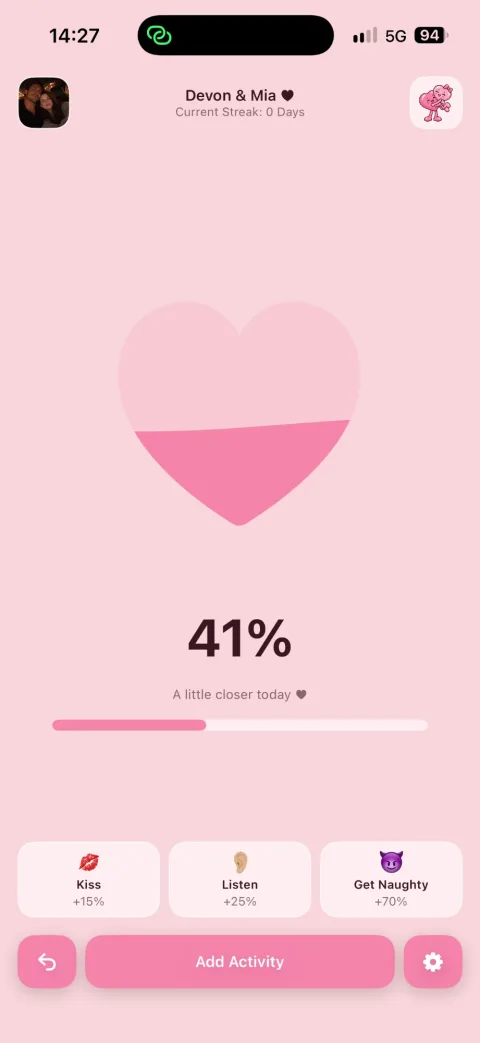
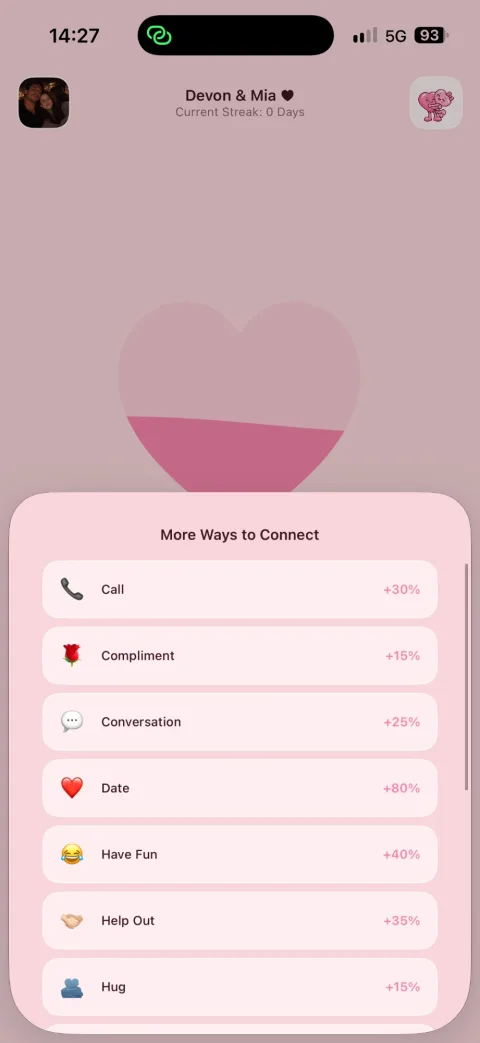
Buffaly is an iPhone app for couples who are already together. You share one heart, and either of you logs a real moment to fill it: Compliment, Hug, Kiss, Help Out, Little Surprise, Listen, Call, Date and more. Compliment, Hug and Kiss add 15 percentage points each, a Help Out or Little Surprise adds 35. It maps well onto these ideas, and the heart slowly empties, so it reminds you to keep doing the small things.
What Buffaly is not: it is not a quiz or content app, not a messaging app, and it does not share your location. It is an entertainment tool, not a medical, psychological or counselling service. The download is free and your first action is free. Then there is a 7-day free trial, then EUR 4.99 per month or EUR 29.99 per year for both partners. It needs an iPhone with iOS 17 or later; there is no Android version yet.

Frequently asked questions
How do I make my partner feel loved every day?
Pick one or two small habits: a specific thank you, a proper hug when you meet, a message in the middle of the day. Consistency matters more than size.
How do I know what makes my partner feel loved?
Ask them: "When do you feel most loved by me?" and "What is one small thing I could do more often?" Then try it for a few weeks and check in again.
What if my partner does not seem to notice?
Tell them what you have been trying and ask what would help. People often do not recognise a gesture that does not match how they feel loved.
What are small ways to show love?
A specific compliment, a note, taking a task off their plate, a long hug, a message in the middle of the day, or giving them your full attention for ten minutes.
How can I make my partner feel loved and appreciated?
Be specific. Instead of a general thank you, say what they did and what it meant to you. Appreciation sounds believable when it is concrete, and it is easy to do daily.
How can I make my partner feel loved over text or from a distance?
Send something specific rather than generic: a memory, a photo of something that reminded you of them, or a short voice message. Plan a call or a shared activity, and tell them what you are looking forward to next time you meet.
How do I make my partner feel loved again after a rough patch?
Start small and be consistent: listen without defending yourself, name what you will do differently, and show up in ordinary moments. If trust has been broken or you are stuck, a licensed couples therapist can help.
Do I need to know the five love languages?
No. They can be a useful starting point for a conversation, but you do not need a quiz. Asking your partner directly and noticing how they respond tells you more.
Can an app make my partner feel loved?
No app can do that for you. Buffaly is a tool that helps you remember to do the small things and shows you both when you last did.