
Home › Blog › How to set boundaries
How to set boundaries in a relationship: a practical guide with scripts
A boundary is a clear line about what you are comfortable with, what you need and how you want to be treated. In a relationship, boundaries are not walls to keep a partner out. They are the shape of a space where both of you can feel safe and respected.
Many people struggle with boundaries. They fear it will cause an argument, sound selfish or push their partner away. Others set them in anger and then drop them to keep the peace. This guide explains what boundaries are, the main types, how to find your own, how to say them without a fight, how to keep them, and what to do when they are crossed. It is general advice from us, not therapy. If your partner threatens, controls or hurts you, contact a local support service.
What a boundary is, and what it is not
A boundary is about your behaviour and what you will do. It is not an order to your partner.
- A boundary: "If you shout at me, I will leave the room and we can talk when we are both calm."
- A demand: "You are not allowed to shout at me."
The difference matters. You cannot control what another person does. You can decide what you will do in response. That is why a boundary has two parts: what you need, and what you will do if it is not respected.
A boundary is also not a punishment. It should not be said in anger, used as a threat or changed depending on your mood. A calm, consistent boundary is easier to understand and respect.
Why boundaries help a relationship
- They reduce resentment. Unspoken needs turn into quiet anger.
- They prevent burnout. You are not always giving more than you can.
- They build trust. Your partner knows where they stand.
- They support closeness. You can be open because you know you will not be overrun.
- They help each of you stay yourself. You keep your own friends, interests and values.
Types of boundaries
Emotional boundaries
How you share and handle feelings. For example: "I want to hear how you feel, but I cannot be your only support." Or: "I need a break when an argument becomes too heated."
Time and energy boundaries
How you spend your time. For example: "I need one evening a week to myself" or "I do not answer work messages after eight."
Physical boundaries
Touch, space and privacy. For example: "I would like to have a say about affection in front of other people." Consent matters in every area.
Digital boundaries
Phones, messages and social media. For example: "I do not want us to read each other's private messages" or "Please ask before you post photos of me."
Money boundaries
How you share, spend and discuss money. For example: "We agree before spending over a set amount."
Family and friends boundaries
How much time you spend with others, and how you handle opinions. For example: "I do not want our arguments shared with your family."
How to find your own boundaries
Many of us do not know our boundaries until they are crossed. A few questions can help.
- What makes me feel resentful, tired or tense? That feeling often points to a boundary.
- What do I wish I had said no to? Think of recent situations.
- What do I need to feel safe and respected? Time, privacy, honesty, calm?
- What are my non-negotiables, and what am I flexible about? Some boundaries are firm. Others are preferences.
- What would I tell a friend? If a friend described my situation, what would I suggest?
Write your answers in a few lines. You do not need a long list, just two or three that matter most.
How to say it: a simple formula
A short, calm structure works well.
When [specific situation], I feel [feeling]. I need [request]. If that is not possible, I will [your action].
Examples:
- "When plans change at the last minute, I feel unimportant. I need a message as soon as you know. If it keeps happening, I will make other plans for those evenings."
- "When you check my phone, I feel watched. I need us to trust each other with our privacy. If that does not feel possible, I would like us to talk to someone."
- "When we argue late at night, I feel exhausted. I need us to pause after ten and return to it the next day."
Tips for the conversation
- Choose a calm time. Not in the middle of a fight.
- Start with what you want. "I would like more time for myself" is easier to hear than a list of complaints.
- Be specific. "More respect" is vague. "Please do not interrupt me when I am speaking" is clear.
- Keep it short. One boundary at a time.
- Say it kindly and mean it. Your tone can be soft while your words stay clear.
- Do not over-explain. You can explain, but you do not need to defend or justify.
- Ask for their view. Boundaries are easier to keep when both people understand them.
How to keep a boundary
Setting it is the first step. Keeping it is harder.
- Follow through. If you said you would leave the room, leave the room.
- Be consistent. A boundary that changes with your mood confuses everyone.
- Do not apologize for having one. You can say "I am sorry this is hard to hear" without taking it back.
- Expect pushback. People often resist change at first. It does not mean you are wrong.
- Give feedback. "Thank you for waiting until I was calm" reinforces what works.
- Review it. Boundaries may shift as your life changes. Talk about them from time to time. Our relationship check-in questions can help.
What to do when a boundary is crossed
- Pause. Take a breath before you respond.
- Name it calmly. "That crossed the line we talked about."
- Repeat the boundary. "I need you to stop reading my messages."
- Follow through on your part. If you said you would leave the room, do it.
- Talk later. Once you are both calm, discuss what happened.
- Notice patterns. One slip is different from a repeated disregard. If it keeps happening after clear conversations, see our guide to red flags in a relationship.
Common situations and scripts
Your partner wants more time than you can give
"I love spending time with you, and I also need time alone to feel myself. Can we agree on two evenings a week together and one for each of us?"
Your partner is always on their phone
"I feel left out when we are together and you are on your phone. Can we put phones away during dinner?"
Your partner shares private things with others
"I would like to keep some things between us. Please ask before you tell others about our arguments."
Your partner makes jokes at your expense
"I know you mean it as a joke, but that one hurts. Please stop making it."
Your partner pressures you about sex or affection
"I want us to be close, and I need to feel free to say no without it becoming a problem. Can we talk about how to make that easier?" Consent is always required, and you never owe anyone intimacy.
Your partner criticises your friends or family
"I understand you have concerns, and I want to keep my relationships. Please do not tell me who I can see."
Boundaries in a long-distance relationship
Distance brings its own questions, and clear boundaries help.
- Call rhythm. Agree how often you talk, and what happens when one of you is busy. "I may not answer during work, and I will call back in the evening" prevents hurt feelings.
- Social media. Decide together what you share and what you do not.
- Visits. Talk about how often you meet, who travels and how you split the cost.
- Alone time. Needing a quiet evening does not mean you care less.
- Arguments over text. Agree to move heated topics to a call, or pause until you can speak.
See our guide to long-distance relationship questions for conversation starters.
When your partner sets a boundary with you
It is not only about your lines. When your partner says "I need some time alone this evening" or "Please do not bring that up in front of my family", it can feel like rejection. Try to hear it as information, not an attack.
- Listen first. Ask what they need and why.
- Do not argue about whether they should feel that way.
- Thank them for telling you. It takes courage.
- Say what you can offer. "I can give you the evening and we can talk tomorrow."
- Follow through. Respecting it once matters more than apologizing ten times.
If setting boundaries feels scary
It is common to feel guilty, anxious or selfish when you start. A few thoughts that may help.
- Boundaries are a form of care, for yourself and for the relationship.
- Start small. Practise with something low stakes.
- Rehearse. Say the words aloud or write them down first.
- Expect awkwardness. It gets easier.
- Get support. A friend or counsellor can help you practise.
- Notice who respects them. People who care about you will usually try to meet them, even if it takes time.
Boundaries are not the same as ultimatums
An ultimatum says "Do this or I will leave", often in anger and often as a way to force change. A boundary says "This is what I need, and this is what I will do." It leaves room for your partner's response. If your partner repeatedly ignores a clear, calm boundary about something that matters, you may need to make bigger choices. That is different from a threat made in a heated moment.
Healthy boundaries for both partners
Boundaries run in both directions. Ask your partner about theirs and listen. Respecting their limits builds the trust that makes it easier for yours to be respected. Our guides to how to be a better partner and feeling neglected in a relationship include more on balancing needs.
Where Buffaly fits
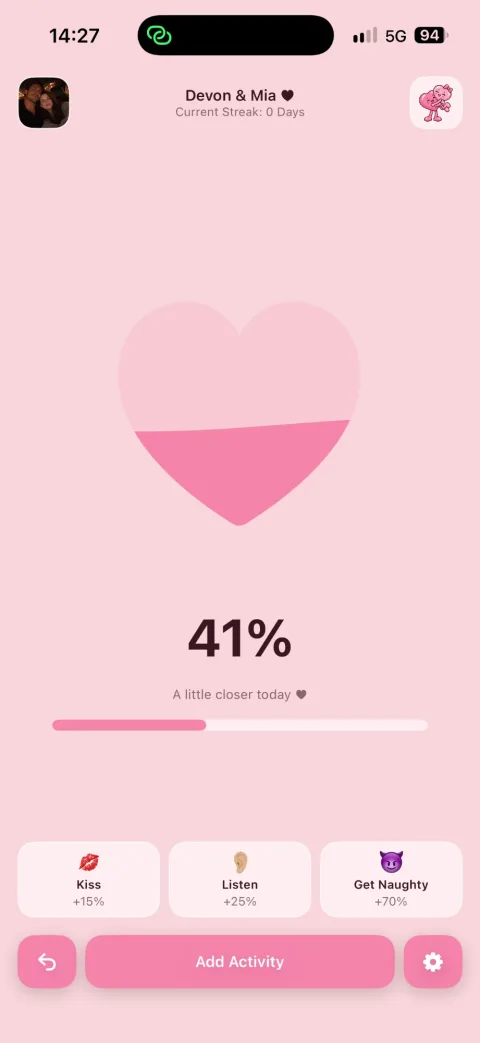
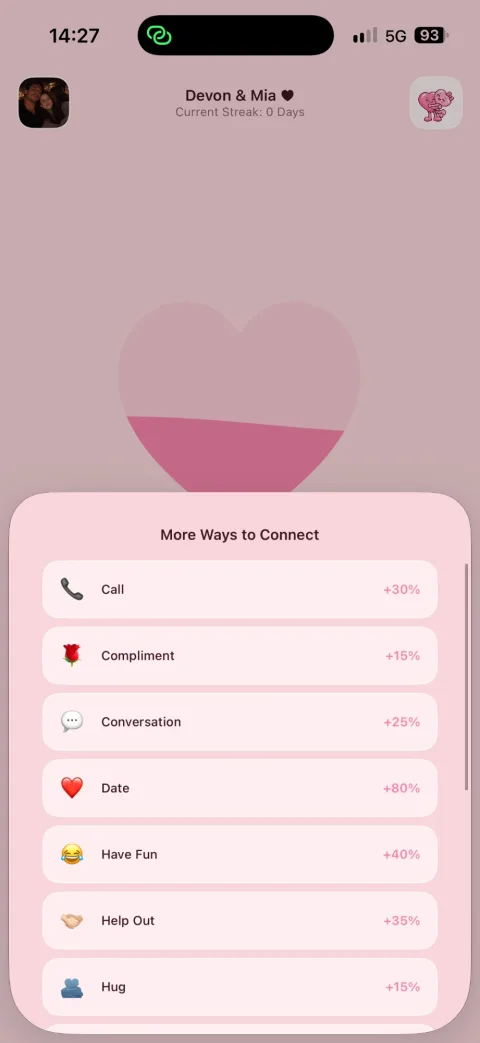
Buffaly is an iPhone app for couples who are already together. You connect with a 4-character code and share one heart. Buffaly does not set or enforce boundaries, and it is not a counselling tool. It is a light way to log small, real actions such as Conversation (+25 percentage points for 24 hours), Listen (+25 for 24 hours) and Help Out (+35 for 30 hours), so the shared heart shows when you last made time for each other. The heart slowly empties, so it is a reminder, not a judgement.
What Buffaly is not: it is not a quiz or content app, not a messaging app, and it does not share your location. It is an entertainment tool, not a medical, psychological or counselling service. The download is free. Using Buffaly needs a subscription, and one subscription covers both partners; the price is shown in the App Store in your own currency before you subscribe. It needs an iPhone with iOS 17 or later; there is no Android version yet.
Frequently asked questions
What are healthy boundaries in a relationship?
Healthy boundaries are clear, calm limits about your behaviour and needs, such as time alone, privacy, how you handle conflict and what you share with others. Both partners can have them and respect each other's.
How do you set boundaries with your partner?
Choose a calm moment and be specific: say when it happens, how you feel, what you need and what you will do if it is not possible. Follow through and keep it consistent.
What if my partner ignores my boundaries?
Name it calmly, repeat the boundary and follow through on your part. If it keeps happening after clear conversations, consider outside help and look at the pattern.
How do I set boundaries without hurting my partner?
Say it kindly and focus on what you need, not on blaming them. Explain once, ask for their view and avoid threats or anger.
Are boundaries selfish?
No. Boundaries protect your wellbeing and help a relationship by reducing resentment and building trust.
What are examples of boundaries in a relationship?
Time alone each week, privacy on phones, agreeing on money limits, taking a break during heated arguments and not sharing private arguments with family.
Can Buffaly help me set boundaries?
No. Buffaly does not set or enforce boundaries. It is a light way to log small actions with your partner so you both see when you last made time for each other.