
Home › Blog › Red flags in a relationship
Red flags in a relationship: 25 warning signs and what to do about them
A red flag is a warning sign: a behaviour or pattern that suggests a relationship may be unhealthy, unfair or unsafe. Some red flags are small and fixable if both people care. Others are serious, and the right response is to protect yourself.
This guide lists 25 red flags in a relationship, grouped by theme, with a short explanation of each. It also covers how to tell a red flag from a bad day, what to do if you spot one, how to talk about it and when to get outside help. This is general advice from us and not a diagnosis. If you ever feel afraid of your partner, or you are being hurt, controlled or threatened, please contact a local support service, a trusted person or the emergency number where you live.
Red flag or bad day?
Everyone has bad days. A partner who snaps after a hard shift, forgets a message or is moody once is not necessarily a red flag. What turns a behaviour into a flag is usually one of three things.
- Pattern. It happens again and again, not once.
- Impact. It makes you feel afraid, small, confused or constantly on guard.
- Response. When you raise it, you get defensiveness, blame or ridicule rather than a real conversation.
A good question to ask yourself is: "If a friend told me this about their relationship, what would I think?" We often see other people's situations more clearly than our own.
Communication red flags
- Stonewalling. One of you goes silent for hours or days instead of saying "I need a break and I will come back to this."
- Constant criticism. Everything you do is wrong or not enough, and comments are about who you are, not what happened.
- Contempt. Eye-rolling, mockery, name-calling, sarcasm that is meant to hurt. Contempt says "I am better than you."
- Never apologizing. Mistakes are always someone else's fault. Our guide to how to apologize shows what the alternative looks like.
- Defensiveness every time. You cannot raise a problem without it turning into an argument about you.
- Bringing up the past as a weapon. Old mistakes are used to win new arguments.
Trust and honesty red flags
- Lying about small things. If they lie about ordinary details, it is hard to trust them with bigger ones.
- Secrecy about phones, money or plans. Privacy is healthy. Hiding is different.
- Jealousy that turns into accusations. Feeling jealous sometimes is human. Accusing you, checking on you or punishing you is not.
- Constant checking. Reading messages, tracking your location or demanding passwords is a control issue, not a trust one.
- Breaking promises over and over. Once is a slip. A pattern is a signal.
Control and respect red flags
- Deciding who you see. A partner who isolates you from friends or family, or makes you feel guilty for seeing them, is limiting your support.
- Controlling money. Not allowing you to see, access or spend shared money fairly.
- Making decisions for you. What you wear, where you go, what you do.
- Ignoring boundaries. "No" is treated as a challenge or a negotiation. Our guide to setting boundaries explains how to say it.
- Ridiculing your goals. Making fun of your job, hobbies or dreams.
- Pressure about sex or intimacy. Guilt, sulking, threats or pushing after you have said no.
Emotional red flags
- Gaslighting. Telling you that you did not see what you saw or say what you said, until you doubt your own memory.
- Blaming you for their emotions. "You made me do it" or "If you loved me, you would not make me angry."
- Love bombing followed by withdrawal. Intense attention that swings suddenly to coldness, so you keep working to earn it back.
- Extreme mood swings that you have to manage around, and you feel you are walking on eggshells.
- No empathy. When you are hurt or sad, they are bored, irritated or turn it into a story about themselves.
Safety red flags
- Threats. Threats of harm to you, themselves, your pets or your property.
- Physical aggression. Pushing, grabbing, blocking a door, breaking things, hitting.
- Making you afraid. If you change your behaviour mainly to avoid their reaction, that is a serious sign.
If any of numbers 23 to 25 apply to you, please talk to someone you trust and contact a local support service or the emergency number where you live. This is not a problem to fix on your own with a better conversation.
Why some red flags are easy to miss
- They start small. One check of your phone, one comment about a friend. Each step feels minor.
- They come with kindness. Many people are warm and charming most of the time.
- We explain them away. "They are stressed", "they had a hard childhood", "they did not mean it".
- We compare ourselves with worse. "At least they never hit me" can hide how much you have accepted.
- We fear being alone. The wish to keep a relationship can push you to ignore signals.
- They are normal in our family or friends. If you grew up with it, it may feel like love.
What to do if you spot a red flag
- Name it to yourself. Write down what happened, when and how it made you feel. A short note is enough.
- Check the pattern. Is it once, sometimes or regularly? Is it getting better, worse or the same?
- Talk to someone you trust. A friend, a sibling or a counsellor. Say it out loud and listen to how it sounds.
- Raise it with your partner, if it is safe to do so. Pick a calm moment and use a specific example.
- Watch the response. A person who cares will listen, take responsibility and try to change. A person who minimizes, blames or punishes you is telling you something.
- Set a boundary and see if it is kept. Words matter less than behaviour over weeks.
- Decide what you need. More time, outside help or a break. You are allowed to choose, even if the answer is hard.
How to talk about it
The way you raise a concern matters. Keep it specific and calm.
- Use a recent example. "On Saturday, when you read my messages without asking, I felt watched."
- Say how it affects you. "I feel anxious when I have to explain who I am talking to."
- Say what you need. "I would like us to agree that we do not check each other's phones."
- Ask for their view. "How does this look from your side?"
- Do not do it in the middle of a fight. Pick a quieter moment.
If you do not feel safe having this conversation, do not have it alone. Talk to a support service first.
When a red flag can be worked on
Some red flags are habits rather than character, and a couple can improve them if both want to.
- Stonewalling can change if one person learns to say "I need a break and I will come back to this" and keeps the promise.
- Criticism can change if you swap complaints about the person for requests about the behaviour.
- Jealousy can change if the jealous partner takes responsibility for it and works on it, and the other partner offers reassurance without being controlled.
- Poor communication can change with practice. See our relationship check-in questions for a simple weekly habit.
A couples therapist can help if you are both willing. The important part is that both people are trying, and that you can see changes over time.
When to leave or get help
It may be time to step back or leave if:
- you are afraid of your partner,
- you are being controlled, threatened or hurt,
- the same problem returns after repeated honest conversations,
- you feel smaller, more anxious or more isolated than before the relationship,
- or your partner refuses to accept any responsibility.
Leaving is not a failure. If it is not safe to leave openly, a local domestic violence service can help you plan. If you are in immediate danger, call the emergency number where you live.
Checking your own behaviour
Reading a list of red flags makes it easy to think only about the other person. It is worth asking the same questions about yourself, calmly and without self-punishment.
- Do I go silent for days when I am upset, instead of saying I need a break?
- Do I check my partner's phone, location or messages?
- Do I bring up old mistakes to win an argument?
- Do I say things in anger that I would not say in a calm moment?
- Do I get defensive whenever my partner raises a concern?
If you recognise yourself in some of these, that is useful information, not a verdict. Habits can change when you notice them, say so to your partner and make a small, specific plan. A therapist or counsellor can help if the patterns are hard to shift on your own.
What a healthy relationship looks like by comparison
It helps to hold the opposite picture in mind. In a healthy relationship you can disagree and still feel respected. You can say no and not be punished. You have your own friends and interests. Mistakes are named and repaired. You feel more like yourself, not less. Our guide to signs of a healthy relationship lists 25 of them.
Where Buffaly fits
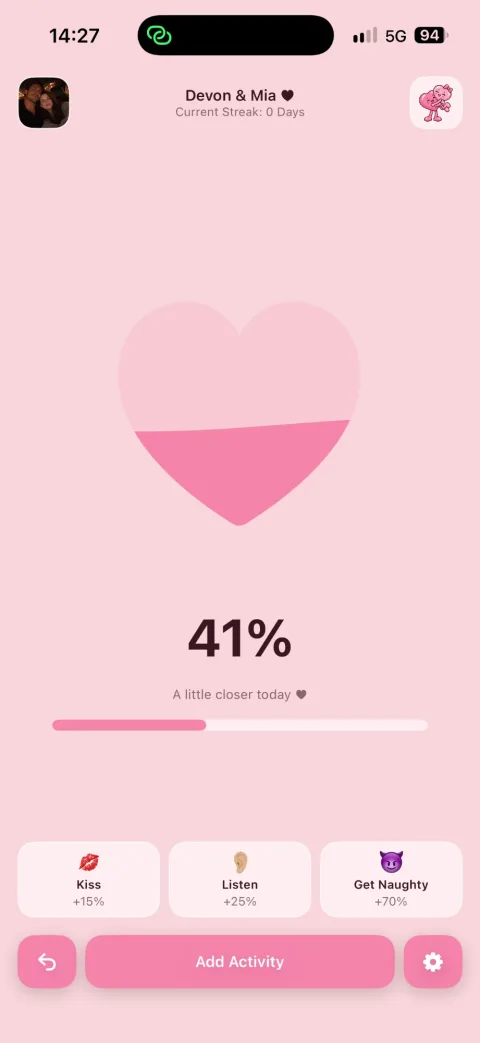
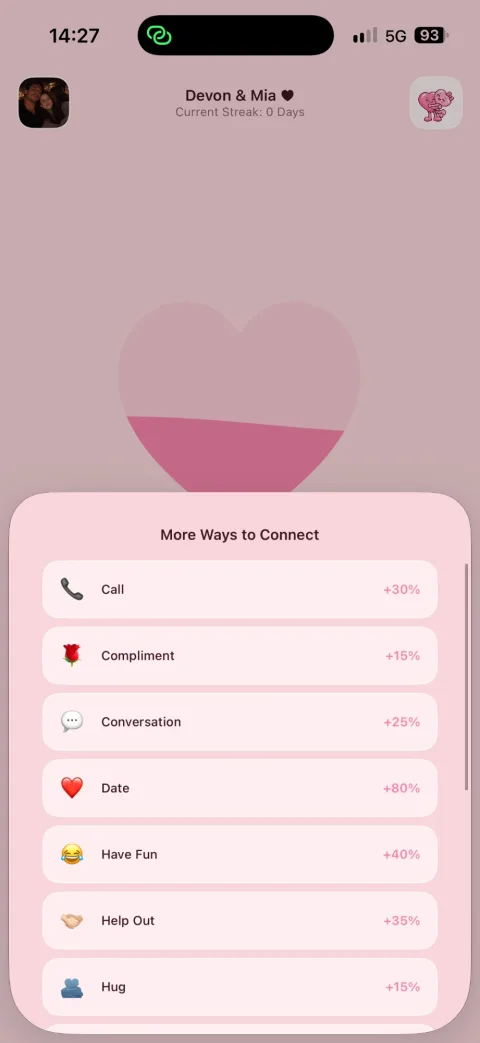
Buffaly is an iPhone app for couples who are already together. You connect with a 4-character code and share one heart. Buffaly cannot tell you whether your relationship is healthy, and it is not a diagnostic or counselling tool. It is a light way to log small, real actions such as Listen (+25 percentage points for 24 hours), Conversation (+25 for 24 hours) and Help Out (+35 for 30 hours), so the shared heart shows when you last made time for each other. If you are afraid of your partner, please contact a local support service rather than an app.
What Buffaly is not: it is not a quiz or content app, not a messaging app, and it does not share your location. It is an entertainment tool, not a medical, psychological or counselling service. The download is free. Using Buffaly needs a subscription, and one subscription covers both partners; the price is shown in the App Store in your own currency before you subscribe. It needs an iPhone with iOS 17 or later; there is no Android version yet.
Frequently asked questions
What are the biggest red flags in a relationship?
Threats, physical aggression, controlling who you see or what you spend, constant lying, contempt and making you afraid are among the most serious. Some of these call for outside help, not a better conversation.
What is the difference between a red flag and a normal problem?
A normal problem is occasional and gets resolved when you talk about it. A red flag is a repeating pattern, makes you feel afraid or small, or meets defensiveness or blame when you raise it.
Can a relationship with red flags be saved?
Some can, especially habits like stonewalling or criticism, if both partners take responsibility and change over time. Serious red flags like threats, control or violence are different, and your safety comes first.
What are red flags in the early stage of dating?
Pushing for fast commitment, lying about small things, ignoring your boundaries, jealousy, hot and cold behaviour and speaking badly about all their exes are common early signs.
What should I do if I notice a red flag?
Write down what happened, check whether it is a pattern, talk to someone you trust, raise it calmly with your partner if it is safe and watch how they respond over time.
Where can I get help if I am afraid of my partner?
Contact a local domestic violence support service, a trusted person or the emergency number where you live. Do not rely on an app.
Can Buffaly tell me if my relationship is healthy?
No. Buffaly is not a diagnostic or counselling tool. It is a light way to log small actions with your partner.