
Home › Blog › Signs of a healthy relationship
Signs of a healthy relationship: 25 things to look for
Most people have never been taught what a healthy relationship looks like; they learn from the couples around them, from films and from their own mistakes. This guide describes 25 signs of a healthy relationship in plain language, grouped by theme, plus a short list of warning signs and advice on when to seek help. It is a guide to reflect on, not a test or a diagnosis.
What "healthy" means
A healthy relationship is not a perfect one. Couples argue, get tired and sometimes feel distant. What makes a relationship healthy is how you treat each other and how you repair after trouble. In a healthy relationship, both people feel safe, respected and free to be themselves, and both feel they can say how they feel and be heard.
Healthy relationships also look different from couple to couple. Some are very close and talkative, others are calm and independent. The signs below are common to many, but your relationship may show them in its own way.
Respect and safety
- You feel safe, physically and emotionally.
- You can say no without fear.
- Your feelings are taken seriously, even when your partner disagrees.
- Neither of you uses insults, threats or humiliation.
- You respect each other's boundaries, body and privacy.
- You can disagree without being punished.
Safety comes first. If you ever feel afraid of your partner, that is a serious sign, and you can contact a professional support service. Our section on warning signs below has more.
Communication
- You can talk about difficult things, even if it is uncomfortable.
- You listen to each other without interrupting too often.
- You say what you need, kindly and clearly.
- You can say sorry and mean it.
- You check in regularly, not only when there is a problem.
- You can laugh about things together, including each other's quirks.
If you want a gentle structure for talking, try our relationship check-in questions or the questions to ask your partner.
Trust and honesty
- You trust each other with money, time and friends.
- You tell the truth, even when it is awkward.
- You keep your promises or explain why you cannot.
- You do not spy, check phones or demand passwords.
- You can talk about jealousy without it turning into control.
- When trust is broken, you work to repair it.
If trust has been hurt, our guide to how to rebuild trust in a relationship explains how it can be rebuilt.
Independence and support
- Each of you has friends, interests and time alone.
- You support each other's goals and celebrate successes.
- You do not feel you have to change who you are.
- Decisions are shared, with room for compromise.
- You can ask for help and give it.
A healthy couple is two whole people, not two halves. If you feel you have lost yourself, that deserves attention.
Fighting fairly and repairing
- Arguments stay about the issue, not about attacking the person.
- You can take a break when things get heated and come back.
- You do not use silence as punishment.
- After a fight, you reconnect with a hug, an apology or a conversation.
- Past mistakes are not used as weapons.
Every couple argues. The question is whether you can make up. Our guide on how to fix a relationship covers repair.
Warmth and fun
- You enjoy each other's company, even doing nothing.
- You still do small things to show love.
- You share jokes, rituals and memories.
- You are affectionate in ways you both like.
- You make time for each other despite busy lives.
For ideas to keep warmth alive, read how to be more affectionate and how to reconnect with your partner.
Warning signs to take seriously
- Constant criticism or contempt.
- Controlling behaviour, such as checking your phone, dictating who you see or controlling money.
- Threats, intimidation or violence.
- Being isolated from friends and family.
- Fear of your partner's reactions.
- Pressure into sex or other things you do not want.
- Repeated lies or betrayal without repair.
- Feeling worse about yourself most of the time.
If you recognise some of these, talk to someone you trust and consider contacting a professional support service. If you are in danger, contact your local emergency number.
When to get help
Seek help if you notice a pattern of hurt, if you cannot talk without fighting, or if you feel stuck. A licensed couples therapist can help you learn new ways to communicate. An individual therapist can help you understand your own patterns. Friends and family can support you too, but a professional offers a neutral space. Asking for help is a sign of care, not failure. If you feel unsafe, prioritise your safety and reach out to a trusted person or a support service.
How to check in on your own relationship
It can be hard to see a relationship clearly from the inside. A simple check-in can help. Choose a quiet time, perhaps once every few months, and ask yourself a few honest questions. Do I feel safe being myself? Do we laugh together? Do I feel heard? Do I trust my partner, and do they trust me? Can we disagree and still feel close? Do I feel better or worse about myself because of this relationship? Write your answers down, then notice patterns. A few "no" answers do not mean the relationship is doomed, but they point to something worth talking about.
You can also invite your partner to answer the same questions separately and compare. The point is not to score each other but to start a conversation. If you want ready-made prompts, our relationship check-in questions are designed for this. Keep the tone kind, listen first and decide together what you want to work on.
Small habits that keep a relationship healthy
- Say thank you daily. It is a small act that builds goodwill.
- Keep one regular date. Even a weekly walk or dinner protects your closeness.
- Check in weekly. Fifteen minutes about how things are going stops small problems growing.
- Be curious. Ask questions and learn something new about each other.
- Share the work. Chores, planning and care are shared fairly.
- Protect your own life. Keep friends, hobbies and time alone.
- Repair quickly. A prompt apology beats a long silence.
- Touch and affection. A hug at the door or a hand on the arm adds up.
None of these is dramatic. Healthy relationships are built from small things repeated over time. For concrete ideas, see how to be a better partner and how to make your partner feel loved.
Health looks different in different seasons
A relationship that is healthy during a calm year may be stretched by a new baby, a job loss, an illness, a move or grief. During those times, the signs may look different. You might have less time, less patience and less energy for fun. A healthy couple in a hard season keeps the basics: honesty, kindness, a willingness to say "I am struggling" and a willingness to listen. They lower expectations without lowering respect. They ask for help from friends, family or professionals when needed.
If you are in a hard season, give yourselves credit for getting through it, and make a plan to reconnect once it eases. Our guide on how to how to reconnect with your partner has simple steps for that.
When the signs are mixed
Real relationships are rarely all good or all bad. You may notice that some signs are strong and others are weak. Maybe you communicate well but struggle with fairness at home. Maybe you have fun together but do not feel safe expressing anger. Mixed signs are an invitation to work on specific areas. Pick one, such as fair chores or honest talk, and agree on a small change you will both try for a month. Check in afterwards. Often, improving one area lifts others. If the mix includes any of the serious warning signs listed above, treat those as the priority and seek support. For guidance on identifying the main problem, read how to fix a relationship.
A note on comparing your relationship to others
Social media and films present a polished version of love, and comparing yourself to them is rarely helpful. The couples you see online are choosing what to show, and every couple has hidden difficulties. The best comparison is to your own relationship a year ago. Is it kinder, closer and more honest than before? Are the arguments getting resolved more easily? Do you feel more yourself? If the answer is mostly yes, you are moving in a healthy direction, whatever anyone else is doing. If the answer is no, treat that as useful information and take a step. The signs in this guide are not a checklist to pass or fail; they are a mirror to help you see what matters to both of you.
Talking to your partner about what you notice
If you spot something that worries you, raise it gently and at a calm moment, not in the middle of an argument. Start with how you feel rather than what they did wrong: "I have been feeling a bit distant lately, and I would like us to spend more time together." Give them space to answer and listen to the whole reply. Ask what they are noticing too. If the conversation gets heated, pause and resume later. Aim for one small agreement, such as a weekly walk or a standing check-in, rather than solving everything at once. If you feel unable to raise the topic safely, that is information in itself, and a trusted friend or professional can help you think it through. Remember that a healthy relationship is not one without problems; it is one where problems can be named and worked on together, without fear.
Keeping the picture in proportion
It is easy to read a list like this and start finding fault. Try not to use it as a weapon or a scoreboard. Use it as a prompt for kindness. If you notice a weak area, ask yourself what you could do to improve it, before asking your partner to change. Small steps from both sides usually lead to more progress than a big confrontation. And celebrate what is working. Every sign that your relationship has, such as honest talk or shared laughter, is worth noticing and saying out loud.
Where Buffaly fits
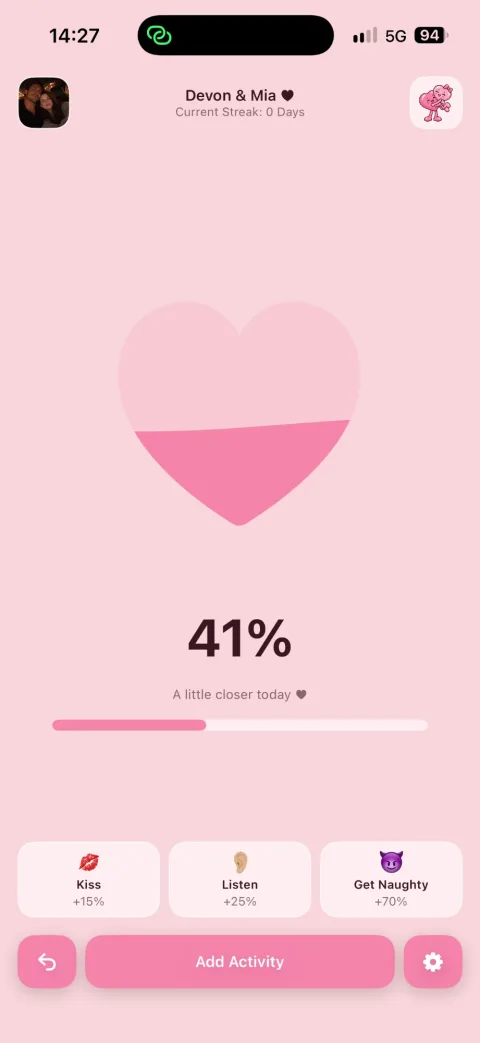
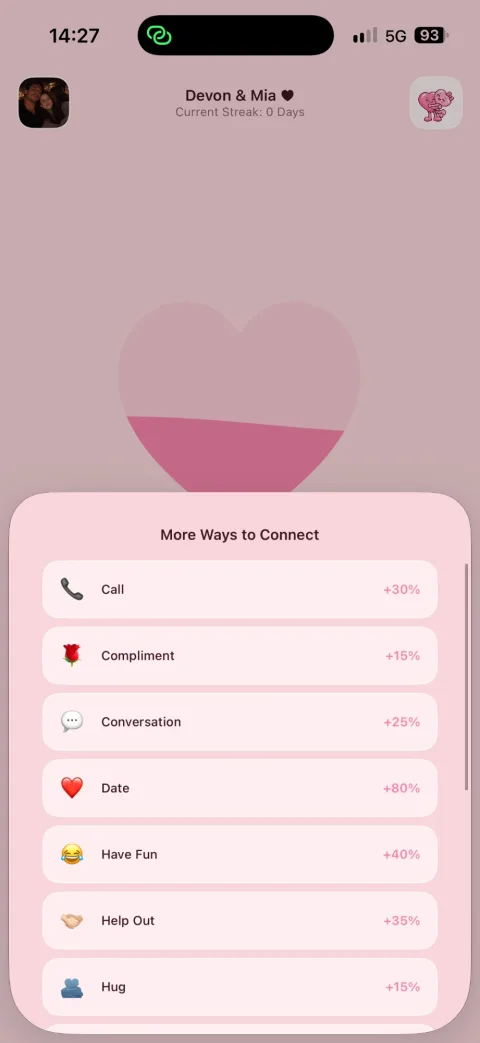
Buffaly is an entertainment tool, not a relationship test, but it can make small, regular moments of care easier to keep. Buffaly is an iPhone app for couples who are already together. You connect with a 4-character code and share one heart. Hug, Kiss and Compliment each add 15 percentage points, a Conversation adds 25, a Date adds 80. The heart slowly empties, so it helps you keep topping up closeness instead of waiting for a big moment. It is meant to make small moments easier to remember. It will not make a relationship good by itself.
What Buffaly is not: it is not a quiz or content app, not a messaging app, and it does not share your location. It is an entertainment tool, not a medical, psychological or counselling service. The download is free and your first action is free. Then there is a 7-day free trial, then EUR 4.99 per month or EUR 29.99 per year for both partners. It needs an iPhone with iOS 17 or later; there is no Android version yet.

Frequently asked questions
What are the signs of a healthy relationship?
Respect, safety, honest communication, trust, independence, fair fighting and warmth are common signs.
Is it normal to argue in a healthy relationship?
Yes. The difference is how you argue and whether you repair afterwards.
What are warning signs of an unhealthy relationship?
Control, threats, isolation, constant criticism, fear of your partner and repeated betrayal are serious warning signs.
Where can I get help?
A licensed couples therapist, an individual therapist or a professional support service. In danger, contact your local emergency number.
Can an app help?
Buffaly can remind you to make small moments happen. It is an entertainment tool, not a counselling service, and it works best alongside real talks and time together.