
Home › Blog › How long have we been together
How long have we been together? Count the days and milestones
It is easy to lose track of how long you have been together. Here is a quick way to work it out, a table of milestones in days and years, and a small idea for each one. If you also want a ready-made number for your phone, see our guide to the love counter.
Work it out in two minutes
- Pick a start date. Agree with your partner which one counts: first date, first kiss or the day you became official.
- Use a spreadsheet: put the date in cell A1 and type
=TODAY()-A1in B1. You get the number of days. - For years and months type
=DATEDIF(A1,TODAY(),"Y")and=DATEDIF(A1,TODAY(),"YM"). - No spreadsheet? Count the full years, add the months and days, or use any date-difference calculator website.
It does not matter which date you choose. It only matters that you choose the same one.
Milestones in days
| Days | Roughly | Idea |
|---|---|---|
| 100 | 3 months | Write each other one thing you have learned about the other. |
| 200 | 6 months and a bit | Recreate your first date. |
| 365 | 1 year | Swap letters about the year. |
| 500 | 1 year, 4 months | A small trip or a day out in a new place. |
| 1,000 | 2 years, 9 months | Write down your 10 favourite memories so far. |
Conversions are rough because months differ in length.
Anniversaries by year
Many couples celebrate on the date each year. Gift traditions differ by country, so follow what feels right for you. A card and an evening together always works.
What if we do not agree on the date?
It happens. One of you remembers the first message, the other the first kiss. Do not argue about it. Either celebrate both or pick one and move on. If it turns into a recurring fight about who remembers more, that may be about something else, and our relationship check-in questions can help you find out what.
Make the number mean something
- Mark milestones in a shared calendar.
- Ask each other one new question each time. Start with our questions to ask your partner.
- Keep a note on your phone for one memory per milestone.
- If you are apart, plan a call or a package. See apps for long-distance couples.
Why counting the days feels good
Counting days sounds silly until you do it. Then a small number turns into a story. "We have been together 412 days" means 412 mornings, a few arguments, some bad films and a lot of ordinary evenings that you got through together. The number gives you something to look back on, and it gives you a reason to say something kind to each other on a day that would otherwise pass without comment.
It also helps with perspective. When a relationship hits a rough patch, remembering that you have already shared hundreds of days can remind both of you that this is one chapter, not the whole book. It works in good times too: a round number is an excuse to stop, look up from your phones and mark the moment.
None of this requires an app, a ceremony or money. It requires a date you both accept and a little attention when the number comes around.
Choosing the start date
The date you pick shapes how the whole count feels, so it is worth a short conversation. There is no correct answer. These are the usual options:
- The first date. Easy to remember, and it is the day you decided to see each other again.
- The first kiss. Romantic, and often a clearer memory than the first date.
- The day you became official. The date you said "we are together" or changed a status. Many couples prefer this one because it marks a shared decision.
- The first "I love you". A good choice if you want to count your time as a couple in love, not only as a couple.
- The day you met. It can be a fun alternative, but the count then includes time you were not together.
If you disagree, count both and celebrate twice. Two anniversaries are better than one argument. What matters is that the two of you use the same date every time, so the number never turns into a dispute.
Counting it by hand: a worked example
Suppose you got together on 14 March 2024 and want to know where you are on 22 October 2026. Count the full years first: from 14 March 2024 to 14 March 2026 is two years. From 14 March 2026 to 14 October 2026 is seven months. From 14 October to 22 October is eight days. So you are at two years, seven months and eight days.
For days only, a spreadsheet is easiest. Put the start date in cell A1 and type =TODAY()-A1 in B1. Format B1 as a number rather than a date, otherwise the sheet shows a strange calendar date. If you want a fixed target, such as "how many days until our 1,000th day", add 1,000 to the start date: =A1+1000 gives the exact date.
Leap years are already handled by the spreadsheet. If you count by hand, remember that a year has 365 days, except a year that includes 29 February, which has 366. That is why 1,000 days is a little under two years and nine months, not exactly that.
Dates worth putting in your calendar
Once you know the start date, you can work out the next several milestones in advance and put them in a shared calendar. Day milestones are popular because nobody else celebrates them, which makes them yours. Common choices are 100, 200, 365, 500, 1,000 and 2,000 days. Many couples also like round months, such as the sixth month, and the yearly anniversary.
A good habit is to add the next three milestones to your calendar the moment you work them out, each with a reminder the day before. A reminder the day before gives you time to buy a card, book a table or write a note, instead of remembering at ten at night.
- 100 days: the end of the very first stretch. A short note or a favourite meal is enough.
- One year: worth a proper evening, a letter or a trip.
- 1,000 days: a good excuse to look back through photos together.
- Any milestone while you are apart: schedule a call and send something small in advance, for ideas see long distance date ideas.
What to do on a milestone
The best milestone ideas are small and specific to the two of you. You do not need a surprise party. You need a moment where both of you slow down and notice the time you have had.
- Recreate your first date as closely as you can, including the same food or the same walk.
- Swap letters. Each of you writes a page about the period since the last milestone, and you read them aloud.
- Look back at photos and pick your five favourites. Print one.
- Ask each other new questions. Our questions to ask your partner work well at a milestone dinner.
- Plan the next one. Choose one thing you want to do before the next milestone and write it down. The couples bucket list has plenty of ideas.
- Say thank you. Name one thing your partner did over the last stretch that you appreciated. See compliments for your partner for wording.
If money is tight, remember that time and attention are the actual gift. A walk, a home-cooked meal and a phone-free evening can mean more than a restaurant, and our date night ideas at home shows how.
When you are celebrating from a distance
Milestones are harder when you cannot share a room. Treat the day like a date anyway. Pick a time, put your phones on do-not-disturb, and do something together on a video call, such as eating the same meal or watching the same film. Send a small package in advance with instructions not to open it until the call. A handwritten note arrives with more weight than a message.
Time zones can make the calendar tricky, so agree whose date counts. The simplest rule is to use the date where the first of you is already celebrating, or to count from the start of the day in the later time zone. Pick one and keep it. For more ideas see apps for long-distance couples.
Common mistakes with anniversaries and counters
- Letting one person own the dates. If only one of you remembers, the other can feel judged when they forget. Put the dates in a shared calendar.
- Turning the count into a test. "You forgot our 300th day" is not a good opening line. Treat missed dates as a chance to celebrate a day late.
- Spending to prove something. A milestone is not a competition. Choose what you can both afford.
- Only marking the big ones. Small ones keep the habit alive. A quick message on day 150 costs nothing.
- Ignoring the hard bits. If the last stretch was difficult, acknowledge it. A milestone can include "we got through that".
If counting days starts to feel like pressure instead of fun, change the format. Move to months, or only to the yearly date. The point is closeness, not keeping a score.
Questions to ask on a milestone
A milestone is a good moment for a slow conversation. These questions work well over dinner or on a walk, and each one invites a story rather than a yes or no.
- What is your favourite memory from the last stretch?
- What moment made you feel closest to me?
- What did you learn about yourself since we got together?
- What do you want us to do before the next milestone?
- What small thing do I do that you quietly love?
- Is there something you wish we did more often?
Take turns, and listen to the full answer before you add your own. For more prompts, see our questions to ask your partner and the relationship check-in questions.
In short
Working out how long you have been together takes two minutes, and the best part is what you do with the answer. Pick a start date you both agree on, put the next milestones in a shared calendar, and plan something small for each one. Keep it light, keep it shared and do not worry if you celebrate a day late. A note, a walk or a meal is enough. The number is only a prompt. What matters is that you pause, look back and look at each other, a few times a year, on purpose.
Where Buffaly fits
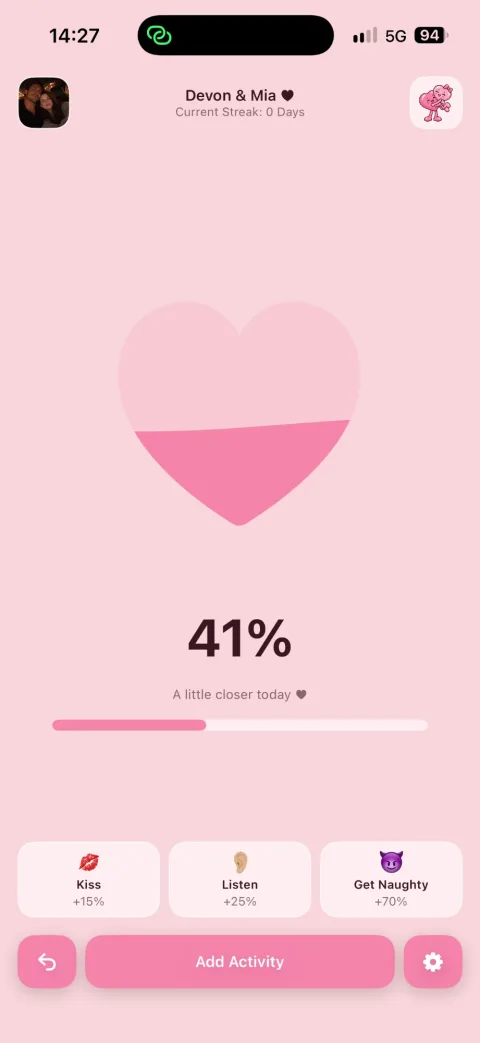
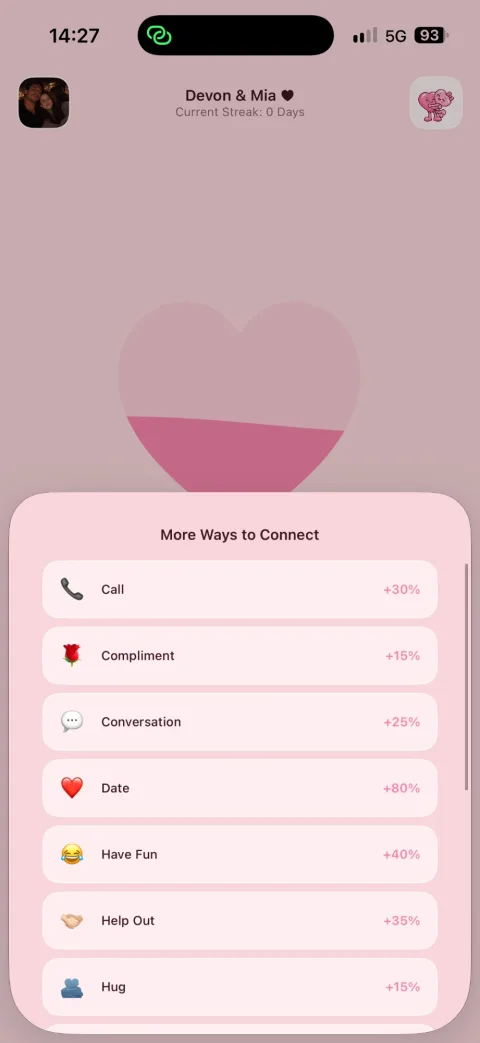
Counting days shows how long you have been together. Buffaly is about how connected you feel right now. Buffaly is an iPhone app for couples who are already together. You connect with a 4-character code and share one heart. Hug, Kiss and Compliment each add 15 percentage points, a Conversation adds 25, a Date adds 80. The heart slowly empties, so it helps you keep topping up closeness instead of waiting for a big moment. It is meant to make small moments easier to remember. It will not make a relationship good by itself.
What Buffaly is not: it is not a quiz or content app, not a messaging app, and it does not share your location. It is an entertainment tool, not a medical, psychological or counselling service. The download is free and your first action is free. Then there is a 7-day free trial, then EUR 4.99 per month or EUR 29.99 per year for both partners. It needs an iPhone with iOS 17 or later; there is no Android version yet.

Frequently asked questions
How do I calculate how long we have been together?
Use a date calculator or a spreadsheet. Put the start date in a cell and subtract it from today with =TODAY()-A1 to get days.
Which date should count as the start?
The one both of you agree on, such as the first date or the day you became a couple.
How many days is one year?
365 days, or 366 in a leap year.
What is the 100-day anniversary?
The 100th day since your chosen start date, about three months in. Some couples mark it with a small gift or note.
Does Buffaly show how long we have been together?
Not in the current App Store version. It shows a shared heart and a streak.