
Love counter: how to count the days you have been together
A love counter shows how long you have been together, in days, months or years. Some people like the number on their phone, some like it as a small ritual. Here is what a love counter is, how to work the number out yourself, which milestones are worth a celebration and what to check before you pick an app.
What a love counter does
It takes a start date, usually the day you got together, and shows the time since then. Most counters offer the total in days, plus months and years, and some add a countdown to the next milestone or anniversary. Apps and websites that do this are easy to find. The number itself is simple, so the choice is mostly about design and whether it stays on your screen where you can see it.
Count it yourself
If you just want the number, you do not need an app.
- Pick the start date. The first date, the day you became a couple or the day you said I love you. Choose one and stick to it.
- Spreadsheet: in Google Sheets or Excel, type the start date in a cell (for example A1) and use
=TODAY()-A1in another. The result is the number of days. - Years and months:
=DATEDIF(A1,TODAY(),"Y")gives full years and=DATEDIF(A1,TODAY(),"YM")the months on top. - Calendar: count in weeks and divide, or use a date calculator website.
If you want a calculator for this, our guide on how long have we been together has the milestone table.
Milestones worth marking
| Milestone | Roughly |
|---|---|
| 100 days | about 3 months |
| 365 days | 1 year |
| 500 days | 1 year and 4 months |
| 1,000 days | about 2 years and 9 months |
| 2,000 days | about 5 years and 6 months |
Day milestones are fun because they land on dates nobody else celebrates. The conversions are rough because months have different lengths.
What to look for in a counter app
- Widget: a Home or Lock Screen widget keeps the number visible without opening anything.
- Privacy: read what it collects. A start date should not need your location or contacts.
- Price: many are free with ads or one-time upgrades. Check what is behind a paywall.
- Sharing: do both of you see the same number, or only one phone?
- Platform: some are iPhone only, some Android only.
Making the number mean something
A count on its own is just arithmetic. It becomes meaningful when you do something with it: a note, a small gift or a question at each milestone. Try our questions to ask your partner on a 100-day mark, or plan a date night at home.
Why people like seeing the number
A love counter turns an abstract feeling into something you can look at. Seeing "week 87" or "day 612" gives many couples a small lift, a sense of progress and a reason to say something nice. It can also be a quiet reminder on hard days that you have already come a long way together.
Some people use it as a private ritual: they open the counter, smile and send a one-line message. Others put the number on a wallpaper or widget so they see it every time they pick up the phone. Whatever you choose, the number only works if it feels like yours, not like a checklist.
Types of love counters
- Simple day counters. One date, one number. Quick to set up and easy to read.
- Milestone counters. They show the next big number (100 days, a year) and count down to it.
- Anniversary countdowns. They count the days until a date, such as your next yearly anniversary or the day you will see each other.
- Widgets. Small tiles for the Home or Lock Screen that show the number without opening an app.
- Shared counters. Both partners see the same number on their own phones, usually with an invite or a code.
- Photo-based counters. The number sits on top of a photo of the two of you.
Pick the type that fits how you use your phone. If you check your Lock Screen constantly, a widget is the right choice. If you only look once a month, a simple web page or spreadsheet is enough.
Counter, countdown or both?
A counter looks backwards (days together). A countdown looks forwards (days until we meet, until the wedding, until the holiday). They feel quite different. A counter gives a warm, settled feeling. A countdown builds anticipation, which is especially useful if you live apart.
Many long-distance couples run both: a counter for how long they have been together and a countdown to the next visit. If you want ideas for that gap, read long distance date ideas and apps for long-distance couples.
Setting up a counter in a spreadsheet
If you want full control and no extra app, a spreadsheet does the job well.
- Open a new sheet in Google Sheets or Excel.
- In cell A1 write the label "Together since" and in B1 enter your start date.
- In A2 write "Days together" and in B2 type
=TODAY()-B1. Set the cell format to a plain number. - In A3 write "Years" and in B3 type
=DATEDIF(B1,TODAY(),"Y"). In A4 write "Months on top" and in B4 type=DATEDIF(B1,TODAY(),"YM"). - In A5 write "Next 100-day mark" and in B5 type
=B1+CEILING(B2/100,1)*100to see the date of the next multiple of 100 days. Format B5 as a date.
Share the sheet with your partner, and add it to the Home Screen as a shortcut. It is not as pretty as an app, but it is free, private and entirely yours.
Privacy: what a counter really needs
A counter needs one thing: a date. It does not need your contacts, your location, your photos or access to your messages. Before you install an app, read what it asks for. If it wants more than it needs, skip it.
- Check the permissions the app requests when you first open it.
- Check whether it asks you to create an account and why.
- Look at what happens to the data if you delete the app or the account.
- Be careful with apps that ask for your partner's name, photos or birthday if they do not explain why.
- If it shows ads, find out whether they are tied to personal data.
The safest counters keep the data on your phone. Shared counters need a server to link two phones, and a trustworthy one will say clearly what it stores.
Ideas for using the number
- Daily: send a one-line message when the number rolls over, even a single heart.
- Weekly: use the weekly mark for a short check-in, see our relationship check-in questions.
- Monthly: choose one thing from the couples bucket list for the monthly mark.
- At each hundred: write a short note about one memory from that stretch.
- Before a big number: plan a small surprise a week ahead.
A number is a prompt. The effort goes into what you do with it, and the effort can be tiny.
Making it a ritual
Rituals stick when they are simple and tied to something you already do. Pair the counter with your morning coffee, with brushing your teeth or with the first time you unlock your phone. Look at the number, say or type one kind thing, and put the phone down.
If one of you forgets, do not turn it into an issue. Consistency matters more than perfection, and skipping a day is fine. Come back the next day. If you want a structured daily habit to go with it, see how to be a better partner and how to be more affectionate.
Choosing between a counter, a widget and a spreadsheet
If you are unsure which route to take, compare them on what you care about most.
- You want it to be pretty: an app or widget with themes and a photo.
- You want it to be private: a spreadsheet or notes entry on your own device.
- You want both of you to see it: a shared app or a shared spreadsheet.
- You want it free: a spreadsheet, a notes app or a free tier of an app.
- You want surprises: a countdown with a reminder that fires on the day.
There is no wrong answer. Start simple. If you find yourself looking at the number every day, move to something with a widget. If you never look at it, a yearly reminder is enough.
Small ways to celebrate a number
When the counter hits a round number, mark it in a way that costs little. Send a photo from the day you got together. Cook the meal you ate on your first date. Leave a note under a pillow. Choose a song for the milestone and add it to a shared playlist. Those habits turn a number into a tradition, and our date night ideas at home has more ideas for a low-key evening.
What a counter cannot tell you
A number says how long you have been together. It does not say how close you feel today. Two couples can both be at 800 days and be in very different places. That is why a counter works best next to real conversations, small daily gestures and time without screens. If you feel distant, the number will not fix it, but the relationship check-in questions or our guide on how to reconnect with your partner can help.
A simple milestone plan for the next year
To make the most of your counter, pick the next four milestones and give each one a small plan.
- The next hundred-day mark: a handwritten note.
- Your yearly date: a meal at the place of your first date.
- The next 500 or 1,000 day mark: print a photo and write the date on the back.
- Halfway between: a surprise, however small.
Put all four in your calendar today. When they come around, you will be glad you did.
In short
A love counter is a small tool with a simple job: to remind you how long you have shared your life. Whether you use a widget, a spreadsheet or a note on the fridge, the best counter is one you actually look at, built on a start date you both love. Use the numbers as prompts for kind words and small celebrations, and do not let them become a source of pressure. When the next milestone arrives, stop for a few minutes, look at your partner and say something true. That, more than any app, is what makes the number matter. Set it up today, and the next date will take care of itself.
Where Buffaly fits
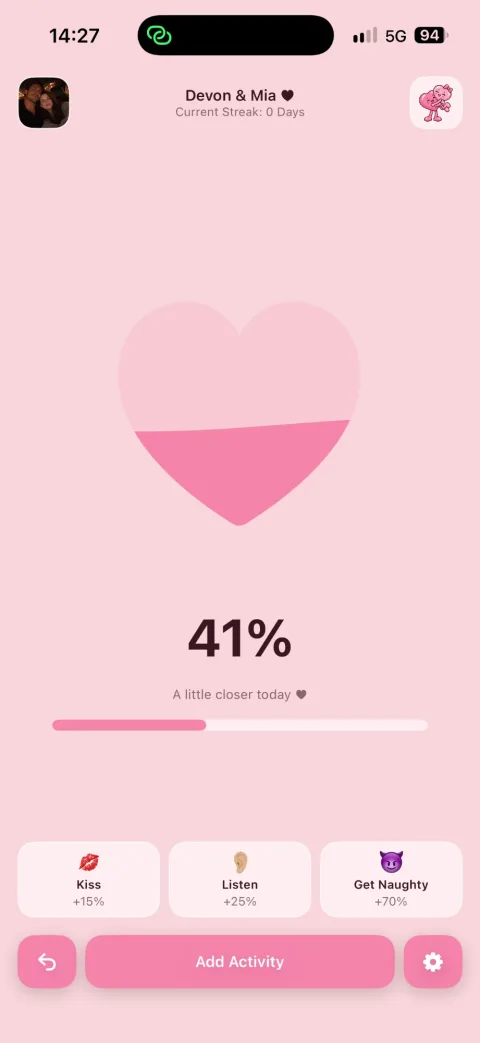
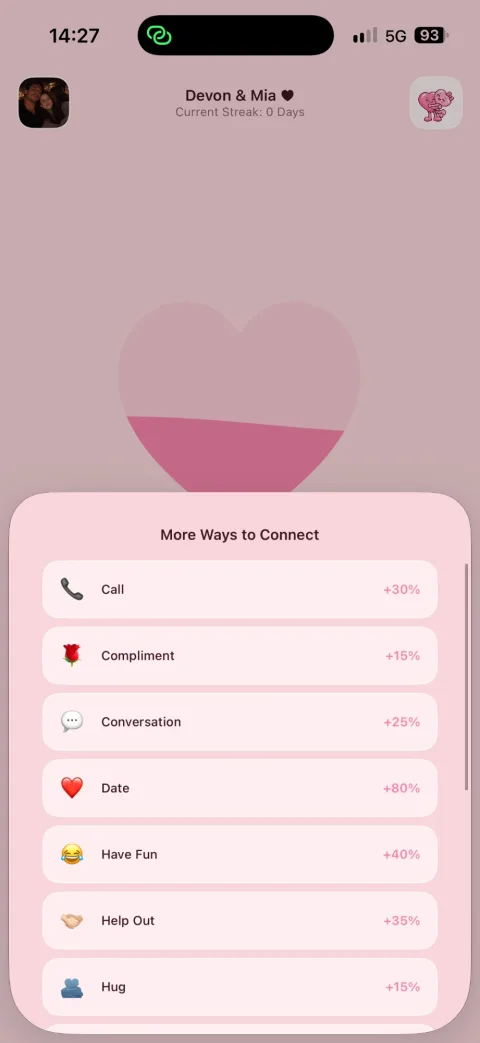
Buffaly does not count days. It tracks something different: how close you have been lately. Buffaly is an iPhone app for couples who are already together. You connect with a 4-character code and share one heart. Hug, Kiss and Compliment each add 15 percentage points, a Conversation adds 25, a Date adds 80. The heart slowly empties, so it helps you keep topping up closeness instead of waiting for a big moment. It is meant to make small moments easier to remember. It will not make a relationship good by itself.
What Buffaly is not: it is not a quiz or content app, not a messaging app, and it does not share your location. It is an entertainment tool, not a medical, psychological or counselling service. The download is free and your first action is free. Then there is a 7-day free trial, then EUR 4.99 per month or EUR 29.99 per year for both partners. It needs an iPhone with iOS 17 or later; there is no Android version yet.

Frequently asked questions
What is a love counter?
A tool that shows how long you have been together, usually in days, months and years from a date you enter.
How do I calculate how many days we have been together?
Use a date calculator or a spreadsheet: enter the start date in a cell and subtract it from today's date with =TODAY()-A1.
Which date should I use as the start?
Pick the one that feels right to both of you, such as the first date or the day you became a couple, and keep it.
Is a love counter app free?
Many are free with ads or optional upgrades. Check the app's own page for what costs money.
Does Buffaly have a love counter?
Not in the current App Store version. Buffaly shows a shared heart and a streak instead.