
Home › Blog › How to be more affectionate
How to be more affectionate with your partner: 15 small habits
Not everyone is naturally affectionate. Some of us grew up in families that did not say "I love you" or hug much, some of us are introverts who recharge alone, and some of us are simply busy and forget. The good news is that affection is mostly a habit, and habits can be built in small steps. Below are 15 small habits for touch, words and attention, followed by what to do if your needs and your partner's do not match, how to be affectionate from a distance, and the mistakes that most often backfire.
None of this is a diagnosis or a rulebook. It is practical advice from us, based on common sense and on what other couples guides tend to agree on, not on a study of our own.
First: what affection actually is
Affection is not the same as passion or romance. It is the everyday signal that says "I like you, I am glad you are here, you matter to me." That signal can travel through touch, words, attention, small favours or shared jokes. Many couples guides point out that partners differ in which of these they notice. So the most useful first step is not a technique but a question: which kind of affection does my partner actually register?
Someone who hugs constantly may feel unloved by a partner who shows care by doing the dishes. The partner doing the dishes may feel they are being very affectionate. Neither is wrong; the signal just does not arrive. Asking beats guessing.
If you are not naturally affectionate
Start small and tell your partner what you are doing: "I would like to be more affectionate, and I am practising." That makes it clear that you are trying and takes pressure off both of you. Pick one or two habits from the list below and keep them for two weeks. It will feel awkward at first, and that is normal.
If you did not grow up with much affection
If hugging, "I love you" or even casual compliments were rare at home, affection can feel like a foreign language. That is not a character flaw, it is simply something you never saw modelled. A few things tend to help: start with the form of affection that feels least exposed (often words in a message rather than a kiss in public), name the discomfort instead of hiding it ("this feels strange for me, it is not about you"), and let your partner know that awkwardness is not rejection. If affection feels frightening or painful rather than just unfamiliar, a licensed therapist is the right person to talk to; a blog post is not.
If you are an introvert
Introverted people are often quietly affectionate but not loudly so. Low-key habits count just as much: sitting next to each other while you each read, making their coffee, a private joke, a hand on the back in a crowded room. You do not need big displays. What you do need is to make them visible, because a partner cannot see affection that stays in your head. Say it once in a while: "I like having you around, even when I am quiet."
15 small habits
With touch
- Hug when one of you comes home, and hold it a little longer than usual.
- Hold hands on a walk or when you are watching something.
- Sit close on the sofa instead of at the other end.
- Give a quick shoulder or back rub when they are stressed.
- Kiss goodbye and hello, every time.
- Touch their arm or back as you walk past.
With words
- Say "I love you" more often, and say it when it is not a goodbye.
- Tell them one thing you like about them, out loud or in a message.
- Say "thank you" for the small things.
- Send a short message in the middle of the day that is only affection, with no question or to-do attached.
- Use a nickname or an inside joke that is just yours.
With attention
- Put your phone away when they are talking.
- Look at them when you say hello.
- Notice something small about their day and ask about it later.
- Ask what kind of affection they would like more of.
You do not need all fifteen. Two that you will really keep beat ten that you drop by Friday. If you want more words to work with, see our list of compliments for your partner.
Affection without touch
Some people dislike being touched, some have sensory sensitivities, some are in pain or recovering from illness, and some simply are not in the mood. Affection does not have to include touch to be real. Options that work without it: words and written notes, small favours (taking over a chore they dislike), undivided attention, sitting in the same room doing separate things, cooking for them, remembering details they mentioned, and shared humour. If touch is hard for you, say what is comfortable instead of only what is not: "I find long hugs hard, but I like leaning on you while we watch something." That gives your partner something to say yes to.
When one of you wants more touch than the other
This is probably the most common affection problem, and nobody is the villain in it. One person feels starved; the other feels pressured. A pattern often develops: the one who wants more reaches out, the other pulls back to get breathing room, and the first reaches out harder. Breaking the loop usually takes three moves.
1. Separate the need from the person
"I miss feeling close to you" lands better than "you never touch me." And for the partner who wants less: "I love you, and I need touch to be my choice sometimes" lands better than silence or irritation.
2. Make a small, specific agreement
Vague promises ("I will try to be more affectionate") fade. Specific ones stick: one long hug a day, holding hands on the evening walk, a kiss goodbye. The higher-touch partner gets reliable contact; the lower-touch partner gets a clear, limited ask they can say yes to without feeling overrun.
3. Keep a "no" that is safe
Affection that cannot be declined turns into duty. Agree that either of you can say "not right now" without it being taken as rejection, and that the person who declines offers an alternative ("not a cuddle, but sit with me for ten minutes"). Check in again after a few weeks and adjust. Our post on relationship check-in questions has wording you can borrow.
If the mismatch has become a source of hurt or resentment that you cannot resolve between you, a couples therapist can help. That is a sensible step, not a failure.
How to talk about it without a fight
- Pick a calm moment. Not in bed, not right after being turned down, not mid-argument.
- Start with what you value. "I love how you make me laugh, and I would like more small moments of closeness."
- Use "I" sentences. "I feel distant lately" invites a conversation. "You are cold" invites a defence.
- Ask for their version. "What kind of affection feels good to you? What feels like too much?"
- Agree on one experiment for two weeks, then talk again.
If you want conversation starters that go beyond this one topic, try questions to ask your partner.
Affection in a long-distance relationship
When you cannot hug, affection has to travel in other ways. Things that tend to work: a daily message that is only warmth, a short voice note instead of text, a call with no agenda, watching the same show at the same time, sending a small thing in the post, and planning the next visit so you both have something to look forward to. The words and attention habits above all work at a distance; the touch habits wait for your next visit. Be careful not to let every call turn into logistics, because then affection is the first thing to go.
Common mistakes
- Doing it all at once. A sudden flood of hugs and "I love you" can feel odd or even suspicious. Build gradually.
- Using affection as a trade. Hugs given only to get something, or withheld as punishment, teach your partner to distrust them.
- Keeping score. "I hugged you three times today and you did not once" turns warmth into an audit.
- Assuming your style is theirs. What feels loving to you may not register with them. Ask.
- Making affection a hidden sexual request. If every touch means "I want sex", a partner may start avoiding all touch. Separate the two so a cuddle can just be a cuddle.
- Taking a "no" personally. Declining a hug in the moment is not declining you.
- Waiting until you feel like it. Many people feel affectionate after they start, not before.
- Staying silent about discomfort. If something feels too much, say so kindly. Pretending leads to resentment.
If you are worried that the real issue is feeling ignored in general, read feeling neglected in a relationship. For the other side of this topic, see how to make your partner feel loved and how to reconnect with your partner.
Where Buffaly fits
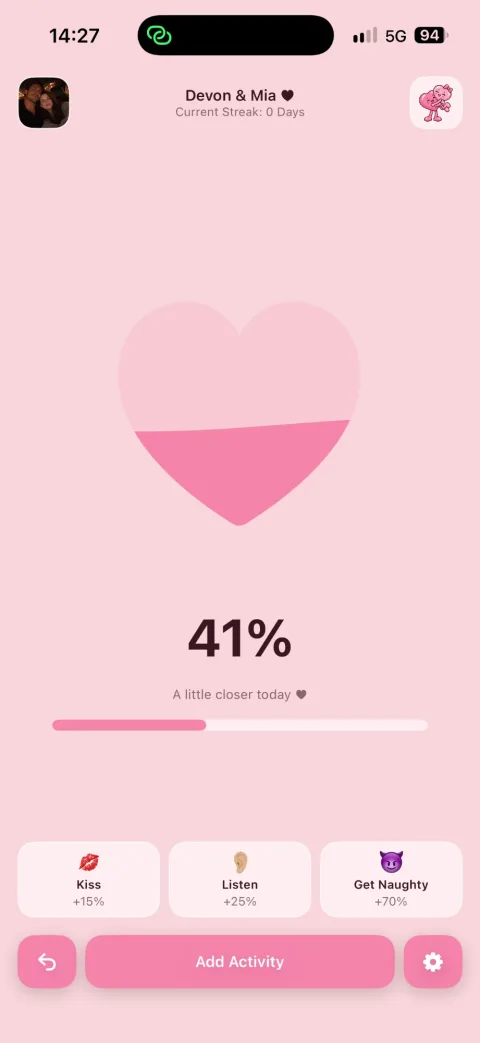
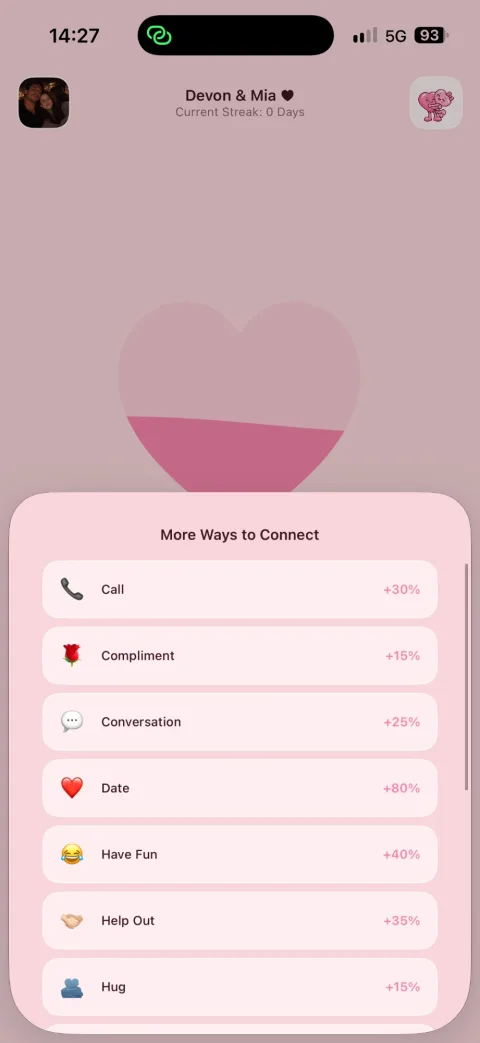
Buffaly is an iPhone app for couples who are already together. You share one heart, and you log real moments to fill it. Hug, Kiss and Compliment each add 15 percentage points for 18 hours, Touch adds 10 for 16 hours. Other actions such as Call work without being in the same place, which helps if you are long-distance. It is a small reminder to practise affection every day. The heart slowly empties, so small, regular moments work best.
What Buffaly is not: it is not a quiz or content app, not a messaging app, and it does not share your location. It is an entertainment tool, not a medical, psychological or counselling service. The download is free and your first action is free. Then there is a 7-day free trial, then EUR 4.99 per month or EUR 29.99 per year for both partners. It needs an iPhone with iOS 17 or later; there is no Android version yet.

Frequently asked questions
How can I be more affectionate if I am not a touchy person?
Start with one small habit, like a proper hug when you meet, and tell your partner you are practising. Keep it for two weeks before adding anything else. If touch is hard, begin with words or attention, which count just as much.
What are small ways to show affection?
A longer hug, holding hands, a kiss goodbye, a message in the middle of the day, saying thank you, and giving them your full attention for a few minutes.
How can I be more affectionate if I did not grow up with it?
Pick the form that feels least exposed, often a message or a thank-you, and tell your partner that awkwardness is not rejection. Build slowly. If affection feels frightening rather than just unfamiliar, a licensed therapist can help.
How do I show affection if I am an introvert?
Low-key habits count: sitting close while you each do your own thing, making them a drink, a private joke, a hand on the back. The key is making your affection visible by saying it now and then.
What if my partner is not affectionate enough for me?
Ask for something specific and easy to do, such as a long hug every day. Say how you feel with an “I” sentence, appreciate the effort when it happens, and avoid pressure. If it stays a problem, talk to a couples therapist.
What if I want less touch than my partner?
Say it kindly and offer alternatives. Agree on a small, specific amount of daily contact and a safe way to say “not right now”, and name what you are happy to do instead.
How can you be affectionate in a long-distance relationship?
Use words and attention: a daily warm message, voice notes, calls with no agenda, watching something at the same time, a small parcel, and a planned next visit.
Can you learn to be more affectionate?
Yes. Affection is largely a habit, and most people can build it in small steps. It may feel awkward at first, and that passes.
Does Buffaly track affection?
Buffaly lets you log actions such as Hug, Kiss, Touch, Compliment and Call so the shared heart reflects them. It is not a diagnosis or a score between partners, and it is not therapy.