
Home › Blog › How to stop overthinking
How to stop overthinking in a relationship: 12 practical steps
You send a message and the reply takes three hours. By hour two you have decided they are angry, losing interest or about to end it. By hour three you have replayed the last conversation twenty times, found six signs you missed and drafted a text you will not send. Then they reply with a photo of their lunch.
Overthinking in a relationship is very common. It is the habit of running worst-case stories about what your partner thinks or feels, often from very little evidence. It is exhausting, and it can wear down the relationship it is trying to protect. This guide explains why it happens, how to recognise it, 12 practical steps to reduce it, what to say to your partner, and when it is worth getting extra support. This is general advice from us, not medical or psychological care. If overthinking is affecting your sleep, work or daily life, please talk to a doctor or a licensed professional.
What overthinking looks like
- Replaying conversations. You go over what you said and what they said, looking for hidden meanings.
- Reading too much into small things. A short text, a different tone, a missed call.
- Predicting the worst. "They are quiet, so they must want to break up."
- Seeking constant reassurance. Asking the same question again and again.
- Checking. Looking at their last seen, their social media or who they follow.
- Rehearsing arguments that have not happened.
- Comparing your relationship with others online.
- Not being able to enjoy good moments because you are waiting for something to go wrong.
Everyone does some of this. It becomes a problem when it takes up a lot of your day, affects your mood or leads you to act in ways that push your partner away.
Why it happens
There is rarely one cause. Some common ones:
- Uncertainty. When we lack information, the mind fills gaps, often with negative guesses.
- Past experiences. If you were hurt, cheated on or left before, your mind may be on guard.
- Fear of loss. The more you care, the more you may worry.
- Low confidence. If you doubt your worth, it is easy to assume your partner will notice.
- Stress and tiredness. Everything feels worse when you are tired.
- Long-distance or irregular contact. Less contact means more room for guesses.
- Social media. Constant visibility of what others do invites comparison and checking.
Understanding why does not make the thoughts vanish, but it helps you see them as a pattern rather than as facts.
Thought or fact?
A useful first step is to separate what you actually know from what you are guessing.
- Fact: "They replied in three hours instead of one."
- Guess: "They are losing interest."
Try writing both on paper. Under the guess, add three other explanations: they were in a meeting, their phone was on silent, they were tired. You do not have to believe the alternatives. The point is to see that the first story is one of many.
12 steps to stop overthinking
1. Notice it and name it
"I am overthinking" is a useful sentence. Saying it quietly creates a little distance between you and the thought.
2. Write it down
Put the worry on paper or in your notes. Writing gets it out of your head and shows how repetitive it is.
3. Ask what you actually know
List the facts. Then list the guesses. Keep the facts and put the guesses aside.
4. Look for other explanations
Come up with three alternatives, including boring ones. Most explanations for a quiet partner are ordinary.
5. Set a worry window
Give yourself ten to fifteen minutes a day to think through worries. When a worry appears outside that time, tell yourself: "I will think about that at six." It sounds odd, but it can stop the constant loop.
6. Move your body
A short walk, stretching or anything physical gives your mind something else to process. A walk outside is especially good when you feel stuck.
7. Change what you are doing
Switch tasks. Call a friend, cook, tidy something, do a short exercise. Overthinking often thrives when you have nothing else holding your attention.
8. Reduce checking
Mute or log out of things that tempt you to check: your partner's last seen, their social media, a shared location. If you cannot stop at once, set small limits, such as checking only twice a day.
9. Talk to a friend
Say the worry out loud to someone who is not your partner. Often it sounds less scary, or the friend offers a different view.
10. Ask your partner directly, calmly
If a worry keeps returning, ask. "I noticed you were quiet earlier. Is everything okay?" is better than guessing. Pick a calm moment and avoid accusations.
11. Be kind to yourself
You are not crazy or needy for overthinking. It is a habit your mind has learned. Speak to yourself as you would to a friend.
12. Build other sources of calm
Sleep, food, movement, time with friends, hobbies. A life that does not depend on one relationship makes each worry less heavy.
How to talk to your partner about it
Many people hide overthinking because they are afraid of being too much. But sharing it can make it smaller.
- Choose a calm time. Not in the middle of a worry spiral or an argument.
- Say what is happening. "I have been overthinking lately, and it makes me anxious when I do not hear from you."
- Say what would help. "A short message when you are busy would help me a lot."
- Do not demand constant reassurance. Ask for something specific and realistic.
- Do not blame. "You make me anxious" puts them on the defensive. "I get anxious when..." keeps it about you.
- Listen to their view. They may have needs too.
Our guides to questions to ask your partner and relationship check-in questions give you conversation starters.
What partners can do to help
If your partner overthinks, a few small habits can help without making you responsible for their feelings.
- Say what is going on. "I am in a meeting until five, I will call after."
- Be consistent. Predictable small things build calm.
- Respond kindly. "I can see this is hard, I am here" works better than "You are overreacting."
- Do not hide. Evasiveness feeds the worry.
- Look after yourself. You can support someone without being their only support. It is fine to say, "I want to help, and I cannot be your only reassurance."
Overthinking in long-distance relationships
Distance gives the mind more space to wander. A few things that help:
- Agree on a loose rhythm. Not a strict schedule, but a rough idea of when you talk.
- Share small things. A photo of your day, a voice note.
- Talk about what silence means. "If I do not answer, I am probably at work."
- Plan the next meeting. Something to look forward to calms the mind.
See our long-distance relationship questions and long-distance date ideas.
A worked example
Say your partner has gone quiet for an evening. Here is how the steps above might look in practice.
- Notice: "I am overthinking again."
- Write: "They have not texted since lunch. They must be angry about what I said yesterday."
- Facts: They said they would be busy at a family dinner. They have not texted since lunch.
- Guesses: They are angry. They are losing interest.
- Alternatives: They are at dinner with their phone away. They are tired. They plan to call later.
- Action: A short walk and a call to a friend. Set the worry window for nine in the evening.
- If it comes back: Send one calm message: "Hope the dinner is going well. Call me when you are free."
Nothing in this example removes the feeling at once. What changes is that the feeling stops running the evening. Most of the time the answer turns out to be ordinary.
Overthinking after an argument
After a fight, the mind loves to replay it. A few ways to cope.
- Take a break. If you are still upset, say so and come back to it.
- Ask what you can control. You can apologize for your part. You cannot control their reaction.
- Do not send long texts at night. Sleep first.
- Make a small repair. A kind message, a hug or a simple "I care about you" can stop the spiral.
- Remember that one argument is not the relationship. Healthy couples argue. What matters is how you repair. Our guide to how to apologize shows how.
When overthinking points to something real
Sometimes the worry is not just in your head. If your partner is often distant, evasive, dishonest or unkind, it is reasonable to feel uneasy. Trust your sense of what you see, not only what you imagine. Compare the facts with our list of red flags in a relationship. If the pattern repeats, talk to your partner, to a friend and, if needed, to a counsellor.
When to get extra support
Please consider speaking to a doctor, therapist or counsellor if:
- worry takes up much of your day,
- it affects your sleep, appetite or work,
- you feel panicky or hopeless,
- you cannot stop checking or seeking reassurance,
- or the pattern has been there in many relationships.
This is not a failure. It is the same as getting help for any other long-lasting habit that does not improve by itself.
Where Buffaly fits
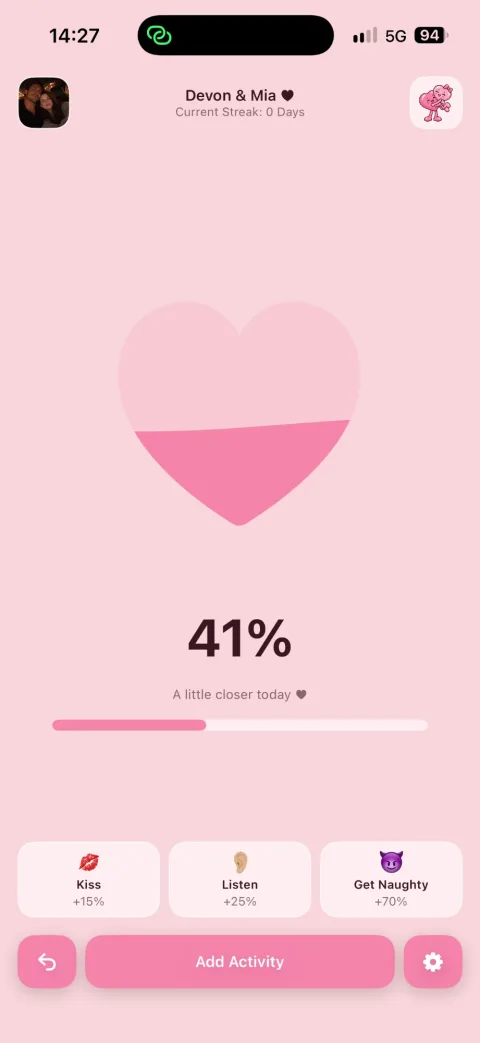
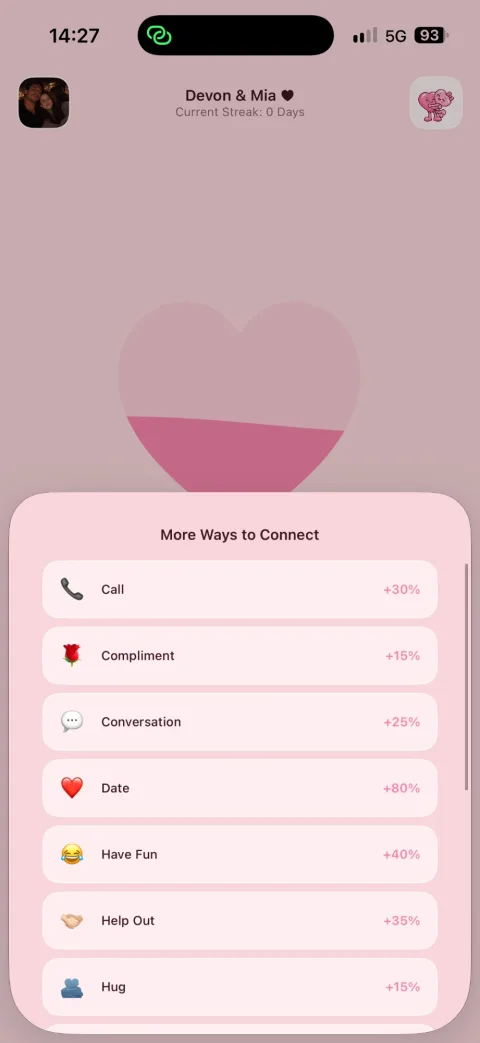
Buffaly is an iPhone app for couples who are already together. You connect with a 4-character code and share one heart. Buffaly is not a mental health tool and cannot reduce anxiety. It is a light way to log small, real actions such as Conversation (+25 percentage points for 24 hours), Listen (+25 for 24 hours) and Hug (+15 for 18 hours), so the shared heart shows when you last made time for each other. The heart slowly empties, so it is a simple reminder.
What Buffaly is not: it is not a quiz or content app, not a messaging app, and it does not share your location. It is an entertainment tool, not a medical, psychological or counselling service. The download is free. Using Buffaly needs a subscription, and one subscription covers both partners; the price is shown in the App Store in your own currency before you subscribe. It needs an iPhone with iOS 17 or later; there is no Android version yet.
Frequently asked questions
How do I stop overthinking in my relationship?
Notice and name it, separate facts from guesses, write the worry down, look for other explanations, limit checking, move your body and talk to a friend or your partner calmly.
Why do I overthink everything my partner does?
Uncertainty, past hurt, fear of loss, tiredness and low confidence are common reasons. The mind fills gaps with worst-case stories, especially when contact is irregular.
Is overthinking a sign that something is wrong?
Not necessarily. It is often a habit linked to anxiety or past experience. But if your partner is regularly distant, dishonest or unkind, your unease may point to something real.
How do I talk to my partner about overthinking?
Choose a calm time, say what happens and what would help, ask for something specific and realistic, and avoid blaming. For example: "A short message when you are busy would help me."
How can I stop checking my partner's phone or social media?
Mute or log out of what tempts you, set small limits, replace the habit with something else and tell a friend. If it feels out of control, consider talking to a professional.
When should I get professional help for overthinking?
If it takes up much of your day, affects sleep or work, makes you panicky or hopeless, or has been present in many relationships.
Can Buffaly help me stop overthinking?
No. Buffaly is not a mental health tool. It is a light way to log small actions with your partner so you both see when you last made time for each other.