
Home › Blog › How to say I love you when it's hard to say
How to say I love you when it's hard to say it
Some people say I love you as easily as they say good morning. For others the words get stuck somewhere between the heart and the mouth. They feel the love, they show it in a hundred ways, and when the moment comes their throat tightens, they change the subject, they make a joke, or they say "same" and hope it counts.
If that is you, you are not broken and you are not cold. This guide looks at why the words can be hard, what is worth finding out about yourself, ten gentle ways to start, scripts you can practise, and what to do if you are the partner of someone who struggles to say it. It does not promise a quick fix, and it is not medical or psychological advice. If the difficulty comes from something painful in your past, a qualified therapist is the right person to talk to. The aim here is practical: to help you take small, safe steps toward saying the words, at a pace you control.
Why the words can be hard
There is no single cause, and you do not have to know yours to make progress. But it helps to recognise some common patterns.
- Family style. In some families, love is shown through food, help and presence, and the words are rare or never said. If nobody around you said it growing up, the sentence can feel foreign, even when the feeling is strong.
- Culture. In some cultures and languages, verbal declarations are less common than in others, or are reserved for big occasions. The phrase can feel too big for an ordinary Tuesday.
- Fear of rejection. Saying it puts you in a vulnerable place. If you are afraid the other person will not say it back, silence can feel safer.
- Past hurt. If love was once followed by loss or betrayal, saying it again can feel risky.
- Perfectionism. Some people feel that the words must be said at exactly the right moment, in exactly the right way. Since that moment never comes, they never say it.
- Personality. Some people are simply private about feelings. They are not hiding anything; they just express it differently.
- Not feeling sure. Sometimes the words are hard because you are not certain yet. That is honest, and worth respecting.
Knowing which pattern fits you changes the approach. If it is habit and family style, practice helps. If it is fear, small safe steps help. If it is uncertainty, patience and honesty help more than any technique.
First, is it true?
A quiet question to ask yourself: do you love this person, or are you unsure? If the answer is yes, then the difficulty is about expression, and the rest of this guide applies. If the answer is "I am not sure", say so to yourself clearly, because a forced I love you is worse than a late one. Our guide on when to say I love you for the first time helps with this question. It includes signs you might be ready, signs you might want to wait, and a check on your motives.
10 gentle ways to start
You do not need to jump straight to the full sentence. Each of these is a stepping stone. Pick the one that feels easiest, and move on when you are ready.
1. Write it down first
Write the words in a notebook, only for yourself. Seeing them on paper can make them less frightening. Then write them to your partner in a private note you do not have to send.
2. Say it to an empty room
It sounds silly, and it works. Your mouth needs practice making the shape of the sentence. Say it quietly while washing up. Say it in the car. Do it until it stops sounding like a dramatic line from a film.
3. Start with a smaller version
If "I love you" is too big, try "I really care about you", "I am so glad you are in my life" or "you mean a lot to me". These are honest and they build a path toward the full sentence.
4. Say it in writing
Send a message, write a card, leave a note. Writing removes the pressure of facial expression. Our post on how to say I love you over text has 40 examples you can adapt, and love notes has ideas for places to leave them.
5. Send a voice note
A voice note is halfway between a text and a conversation. You can record it alone, redo it until it feels right, and send it without watching the reaction.
6. Say it when you leave
Saying it as you walk out the door, on a call that is about to end or at the moment you hang up takes the pressure off, because you are not waiting for an immediate response.
7. Say it in the dark
Many people find it easier at bedtime, with the lights off. No eye contact, no performance, just two people and quiet.
8. Say it while doing something
Walking, driving, cooking. Side-by-side activities feel less intense than face-to-face talk. Some people say the hardest things best when they are looking at the road.
9. Use a quote or a song
If you cannot find your own words, borrow someone else's, then add one line of your own. This is a bridge, not a final destination. Our collections of love quotes and love songs can help you find something that fits.
10. Tell your partner it is hard
This is the bravest and often the most effective step. "I find it hard to say, but I feel it" is itself an expression of love. It also lets your partner stop guessing and start helping.
Scripts to practise
Having a sentence ready removes the worst part, which is the blank in the moment. Here are a few options for different levels of comfort. Say each one out loud a few times before you use it.
Level 1: Warm but small
- "I am really glad we are together."
- "You make my days better."
- "I do not say this a lot, but I appreciate you."
Level 2: Close to the words
- "I care about you a lot more than I show."
- "I think about you all the time."
- "You are the person I want to tell everything to."
Level 3: The full sentence
- "I love you."
- "I love you, and I find it hard to say, so I am saying it anyway."
- "I have wanted to tell you for a while. I love you."
It is fine to spend weeks at level 1 and 2. Nobody is watching a clock. If you want inspiration for what to put in these sentences, the specific details in our guide to reasons why I love you can turn a vague feeling into a concrete sentence.
Show it in other ways while you practise
While you are working up to the words, do not let your partner wonder. Make the love visible in everyday things. A person who shows love consistently often has an easier time with the words later, because the feeling is already in the room.
- Remember small things. Their coffee order, the name of their difficult colleague, the date of their exam.
- Help without being asked. See our post on acts of service.
- Give your full attention. Put the phone down. Quality time is a language of its own.
- Touch. A hand on the back, a hug that lasts a little longer than usual.
- Say small positive things. A compliment is easier than a declaration. Our list of compliments for your partner has plenty.
It is also worth saying plainly: "I show it more than I say it." Your partner may already see it, and knowing that you know can ease the pressure.
If you are afraid they will not say it back
This is the biggest fear for many people, and it is reasonable. Saying I love you can feel like handing over a fragile object. Some thoughts that can help:
- Say it as a gift, not as a question. "I love you" is a statement. If you add "do you?", it becomes a test.
- Decide in advance that no reply is fine. If you know you will be okay with a pause, saying the words is less risky.
- Look at the evidence. How has your partner treated you? Do they show interest, make time and care how you feel? These are better indicators than a sentence.
- Remember that timing differs. Someone who does not answer right away may need a day to find their own words.
- Be honest with yourself. If you often fear that your partner does not care, the fear may be telling you something about the relationship or about an old pattern. Our post on how to stop overthinking in a relationship may help you tell which it is.
If your partner is the one who finds it hard
If you are the partner of someone who rarely says it, patience and clarity both matter. Here is what tends to help.
- Look at what they do. Many people who cannot say it show it clearly: they plan, remember, fix and show up. Make a list. You may find more love than you were hearing.
- Tell them what you need, kindly. "I know you show it in many ways, and I would love to hear it sometimes too." Say it once, calmly, not as a complaint.
- Make it safe. Do not tease, grade or react with surprise when they do say it. A calm "thank you, I love you too" is perfect.
- Do not demand it. Pressure makes the words harder. Invitation makes them easier.
- Offer easier routes. Suggest voice notes, notes or a shared notebook. Let them choose the format.
- Say it yourself. A partner who hears I love you often learns that it is safe.
- Notice progress. A halting "I really care about you" is a step. Welcome it.
It can help to learn what your partner hears as love. Some people feel most loved through words of affirmation, others through time, help, gifts or touch. You can try the love languages test together and talk about the results. If you discover you have different languages, that is not a failure. It is a map.
When it is more than shyness
Sometimes difficulty with the words is part of a larger pattern: trouble naming feelings at all, a tendency to shut down when things get emotional, or a history that makes closeness feel unsafe. If that sounds familiar, it can help to talk to a counsellor or therapist, individually or as a couple. This is not a sign that something is wrong with the relationship. It is a way to get support for something that is hard to do alone. Buffaly is an entertainment tool, not a counselling service, and cannot replace that kind of help.
A small practice plan for four weeks
If you like structure, here is a simple plan. Adjust it to your pace.
- Week 1: write three honest sentences about your partner in a private notebook. Say one out loud when alone.
- Week 2: send one warm message a day, from the level 1 list. No replies required.
- Week 3: send a voice note with a level 2 sentence. Say another one in person, side by side, while doing something.
- Week 4: choose the moment (leaving, bedtime, a call) and say the full sentence, or the "this is hard to say" version.
After that, keep going. The tenth time is easier than the first. The hundredth is not a big event at all, and that is the aim.
A closing thought
Hard to say does not mean absent. It means you have a feeling that matters to you more than the words can hold, and you want to get it right. That is not a flaw. But the person you love cannot read your mind, and the words, even clumsy ones, carry something that actions alone cannot. Start small, use the route that suits you, and let your partner know you are working on it. The sentence is short. You are allowed to take your time getting there.
Where Buffaly fits
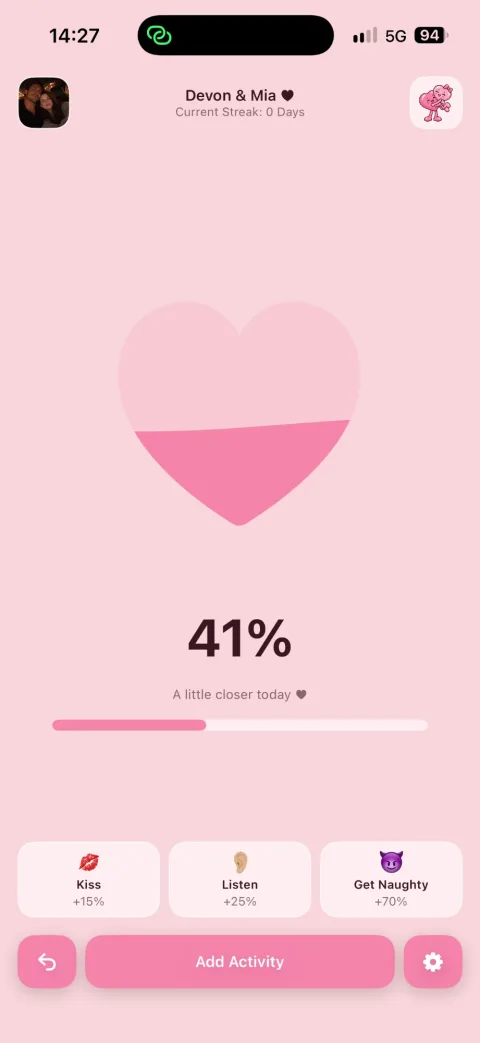
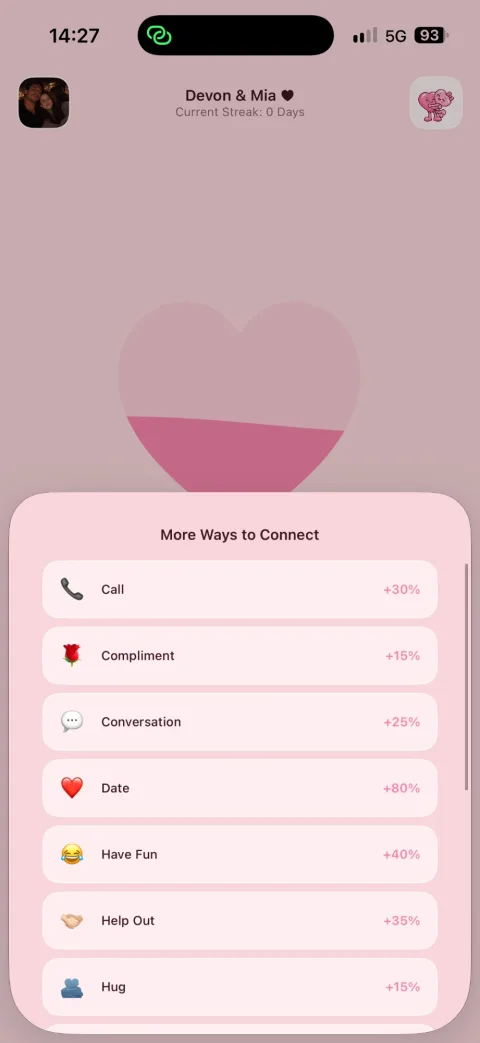
If saying it is hard, doing small things together is a good place to start, and Buffaly is made for small things. Buffaly is an iPhone app for couples who are already together. You connect with a 4-character code and share one heart. Compliment, Hug and Kiss each add 15 percentage points, a Conversation adds 25 and a Date adds 80. The heart slowly empties, so it shows when you last made time for each other and nudges you to top it up. Widgets on the Home Screen and Lock Screen keep the number visible between moments.
What Buffaly is not: it is not a quiz or content app, not a messaging app, and it does not share your location. It is an entertainment tool, not a medical, psychological or counselling service, and it will not make a relationship good by itself. The download is free. Using Buffaly needs a subscription, and one subscription covers both partners; the price is shown in the App Store in your own currency before you subscribe. It needs an iPhone with iOS 17 or later; there is no Android version yet.
Frequently asked questions
Why is it so hard for me to say I love you?
Common reasons include family or cultural style, fear of rejection, past hurt, perfectionism, personality, or not being sure yet. Knowing which fits helps you choose a way forward.
How can I tell my partner I love them if I'm shy?
Start with writing or a voice note, use a smaller phrase like I really care about you, or say it in a low-pressure moment such as leaving or bedtime.
Is it a bad sign if I can't say I love you?
Not by itself. Some people show love in actions long before they say the words. If you are unsure whether you love the person, be honest with yourself first.
What if my partner finds it hard to say I love you?
Look at what they do, tell them kindly what you need, make it safe, do not demand it, and suggest easier routes such as notes or voice messages.
Can I tell my partner that saying it is hard for me?
Yes. It is often the most helpful step. It lets your partner stop guessing and see that your difficulty is not a lack of feeling.
When should I get professional help?
If the difficulty comes with trouble naming feelings, shutting down or painful past experiences, a counsellor or therapist can support you, alone or as a couple.
Can Buffaly help if I find it hard to say I love you?
Buffaly does not write messages or give therapy. You can log small actions like a Compliment, a Hug or a Conversation and watch the shared heart fill.