
Home › Blog › Love languages test
Love languages test: a free 5 minute quiz for you and your partner
You probably know the feeling: you do something loving, and it lands softly or not at all. Your partner does something loving, and you barely notice it. Often nobody is being careless. You are simply each looking for love in a different place. The idea of five love languages is a popular way to talk about that difference, and a love languages test is the quickest way to start the conversation.
This page contains a free test you can take in about five minutes, with no sign-up and no email address. You tick the statements that are mostly true for you, add up five small scores, and read what they might say about how you like to give and receive love. Then you swap with your partner. It is a conversation starter, not a diagnosis, and it does not predict whether a relationship will last.
The five love languages in one minute
The framework says people tend to feel most cared for through one or two of five channels. Here they are in plain words:
- Words of affirmation. Kind, specific words: thanks, praise, encouragement, "I am proud of you". See our guide to words of affirmation.
- Quality time. Undivided attention: a walk without phones, a proper conversation, an evening that is just for the two of you. See quality time as a love language.
- Acts of service. Help that lightens the load: cooking, sorting out the boring admin, fixing the thing that has been broken for weeks. See acts of service.
- Receiving gifts. Thoughtful tokens that say "I was thinking of you". The size does not matter; the thought does.
- Physical touch. Hugs, holding hands, a hand on the back, sitting close on the sofa. Touch that is not always a prelude to something else.
Most people feel at home in more than one. The point is not to put yourself in a box but to notice which channel makes you feel warmest when it is switched on, and which one makes you feel a little cold when it is missing.
How the test works
Below are twenty statements, four for each language. Read each one and decide whether it is mostly true for you. Do not think about what you would like to be true, or about what your partner would say. Think about the last few months and what actually makes you feel loved, or hurts when it is missing.
- Tick a statement if it is mostly true. Leave it blank if it is not.
- Next to each statement is a letter in brackets. W is words, Q is quality time, A is acts of service, G is gifts and T is touch.
- When you finish, count your ticks for each letter. Each letter can score from 0 to 4.
- Write the five scores down, because you will compare them with your partner's.
A tip: use a piece of paper, not your head. People who tally in their head tend to nudge the numbers towards the answer they expected.
The 20 statements
- A sincere "thank you" or compliment can make my whole day. (W)
- I would rather have an hour of my partner's full attention than a nice present. (Q)
- When my partner takes a task off my plate without being asked, I feel really looked after. (A)
- I keep little things that people gave me, like a note, a ticket or a shell. (G)
- A long hug can calm me down faster than almost anything else. (T)
- I remember kind things people have said to me for a very long time. (W)
- I feel closest to my partner when we are doing something together with our phones away. (Q)
- "Let me deal with that for you" is one of the most loving sentences I know. (A)
- I love it when my partner brings something home because it reminded them of me. (G)
- I like sitting close and touching, even when we are just watching something. (T)
- Hearing "I am proud of you" matters more to me than most things people do for me. (W)
- I get quiet or restless when we go several days with no proper time together. (Q)
- If my partner says they love me but never helps around the house, I do not quite believe it. (A)
- Being remembered on birthdays and special days is important to me, even if it is small. (G)
- If we go a while without touching, I notice and I miss it. (T)
- An encouraging message in the middle of a hard day makes a real difference. (W)
- Being listened to without interruption makes me feel valued. (Q)
- Small practical help, like refilling the tea or warming up the car, makes me smile. (A)
- A thoughtful surprise, even a cheap one, makes me feel known. (G)
- I feel more connected after holding hands or a back rub than after a long talk. (T)
Scoring: what your numbers mean
Count the ticks for each letter and write them down. Then look at the pattern, not just the winner.
One clear high score (3 or 4, others 1 or less)
You have a clear favourite. That is useful, because it is easy to name and easy to ask for. It can also mean you read other people's behaviour through that lens: if you speak touch and your partner speaks words, you may think they are cold when they are just expressing it differently.
Two high scores
This is the most common pattern. You can feel loved through either channel, so you have more flexibility, and you can tell your partner "I am happy with either a message or a hug". Pay attention to which one you miss most under stress, because that is your fallback.
Everything roughly equal
A flat result usually means you are adaptable, or that the statements were too general. Try a second pass with this question: "On a bad day, what would I most want my partner to do?" The answer will often break the tie.
A very low score somewhere
A 0 does not mean you dislike that language. It means it is not the first thing you reach for. Someone with a 0 in gifts can still be touched by a thoughtful present. They just will not feel unloved without it.
What each result looks like day to day
Words of affirmation (W)
You are fed by language. Specific praise beats general praise: "You handled that call with your boss really calmly" lands better than "good job". Harsh words also stay with you longer than they do with other people, so a sarcastic comment may hurt more than your partner realises. What to ask for: a short message in the day, thanks said out loud, and no sarcasm when you are tired. What to give: notice something specific and say it, every day if you can. Our compliments for your partner list has ready-made lines.
Quality time (Q)
Attention is your currency, and a divided attention feels like none at all. Sitting next to each other while both scrolling does not count. What to ask for: one regular slot that is protected, even if it is only twenty minutes, and a phone-free conversation now and then. What to give: put the phone in another room, ask one proper question and listen to the end. Try the questions to ask your partner for something to start with.
Acts of service (A)
You feel loved when someone makes your life easier. Promises that are not followed by action ring hollow. What to ask for: name the two or three tasks that weigh on you most and ask for help with one. What to give: look for the chore your partner dislikes and quietly take it over, then do not mention it for credit. A word of warning for people high in this language: do not turn help into a scoreboard, because that is a quick way to resentment.
Receiving gifts (G)
This one is often misunderstood as materialism. It is about being remembered. A gift says "I saw something and thought of you", and the value can be tiny: a snack you like, a pressed flower, a postcard. What to ask for: small, regular tokens rather than one big annual present. What to give: keep a note on your phone of things your partner mentions they like, and use it. If you are stuck, our gift ideas for a long-distance boyfriend have plenty of low-cost options.
Physical touch (T)
Touch tells you that you are safe and wanted. This does not mean only intimate touch: a hand on the shoulder, a foot nudge under the table and a long hello hug all count. What to ask for: a hug at the start and end of the day, and a say in the kind of touch you want. What to give: ask before you assume, because a touch language does not mean touch at any time. If you are apart, see the guide to being more affectionate for ways to keep it going.
Take it together: a 20 minute conversation
The test is only useful if you talk about the result. Here is a simple script that fits into one evening.
- Both take the test alone. No peeking, no coaching. Ten minutes at most.
- Share your top two. "My top two are acts of service and quality time." Do not argue with each other's numbers.
- Tell one story each. "A time I felt really loved was when you..." Keep it concrete.
- Tell one miss each. "A time I felt a bit lonely was when..." No blame, just a description.
- Agree on one small thing each. For example, "I will send you one message in the afternoon" and "I will clear the table without being asked on Tuesdays".
- Set a date to check in. Two weeks is enough. Ask: did it help?
If the conversation gets heated, stop. Nobody has to defend a score. If it keeps happening, our relationship check-in questions give you a calmer format.
When your languages do not match
It is very common for two people to have different top languages. A words person and an acts-of-service person can each be generous and still miss each other. Here is how it often plays out, and what helps.
- Words and acts. One person writes sweet messages, the other fixes the leaking tap. Each thinks the other is not trying. Fix: translate. "When you repaired the tap, that was your way of saying I love you. Thank you." Then ask for the words directly.
- Quality time and gifts. One person plans a full evening, the other brings home a small surprise. Fix: name what each means. The surprise says "I thought of you", the evening says "I want to be with you".
- Touch and words. One person reaches for a hug when stressed, the other wants to talk it through first. Fix: do both, in a fixed order. Hug first, talk second, or the other way round, but agree on it.
- Time and service. One wants a slow evening, the other wants the dishes done first. Fix: do the dishes together, then sit down. Nobody has to give up their language.
Treat it as learning a second language. You will be clumsy at first. A clumsy attempt is still a sign that you care, so reward the effort and not just the result.
Mistakes people make with love languages
- Treating the result as a fixed label. People change with stress, jobs, kids and age. Retake the test in a year.
- Using it as a weapon. "You are not speaking my language" is a poor way to start an argument. Ask instead, "What would help me feel loved this week?"
- Only giving what you like. If your top language is gifts, you will probably buy gifts. If your partner's is quality time, the present will not land as well as an evening.
- Forgetting the basics. Love languages are a tool for noticing and communicating. They do not replace honesty, respect, kindness and apologies when you get it wrong. Our guide on how to apologize covers that part.
- Expecting the test to fix a hard patch. If you are drifting or feeling neglected, a quiz will not repair it. Talk, and read feeling neglected in a relationship if that is where you are.
- Believing it explains everything. It is a simple framework. It cannot account for attachment history, culture, health or personality. Use it as a doorway into a conversation, not as the final word.
A 7-day experiment
If you want to put the result to work without a big talk, try one week of small, targeted gestures. Each of you picks the other person's top language and does one thing per day.
- Day 1. Say one specific thing you appreciate about them.
- Day 2. Ask them what they would like to do this weekend, and listen to the whole answer.
- Day 3. Take over one task they usually do.
- Day 4. Bring a tiny thing that fits them: a snack, a postcard, a song you saved.
- Day 5. Offer a hug that lasts a bit longer than usual.
- Day 6. Pick the language where you are weakest and try it once.
- Day 7. Share what worked and what felt awkward.
The week is not a performance. If a day gets missed, pick it up the next day. What you are really training is attention. For more ideas see how to make your partner feel loved and how to be a better partner.
Questions to ask each other after the test
- Which of the five did you expect to score highest, and were you surprised?
- What is one small thing I do that makes you feel really loved?
- What is one thing you wish I did more of, even if it feels silly to ask?
- Which language did you grow up with in your family? Was it the same as the one you want now?
- When you are stressed, which language do you need first?
- When I am stressed, what can I do that does not make it worse?
- Is there a language you would like to get better at giving?
- What is one thing we could add to a normal week that would take less than ten minutes?
Where Buffaly fits
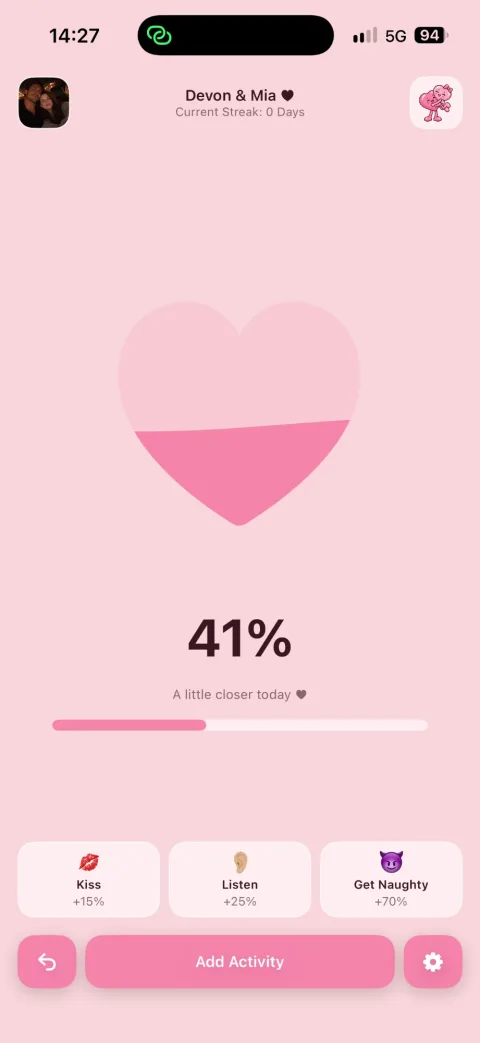
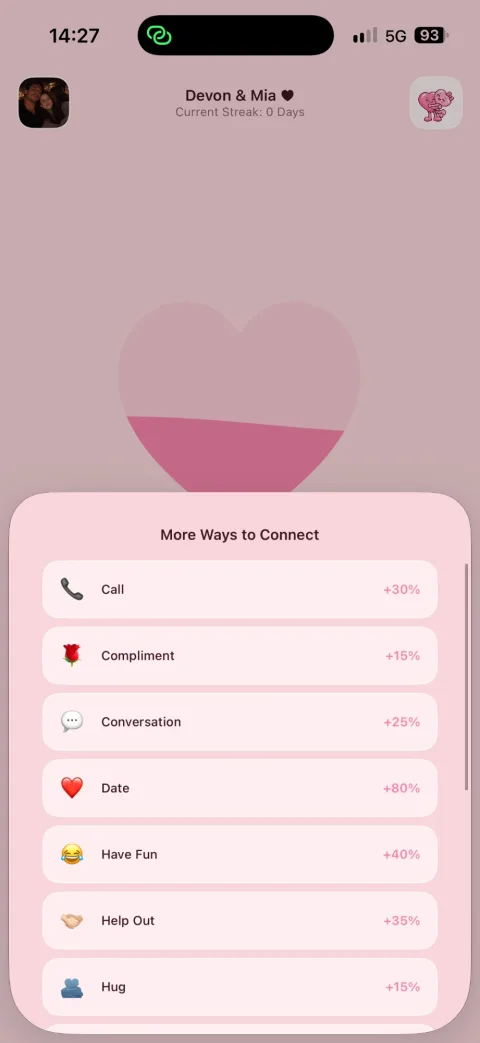
Buffaly turns the "small things add up" idea into something you can see. It is an iPhone app for couples who are already together. You connect with a 4-character code and share one heart. Compliment, Hug and Kiss each add 15 percentage points to it, a Conversation adds 25 and a Date adds 80. Listen adds 25 for 24 hours and Help Out adds 35 for 30 hours. Each action maps loosely to a love language: words, touch, quality time, service. The heart slowly empties, so it shows when you last made time for each other. It does not score your relationship and it will not choose a language for you; the test above does that part.
What Buffaly is not: it is not a quiz or content app, not a messaging app, and it does not share your location. It is an entertainment tool, not a medical, psychological or counselling service. The download is free. Using Buffaly needs a subscription, and one subscription covers both partners; the price is shown in the App Store in your own currency before you subscribe. It needs an iPhone with iOS 17 or later; there is no Android version yet.
Frequently asked questions
What is a love languages test?
A short quiz that asks which kinds of caring behaviour make you feel most loved: words of affirmation, quality time, acts of service, receiving gifts and physical touch. It is a conversation starter, not a diagnosis.
Is this love languages test free?
Yes. It is on this page, needs no sign-up and no email address. Tick the statements that are mostly true for you and count the five letters.
How do I find my love language?
Think about what makes you feel warmest when it happens and coldest when it is missing. Take the test above, then compare the result with your own experience. If they differ, trust the experience.
Can you have more than one love language?
Yes, and most people do. A top two or three is more realistic than a single answer. Your order can also change over time or with stress.
What if my partner and I have different love languages?
That is normal. Name your own language and ask for one small thing in it, and learn one small thing in theirs. The effort counts even when it is a bit clumsy.
How accurate is a love languages test?
It is a self-report about what you feel, so it is only as accurate as your honesty. Use it to start a talk, not to decide anything about a relationship.
Does Buffaly give a love language result?
No. Buffaly is not a quiz app and does not assign a love language. It lets a couple log small actions like Compliment, Hug, Listen and Help Out and keep a shared heart topped up.