
Home › Blog › Quality time love language
Quality time love language: what it means and 40 ways to give it
If your partner says "you never have time for me" even when you are in the same room, quality time may be their main love language. It is not about the number of hours; it is about attention. This guide explains what quality time means, how to recognise it and how to give it, with 40 ideas for different situations and tips for busy lives.
What quality time means
Quality time is one of the five love languages that people often talk about, along with words of affirmation, acts of service, gifts and physical touch. It is a popular way to start a conversation about what each partner needs, not a scientific test, and most people value several of them. For someone who values quality time, feeling loved comes from your undivided attention. They want you to be present: listening, sharing activities and showing interest.
It does not mean being together every minute. It means that when you are together, you are fully there. A twenty-minute walk with no phone can mean more than an evening on the same sofa, each scrolling.
Signs your partner may value quality time
- They suggest doing things together and enjoy shared routines.
- They feel hurt when you check your phone during a conversation.
- They complain that you are always busy or distracted.
- They love long talks and ask follow-up questions.
- They remember activities you have done together.
- They feel closest when you spend a day together.
- They go quiet when plans are cancelled.
None of this proves it. The best way to find out is to ask: "When do you feel closest to me?" and listen to the answer.
What counts as quality time
Quality time has three parts: attention, shared activity and conversation. Attention means putting devices away and focusing on each other. Shared activity means doing something together, whether cooking, walking or playing a game. Conversation means talking in a way that goes beyond logistics: sharing thoughts, feelings and stories. A good test is: would we both say we were really together just now? If yes, it counts.
It does not need to be special. Washing up together while chatting can count, as long as you are paying attention to each other.
Everyday quality time at home
- Eat dinner at the table without screens.
- Take a ten-minute walk after work.
- Drink a morning coffee together before the day starts.
- Cook together, with music on.
- Sit together and share the best and worst of your day.
- Read side by side and read aloud a favourite passage.
- Take turns choosing a series to watch together.
- Put the children to bed together, if you have them, and sit in the quiet afterwards.
- Go to bed at the same time and talk for ten minutes.
- Do the weekly shop together and treat it like an outing.
Small rituals often matter more than big plans, because you can keep them up. For more ideas, see date night ideas at home.
Quality time dates and outings
- A walk or hike in a place you have never been.
- A picnic.
- A day trip.
- A museum or gallery visit.
- A class, such as pottery, dance or cooking.
- A film followed by a long chat.
- A board game night.
- A visit to a market.
- A sunrise or sunset together.
- A weekend away.
For long lists, read our things to do with your partner and date night ideas.
Quality time when you are busy
Busy couples often say they do not have time, but quality time is about intention, not quantity. Look for small slots and use them well. Take a ten-minute coffee together before the day begins. Walk to the shop together instead of going alone. Call during your lunch break. Put your phone in a drawer for the first hour after work. Plan one weekly slot, such as Sunday morning or Wednesday evening, and protect it as you would a meeting. If you have children, arrange childcare or create a quiet evening after bedtime. The aim is to give your partner your full attention for even a short time, regularly.
When you must cancel, say so early and offer a new time. That shows that the time matters.
Quality time at a distance
- Schedule regular video calls and stick to them.
- Watch a film together online.
- Cook the same meal on a call.
- Play an online game.
- Read the same book and discuss it.
- Take a walk at the same time and talk on the phone.
- Send a voice note instead of a text.
- Plan your next visit together, down to the activities.
Distance makes undivided attention even more important. Our guides to long distance date ideas and apps for long-distance couples have more.
What gets in the way
- Phones. The biggest distraction. Agree on phone-free times.
- Multitasking. Doing something else while "listening" does not count.
- Tiredness. Pick times when you have energy, even if short.
- Different schedules. Plan ahead and be flexible.
- Uneven interests. Take turns choosing activities.
- Habit. Break routine with something new now and then.
If one of you needs less time together than the other, talk about it kindly. Agree on a rhythm that gives both enough closeness and enough space.
If you need quality time and your partner does not
If time together matters most to you and your partner is happy with less, it can feel lonely. Explain what you need without blaming: "I feel closest to you when we have an hour just for us, and I would love to plan that weekly." Offer specific suggestions and make them easy to say yes to. Be open to what they enjoy, because they may show love in ways you do not read as time. Ask what helps them feel close. Agree on a trial for a month, then review. If your needs differ a lot, our relationship check-in questions can help you talk it through.
Balancing quality time with the other love languages
Even if quality time is your partner's favourite, a relationship needs a mix. Add kind words, helpful acts and affection to the time you share. Ask your partner which of these matter to them, and try the two-week experiment in how to make your partner feel loved. Your needs may change over the years, so keep checking in.
A weekly quality time plan
A simple structure helps good intentions turn into habits. Try this rhythm for a month and adjust to your own life.
- Daily: ten minutes of undivided attention. Phones away, a hot drink, and each share one thing from the day.
- Midweek: a short shared activity, such as a walk, a game or cooking together.
- Weekend: one longer block of two to three hours for a date, an outing or a project.
- Monthly: a new experience that neither of you has tried before.
Write it on the calendar and treat it like any other commitment. If life gets in the way, move it rather than drop it. After a month, ask each other what worked and what you would change. The goal is a rhythm that feels like a gift, not a duty.
Conversation starters for quality time
A good conversation is the heart of quality time. If you find yourselves falling back on "how was your day", try a few prompts. What is something you learned this week? What are you looking forward to? What is something small that made you happy lately? What would you do with a free day? What is a memory of us that you love? Ask a follow-up question to each answer, and let the other person speak without interruption. Our questions to ask your partner and the relationship check-in questions give you plenty more. You can also pick a topic for a weekly walk, such as travel, childhood, food or dreams, and let the conversation wander.
Remember that listening is half of it. Look at your partner, nod, and resist the urge to fix or compare. Being heard is what makes the time feel like quality.
Quality time with children, family and friends around
Quality time with a partner can get squeezed when other people need you. Make the most of what you have. Keep a small ritual that belongs only to the two of you, such as a coffee once the children are asleep or a walk on Sunday mornings. When you are at family events, find a moment to step aside together, perhaps a short walk or a quiet word. At home, put the children to bed and spend twenty minutes together before you do chores. If you can, arrange childcare once a month for a proper date. Explain to your children that parents need time too. It shows them a healthy relationship, and it helps you be better parents. The key is to be intentional and to protect that time.
If this is difficult, talk about what is realistic. Even small amounts of undivided time count. See how to be a better partner for more ideas about balancing life and love.
When quality time turns into pressure
If one partner needs a lot of time together and the other feels crowded, the topic can become tense. The one who wants more may feel rejected, and the other may feel guilty or smothered. Avoid turning it into a scorecard. Instead, look at what each of you needs. Some people recharge alone and then enjoy time together more. Agree on a rhythm that includes both together time and alone time. Make the together time count by being present, so that less time feels like enough. If you disagree on the amount, try small experiments and review them. Compromise is possible, and it usually involves both of you stretching a little. If feelings of being neglected persist, read feeling neglected in a relationship for ways to talk about it.
A small experiment to start tonight
Tonight, put both phones in another room for twenty minutes. Make a hot drink, sit down together and each answer one question: what was the best part of your day, and what is on your mind? Listen to the whole answer before you add your own. When the twenty minutes are up, notice how it felt. If it felt good, repeat it tomorrow. That single habit, done daily, is often enough to change how connected two people feel.
Where Buffaly fits
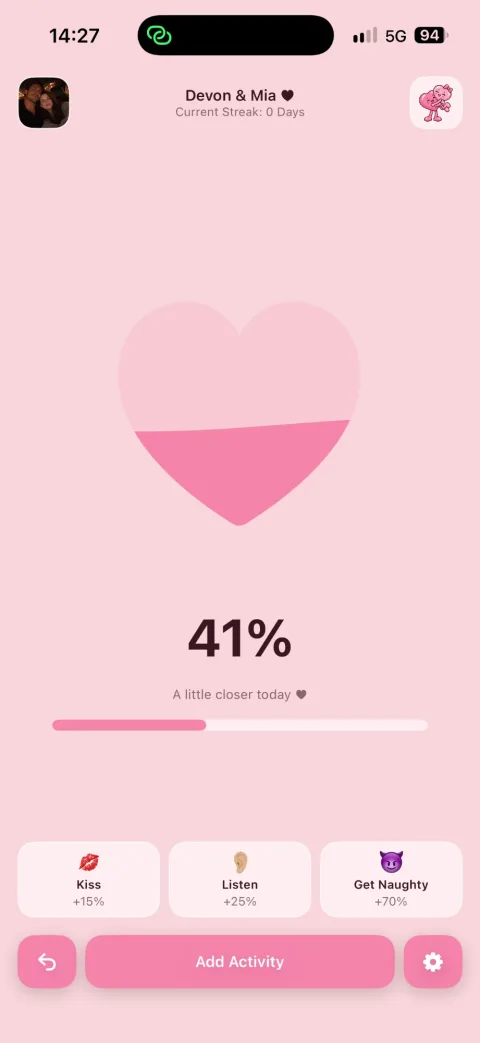
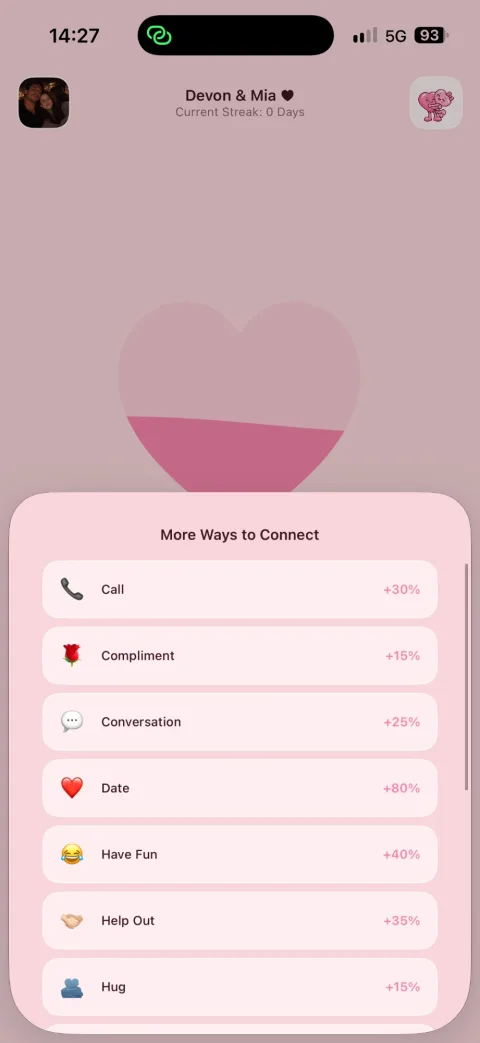
Spending time together is what Buffaly's Date and Conversation actions are for, and the shared heart makes it easy to see when it is time to reconnect. Buffaly is an iPhone app for couples who are already together. You connect with a 4-character code and share one heart. Hug, Kiss and Compliment each add 15 percentage points, a Conversation adds 25, a Date adds 80. The heart slowly empties, so it helps you keep topping up closeness instead of waiting for a big moment. It is meant to make small moments easier to remember. It will not make a relationship good by itself.
What Buffaly is not: it is not a quiz or content app, not a messaging app, and it does not share your location. It is an entertainment tool, not a medical, psychological or counselling service. The download is free and your first action is free. Then there is a 7-day free trial, then EUR 4.99 per month or EUR 29.99 per year for both partners. It needs an iPhone with iOS 17 or later; there is no Android version yet.

Frequently asked questions
What does quality time mean as a love language?
It means feeling loved when your partner gives you their undivided attention and shares time with you.
What are examples of quality time?
A walk without phones, cooking together, a long conversation, a game night or a day trip all count.
How do I give quality time when I am busy?
Use small slots, such as a ten-minute coffee, and give your full attention. Plan one regular weekly slot.
Can long-distance couples have quality time?
Yes, through regular calls, watching films online, cooking together and playing games.
Can an app help?
Buffaly can remind you to make small moments happen. It is an entertainment tool, not a counselling service, and it works best alongside real talks and time together.