
Home › Blog › Emotional intimacy
Emotional intimacy in a relationship: what it is and how to build it
Many couples sense when emotional intimacy is there and when it is missing, but find it hard to describe. You can share a bed, a home and a schedule and still feel alone. You can also feel deeply close to someone you have not touched all week. Emotional intimacy is the difference.
This guide explains what emotional intimacy is, how it differs from other kinds of closeness, how to tell whether it is thin in your relationship and what to do about it. It is practical on purpose: each section ends with something you can try this week. It is not therapy and it makes no claims about what is "normal" for every couple, because couples differ a lot. If your main worry is that you have drifted apart, our page on how to reconnect with your partner covers the first steps back. This page goes one level deeper into the closeness itself: what it is made of and how it grows.
What emotional intimacy actually is
Emotional intimacy is the experience of being known. It is the sense that your partner knows what you are really like, including the messy parts, and stays. It rests on three things:
- Disclosure. You tell each other what is actually going on inside: worries, hopes, embarrassments, small irritations and small joys.
- Responsiveness. When one of you shares, the other pays attention and responds in a way that shows they heard. Not necessarily with advice or agreement, but with presence.
- Acceptance. What you share is not used against you, laughed at without warmth or immediately corrected. Acceptance does not mean agreement; it means you are allowed to have your feelings.
Put them together and you get safety. Safety is the real foundation of intimacy: the feeling that it is okay to be honest here. Without it, people share less. With it, they share more, and sharing builds more closeness. Most advice on emotional intimacy is really advice on building and protecting that safety.
Emotional intimacy compared with other kinds of closeness
Couples often use "intimacy" to mean sex. It is wider than that. Thinking in types helps you spot what is missing.
- Emotional intimacy: sharing feelings and feeling understood.
- Physical intimacy: touch, affection and sex. This includes hugs, holding hands and sitting close, not only sex.
- Intellectual intimacy: sharing ideas, opinions and curiosity, including disagreeing with respect.
- Shared-experience intimacy: doing things together, from cooking to travelling to a routine walk.
- Spiritual or values intimacy: sharing what matters to you, whether through religion, ethics or life goals.
These types overlap and feed each other. For many people, emotional closeness makes physical closeness easier, and physical closeness makes it easier to be open. When one type is missing, couples often try to fix it with another, such as trying to solve a feeling of distance with a holiday. That sometimes helps and sometimes just moves the problem to a nicer place. Naming what is missing gives you a better chance of choosing the right fix.
Signs you have emotional intimacy
Every couple looks different, but there are patterns that many people recognise as signs of closeness:
- You can bring up small worries without feeling you have to justify them.
- You tell your partner about good news first, and bad news soon after.
- You can sit in silence without it feeling tense.
- You know what is going on in each other's lives, including the small things: who annoyed them at work, what they are looking forward to.
- Disagreements feel uncomfortable but not threatening to the relationship.
- You can say "I was wrong" or "I felt hurt" without it becoming a war.
- You feel more like yourself with them than with most other people.
Our page on signs of a healthy relationship covers the wider picture, of which emotional intimacy is one part.
Signs it is missing
A lack of emotional intimacy rarely arrives as a single event. It tends to be a slow drift. Common signs include:
- Logistics-only conversations. You talk about bills, schedules, shopping and who picks up the kids or the dog, but not about how you feel.
- Keeping things to yourself. You decide not to mention something because "it will only start a fight" or "they will not understand".
- Feeling lonely while together. You are in the same room, but each in your own head or phone.
- Turning to others first. A friend, a colleague or a sibling hears things before your partner does.
- Short or sharp exchanges. Conversations are quick, flat or end in irritation.
- Avoiding certain topics. There are subjects that you both know not to raise.
- Less affection. Not only less sex but fewer small touches, jokes and private words.
- Feeling unseen. You made an effort and nobody noticed, or you changed something about yourself and nobody asked.
If several of these ring true, you are not alone. Many long relationships go through quiet periods, especially after a move, a new baby, a job change, illness or grief. If the feeling is mostly "I am not a priority", our page on feeling neglected in a relationship goes into that specifically.
Why intimacy fades
It helps to know the common causes, because most have nothing to do with a lack of love.
- Busy routines. Work, errands and family leave only the tired end of the day for each other.
- Screens. A phone in the hand during a conversation signals that the person is second.
- Unspoken resentment. Small hurts that are never mentioned pile up and turn into distance.
- Fear of conflict. If every serious conversation turns into an argument, people stop having them.
- Stress from outside. Money worries, health, family problems or a hard job can leave little energy for closeness.
- Different ways of coping. One person wants to talk, the other wants quiet. Each reads the other's way as rejection.
- Taking each other for granted. After years together it is easy to stop being curious.
- Past hurt. Broken trust makes people guard themselves. If this is your situation, see how to rebuild trust in a relationship.
Ten ways to build emotional intimacy
1. Ask better questions
"How was your day?" gets "fine". Try "What was the best part of today?" or "Was there a moment today that annoyed you?" Specific questions invite specific answers. Our lists of questions to ask your partner and relationship check-in questions are a good place to start.
2. Listen without fixing
Many people hear a problem and go straight to solutions. That can feel like dismissal. Try three steps first: listen, say back what you heard ("so you felt ignored in that meeting"), and ask "do you want advice or do you just want me to listen?" That last question alone can change many conversations.
3. Share something small every day
Intimacy grows from small disclosures more than from big confessions. Tell your partner one true thing a day: a worry, a moment you enjoyed, something you are embarrassed about. It does not have to be deep. It has to be real.
4. Protect a daily conversation
Ten to twenty minutes without phones, TV or tasks. A walk, a drink at the table, or ten minutes on the sofa. The point is to give attention, not to cover a topic. If your time together is short, quality time shows how to make a small window count.
5. Say the appreciative thing
People feel closer when they feel noticed. Thank your partner for specific things, such as "thanks for making the call to the landlord, I know you hate that". For ideas on wording, see compliments for your partner and words of affirmation.
6. Handle conflict in a way that keeps safety
Disagreement does not have to damage intimacy. Sneering and dismissal do far more harm. Describe what you feel and need, not what is wrong with the other person. "I felt alone this evening" invites a response; "you never care" invites a defence. If a discussion heats up, take a break of twenty minutes and come back.
7. Repair quickly
Couples who stay close are not those who never hurt each other. They are those who repair: they apologise, make a small gesture and move on without a long silence. If you struggle with that step, our page on how to apologize breaks it down.
8. Be curious about each other's inner life
People change. The person you met a few years ago has new fears, new interests and new opinions. Ask about them: "What are you looking forward to this year?" "What have you been thinking about lately?" Treat your partner as someone you are still getting to know.
9. Show affection outside of sex
Touch on the shoulder, a kiss on the way out, holding hands in the car. These small acts carry warmth throughout the day. If it feels like they have faded, how to be more affectionate has practical steps.
10. Do new things together
Shared novelty creates shared stories. A new walk, a class, a different restaurant, a weekend away. See date night ideas and things to do with your partner for starting points.
How to start a deeper conversation
Many people want more openness but do not know how to begin. A few simple openers:
- "I have been thinking about us lately, and I would like to talk about something that is not on the schedule. Is now a good time?"
- "There is something I have been holding back because I did not know how to say it. Can I try?"
- "I miss feeling close to you. What would help you feel closer to me?"
- "What is something you have been carrying lately that I might not know about?"
- "When do you feel most understood by me?"
Pick a moment that is not rushed or tense. Avoid starting a deep talk at 11 pm when one of you is already exhausted. A walk can help, since side-by-side conversation often feels less intense than face-to-face. Keep the first conversation short. You can build up, and stopping on a good note makes the next one easier.
When one of you is less open
In many couples, one person finds emotional talk easy and the other finds it hard. This is not a flaw in either of you. People learn very different habits about feelings in the families and places they grew up in.
If you are the more open one, try to reduce the pressure. Ask one question at a time, accept short answers and show appreciation when your partner shares anything, even a little. Do not turn their first honest sentence into an interrogation.
If you are the less open one, start small. You do not have to describe every feeling. Begin with facts ("I had a stressful day") and add one feeling word ("I felt anxious"). Tell your partner what helps you, for example "I need a bit of time before I can talk about it". That gives them something to work with and avoids the silence being misread.
In both cases, boundaries still matter. Being close does not mean sharing everything at all times. See how to set boundaries in a relationship for how to keep privacy and closeness in balance.
Emotional intimacy in long relationships
After years together, the risk is not a lack of love but a lack of curiosity. You think you know everything about each other, so you stop asking. A few habits protect against that:
- A regular check-in. A weekly conversation about how each of you is doing, separate from planning. Even fifteen minutes is enough.
- Shared rituals. A Sunday walk, a Friday dinner, a morning coffee. Rituals create reliable moments for closeness.
- Looking back. Talk about how you met, what you thought then and what has changed. Our how long have we been together page can show how many days you have shared.
- Planning something to look forward to. A trip, a project, a move. Shared plans keep a sense of "us" that is going somewhere.
- Naming change. When life changes, say it: "I feel different since the baby", "I am not the same since I changed jobs". Change you never discuss becomes distance.
Mistakes that quietly damage intimacy
- Using what they told you as ammunition. One time is enough to teach someone not to share.
- Mocking vulnerability. Even a light joke about something they were nervous to say can close the door for a long time.
- Giving advice nobody asked for. Helpful in intention, dismissive in effect.
- Silent treatment. Going quiet to punish creates more distance than the original problem.
- Comparing them with others. Other couples' highlights are not a fair standard.
- Saving every serious talk for a crisis. If you only talk deeply during emergencies, talking deeply will feel like an emergency.
- Expecting your partner to be your only source of support. Friends and family matter too. A broader circle takes pressure off the relationship.
When to ask for outside help
Some distance goes beyond what two people can fix by trying harder. If you feel stuck in the same argument, if one of you feels afraid or controlled, if there has been a breach of trust or if the sadness does not lift, it can help to speak to a counsellor or couples therapist. Asking for help is not a sign that the relationship has failed; it often means you take it seriously. If you feel unsafe in your relationship, contact a local support service or someone you trust. Buffaly is an entertainment tool and not a replacement for professional help.
A one-week plan to start
- Day 1. Ask one real question and listen to the whole answer.
- Day 2. Thank your partner for something specific.
- Day 3. Put the phones away for twenty minutes during dinner.
- Day 4. Share one worry or one small embarrassment.
- Day 5. Offer a long hug without a reason and without an agenda.
- Day 6. Do something new together, however small.
- Day 7. Ask: "What was the best part of this week for you?" and share your own.
Repeat it for a month and notice what has changed. The aim is not to perform closeness, but to practise it until it feels natural again.
Where Buffaly fits
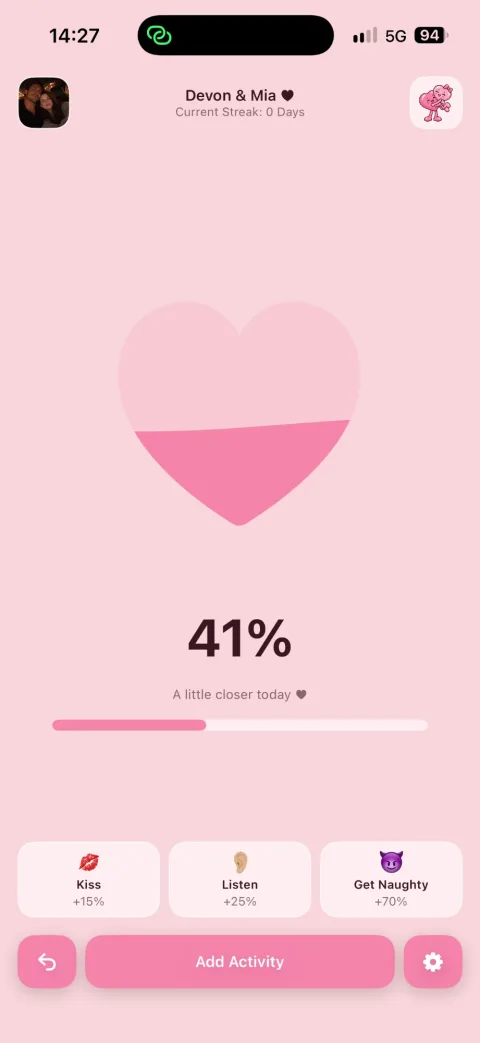
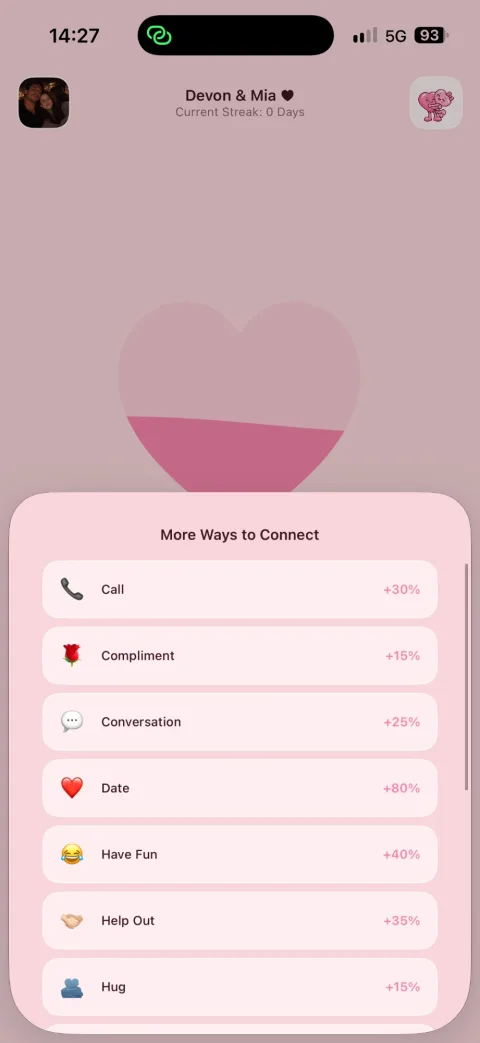
Emotional intimacy is built from small repeated moments of attention, which is also the idea behind Buffaly: a conversation, a compliment or a hug that you actually do, not just plan to do. Buffaly is an iPhone app for couples who are already together. You connect with a 4-character code and share one heart. Compliment, Hug and Kiss each add 15 percentage points, a Conversation adds 25 and a Date adds 80. The heart slowly empties, so it helps you keep topping up closeness instead of waiting for a big moment. It will not make a relationship good by itself.
What Buffaly is not: it is not a quiz or content app, not a messaging app, and it does not share your location. It is an entertainment tool, not a medical, psychological or counselling service. The download is free. Using Buffaly needs a subscription, and one subscription covers both partners; the price is shown in the App Store in your own currency before you subscribe. It needs an iPhone with iOS 17 or later; there is no Android version yet.
Frequently asked questions
What is emotional intimacy?
Emotional intimacy is the feeling of being known and accepted by your partner. It means you can share thoughts, fears and small daily feelings and expect to be met with attention rather than judgment.
What is the difference between emotional and physical intimacy?
Physical intimacy is closeness through touch and sex. Emotional intimacy is closeness through sharing and understanding. They often support each other, but you can have one without the other, and a lack of either can be felt as distance.
What are signs of a lack of emotional intimacy?
You talk about logistics but not feelings, you keep worries to yourself, you feel lonely while together, conversations end quickly or turn into arguments, or you feel more understood by friends than by your partner.
How do you build emotional intimacy?
Through small, regular habits: asking real questions, listening without fixing, sharing something honest each day, handling conflict kindly, making time without phones and noticing each other's efforts.
Can emotional intimacy be rebuilt after it fades?
Often yes, if both people want it. It usually starts with small, safe steps rather than one big talk. If the distance is tied to deeper hurt or trust problems, a counsellor or therapist can help.
Can one person build emotional intimacy alone?
One person can change how they listen and share, and that often shifts the pattern. But intimacy is mutual, so it also needs the other person to take part over time.
Can Buffaly create emotional intimacy?
No app can do that for you. Buffaly is an entertainment tool that helps couples remember small actions such as Conversation, Compliment and Hug. The closeness comes from what you do with those moments.